Commodities stand to benefit from underinvestment and the clean energy transition.
It’s been an interesting first half of the year. Markets performed very well in the face of continued Fed tightening, calls for an imminent recession, a regional banking crisis, debt ceiling debate, and drama around an 11th-hour deal to avoid a default on U.S. debt.
Following the YTD strength in equity markets, Russ Koesterich discusses how a combination of cyclical, and a growth bias may serve investors well in today’s market.
While money market assets have risen in recent years, returns have historically lagged behind a diversified portfolio.
Young workers are struggling to find jobs, despite labor shortages.
Wars cost money, and throughout history, countries have borrowed to fight them. There are plenty of examples of wars bankrupting countries, but the US was so dominant in the 1940s that at the end of World War II, its debt only cost about 1.8% of GDP to service.
Data extracted from all of VettaFi’s digital properties from the data and analytics tool Explorer indicate that investor interest in real estate ETFs has remained steady in the past three months. VettaFi’s LOGICLY tool allows us to examine some of the leading ETFs in the U.S. real estate space.
Anne Walsh, Chief Investment Officer of Guggenheim Partners Investment Management, joins Bloomberg TV to discuss the latest inflation data, the economic cycle, and portfolio positioning.
As businesses worldwide adopt technology, the innovation of AI may result in market leadership changes, global economic growth, and investor opportunities.
When a mega-cap stock is sitting on a 30-year low, I can’t help but look.
The yield on the 10-year note ended August 11, 2023, at 4.16%, the two-year note ended at 4.89%, and the 30-year at 4.24%.
Since World War II, the US Dollar (USD) has served as the world’s preeminent ‘reserve currency’ – the means of exchange for most of the rest of the world to do business.
We maintain a neutral-duration posture overall. We prefer an up-in-quality bias and have become increasingly selective in non-investment grades.
Geopolitics is driving new interest in industrial policy.
A cruder version of the above phrase, “Mess Around and Find Out”, has gained popularity in the American vocabulary. Politicians keep messing around with the creditworthiness of the nation’s sovereign debt. On August 1st, they found out.
There is a rhythm to the markets, and market cycle lows support bull market recoveries. Recently, Ed Yardeni made a bold prediction that the S&P 500 index could hit a high of 5400 in 2024.
Given the current economic backdrop, where can investment opportunities be found, particularly within the fixed income asset class? Head of Franklin Templeton Institute Stephen Dover shares his key takeaways from a panel discussion that he moderated with fixed income experts within the company.
For the years following the Lehman crisis, the Fed put was the norm. Exceptionally loose monetary policy ensured risk assets had a safety net. But central banks were unable to rehabilitate the real economy while governments kept their belts tight.
Consumer spending remains the lifeblood of the economy accounting for nearly two-thirds of economic activity.
Will the economy roll into a formal recession, or is a recovery underway? It's a close call.
Andy Rothman provides his assessment of the Biden Administration’s executive order on certain investments in China.
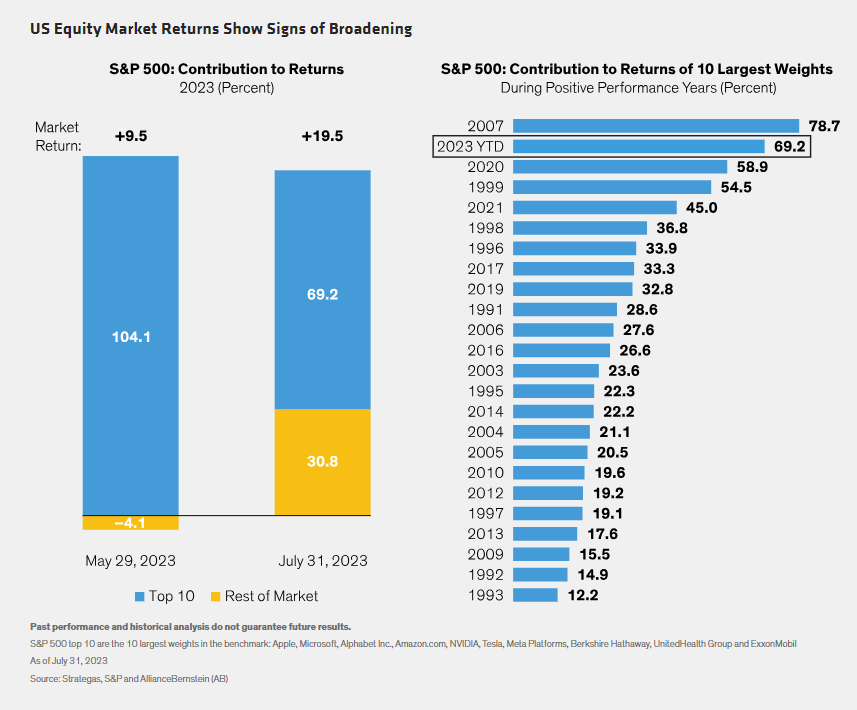
Ten stocks have dominated US equity market gains for most of this year. But the rest of the market may be waking up. That’s good news for active managers who seek to tap diversified sources of long-term returns that can withstand challenging macroeconomic conditions.
Chuck Carnevale, a.k.a. Mr. Valuation gives an update on Medical Properties Trust (MPW) in this video.
Today we’ll continue reviewing Neil Howe’s magisterial new book, The Fourth Turning Is Here, focusing on the Millennial Generation’s important role in the coming crisis. Then we’ll think about what the crisis may look like. Finally—because I always try to look on the bright side—we’ll consider what Neil expects in the “First Turning” that will follow.
A team of scientists claimed to have created a breakthrough material that could superconduct electricity at room temperatures and ambient pressure. But then people started trying to replicate the experiment.
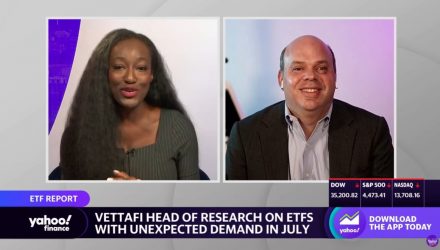
VettaFi head of research Todd Rosenbluth appeared on Yahoo! Finance to discuss ETFs with unexpected demand — including AI-focused ETFs.
With the second half of 2023 underway, how are the macro and market landscapes unfolding?
David Dali, Head of Portfolio Strategy, provides his 12-month outlook for global equity markets.
For the better part of the last century, the largest companies in the world were those that produced physical property – traditional transportation machines, the energy that powered them, or the capital that financed them.
Franklin Templeton’s Head of Digital Asset & Investor Advisory Services Sandy Kaul has a wealth of experience in the financial industry and a vision for the future in the digital asset space. She finds the trend toward democratizing new investment frontiers exciting. Learn more about Sandy in this Q&A.
For experienced and novice investors, there are myriad complexities associated with environmental, social, and governance (ESG) ratings and scoring.
For this edition of Bull vs. Bear, Karrie Gordon and Nick Peters-Golden discuss the case for trading in the old 60/40 portfolio for an alts augmented 50/30/20 portfolio.
Recession? Soft Landing? Getting a read on where the US economy is headed hasn’t been easy.
What might the sensational superstar Taylor Swift have in common with exchange-traded funds? David Mann, our Head of ETF Product and Capital Markets, lightheartedly examines the different eras of the ETF industry—drawing parallels to Swift’s memorable eras as a musician.
Effective tax planning means thinking about how tax rates might change.
Once again, markets are taking the elevator while economic data takes the stairs.
Broader domestic equity benchmarks turned in impressive showings through the first seven months of the year. A significant portion of that bullishness comes thanks to large- and mega-cap growth stocks.
I thought I’d lead with some really impressive statistics. I just finished reading our latest ADV Part 2 (the SEC disclosure document provided annually to clients) describing the firm.
Each year, I head to the woods of Maine for an event called “Camp Kotok.” Over the coming week or so, I’ll be sharing some videos of conversations I had with attendees while there (and also pointing to coverage from other attendees, as well).
Investors should be aware of potential real-time market exposure risks when implementing large changes to their portfolios.
After a rush among issuers to file for spot bitcoin ETFs, followed shortly by a rush to file for ether futures ETFs, the environment for crypto-related ETFs looks significantly different from early 2023 when several crypto ETFs announced closures.
The potential for a Fed pause presents an opportunity for investors to consider adding duration back into their portfolios.
Public and private projects are fueling a new building boom.
Flagging office occupancy rates have municipal bond investors concerned. But US cities have more than one card to play in the revenue game.
In this video, Chuck Carnevale, Co-founder of FAST Graphs, the Fundamentals Analyzer Software Tool will analyze the performance and valuation of PayPal (PYPL) stock.
This article takes a look at a long-term perspective on Treasury yields as of the July 31, 2023 close. The chart below shows the 10-year constant-maturity yield since 1962 along with the Fed funds rate (FFR) and inflation.
Doug Drabik discusses fixed income market conditions and offers insight for bond investors.
Do high-yield bonds still make sense for income investors at this stage of the credit cycle? We think so.
The common currency has not led to common outcomes.
We see compelling value in high-quality, liquid fixed income assets that may offer potential resiliency if the economy weakens.