The US labor market has remained relatively strong, but the trend over the last year or so has been one of normalization back to the pre-pandemic levels.
Goldman Sachs Group Inc. has upgraded its dollar forecasts, citing a robust US economy and likely higher tariffs that may slow monetary easing.
Treasuries extended their drop after Friday’s blowout employment report strengthened speculation that the Federal Reserve is poised to pause its interest-rate cuts for virtually all of this year.
As we enter 2025, the financial markets are optimistic. That optimism is fueled by strong market performance over the last two years and analyst’s projections for continued growth. However, as “Curb Your Enthusiasm” often demonstrates, even the best-laid plans can unravel when overlooked details come to light. Here are five reasons why a more cautious approach to investing might be warranted in 2025.
The aerospace and defense industry plays a pivotal role in both national security and the stock market. With U.S. defense spending leading the world, the largest contractors are well-positioned for growth amid rising global tensions.
Rough times are coming, yes, but I think we have at least 12 good months before the worst gets here. Let’s look at some of the reasons why things should be okay and then look at some of the potential problems.
With 2024 in the books, market participants now know that the tech-heavy Nasdaq Composite Index surged about 85% over the past two years.
Many people these days are on heightened alert for bubbles, and I’m often asked whether there’s a bubble surrounding the Standard & Poor’s 500 and the handful of stocks that have been leading it.
US Treasuries plunged as evidence of a resilient labor market pushed traders to shift their expectations for the Federal Reserve’s next interest-rate cut to the second half of the year.
As we enter 2025, there has been a lot of conjecture about a return to the 5% threshold.
Chief Economist Eugenio Alemán and Economist Giampiero Fuentes break down the factors likely to impact economic growth, inflation and interest rates.
U.S. equities closed 2024 on top and U.S. growth took back leadership from U.S. value.
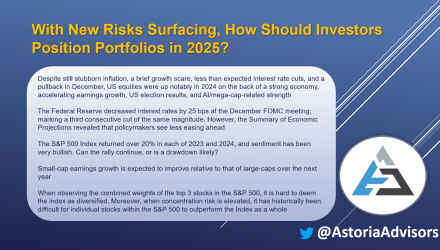
US equities were up notably in 2024, due to a strong economy, accelerating earnings growth, US election results, and AI/mega-cap strength.
US investment banks have little room for error in their upcoming full-year results.
Federal Reserve Bank of Philadelphia President Patrick Harker said officials are on track to lower interest rates this year, but the exact timing will depend on what happens with the economy.
The selloffs that keep flaring in the world’s bond markets are pushing yields toward key thresholds amid escalating worries about elevated inflation, tempestuous politics and swelling government debts.
Yields may trade in a wide range as markets work through issues in the new year. Navigating volatility may mean capturing higher nominal and real yields over the longer term.
While the market has largely moved past that year’s recession debate, it’s worth noting that the traditional definition that persisted for all our careers—two consecutive quarters of negative GDP growth—did occur in the first half of 2022.
Although underlying fundamentals and company financial statements can be difficult to analyze, the general public can easily discern price movements and understand the primary objective—buy low and sell high.
In our year ahead outlook, we unveil 5 key factors we believe offer rare certainty in these uncertain times. Discover how we’re navigating this landscape and positioning portfolios to seize opportunities and mitigate risks in the year ahead.
Two key components drive the shape of the yield curve: expectations for the short-term interest rate and expectations for the term premium.
Our Cash Indicator methodology acts as a plan in case of an emergency. Investors should expect more equity market volatility ahead.
US mortgage rates edged up to just shy of 7% at the turn of year and a gauge of home-purchase applications tumbled to the lowest level since February, adding to evidence of a struggling housing market.
The 20-year Treasury bond offered a grim warning as a selloff fueled by inflationary angst gripped global debt markets: 5% yields are already here.
A few weeks ago, a reader emailed to challenge what he described as our “cautionary, skeptical and net negative” stance on Bitcoin.
A look at the 2025 tax rates and contribution limits means individuals may save or gift more this year. Our Bill Cass shares the updated key tax figures and some planning considerations for the year ahead.
On December 6, the S&P 500 set the most extreme level of valuations on record, exceeding both the 1929 and 2000 market peaks on measures that we find best-correlated with actual, subsequent 10-12 year S&P 500 total returns across a century of market cycles.
The new year begins with economic resilience, but investors should brace for a challenging path in 2025. Key economic indicators are still “goldilocks” and signal continued growth at a sustainable pace.
As we turn the page on 2024 and look ahead into 2025, the key question on investors' minds is: can 2024’s positive momentum in the economy and financial markets continue into 2025?
It’s important that investors remember to rebalance their commodity ETF exposure, particularly as equity ETFs had a strong year in 2024.
Despite a lackluster 2024 for most bonds, investors with an eye on the long-term time horizon could reap future benefits.
Every central banker has a make-or-break moment. As the euro crisis raged in 2012, then-European Central Bank boss Mario Draghi took to describing the common currency as a “bumblebee”:
Federal Reserve Governor Lisa Cook said policymakers can proceed more cautiously with additional rate cuts, citing a sturdy labor market and recent bumpiness in inflation data.
In a recent discussion on TheRealInvestmentShow, Bob Farrell and his 10 investment rules were discussed, which elicited several email questions asking, “Who is Bob Farrell, and where are these rules?”.
Three interconnected lessons from 2024 help shape our 2025 outlook.
The most important issue regarding what lies ahead from an economic perspective is that the economy’s fundamentals remain solid with very few misalignments that could derail it, at least for now.
2024 was about as good as it gets in the equity markets – with the BGEP up 31% and the broader market as a whole posting double digit gains. Underneath the surface, we believe that there are three main drivers of the year’s solid returns. We discuss them below in our market review and outlook.
The College Football playoffs included 12 teams this year and all five automatic berth teams (because they won their conference championships) are now out, including the top two ranked teams, Oregon and Georgia. It wasn’t supposed to turn out this way, and the debate about why has only just started.
Stocks rallied in 2024, delivering a second consecutive year of gains exceeding 20%, as investors embraced cooling inflation, falling interest rates and the prospect of lower corporate taxes under a second Trump administration.
Most people don’t pay much attention to the political process, either local or federal. This year I think it is something we should all be paying attention to as it might affect our various lives.
Money managers are seeing plenty of reasons to remain bullish on gold, following a stellar 2024 that saw the precious metal post its biggest annual gain since 2010.
What happens in the US economy doesn’t always stay there, particularly when it comes to the UK.
Federal Reserve Chair Jerome Powell has indicated that the central bank’s communication will be part of its 2025 monetary policy review.
European bond markets are climbing a mountain of worry. Despite the risks, history suggests a positive outcome.
With 2024 behind us, let's revisit the top 10 most-read charts of the year.
To clear our notebooks entering 2025, here are quick perspectives on a range of topics.
Continuing last year's trend, our 2025 outlook shows fixed income benefiting from high rates, while equities face a narrowing edge over risk-free investments.
Political uncertainty and volatility create fertile ground for active investors to find companies that can successfully navigate a new era.
The year ahead may present challenges as markets and the economy look to maintain momentum.