US mega caps are attractive as they’re likely to be boosted by the fiscal spending bill as well as a robust earnings outlook, according to Morgan Stanley strategists.
Banks are looking to sell $2.25 billion of term loans and $2 billion equivalent of bonds for Boots, to help finance its acquisition by US private equity firm Sycamore Partners, according to people familiar with the matter.
Bitcoin breached $120,000 for the first time, with investor enthusiasm showing few signs of dimming as the US House of Representatives prepares to consider key industry legislation during its “Crypto Week” starting Monday.
As investors try to determine the policy direction of the Trump administration, there is good reason to believe there will be a lot of back and forth.
Now that we're more than halfway through 2025, let's take a look at the top 10 most-read charts so far for the year.
Last week, the iShares Flexible Income Active ETF (BINC) reached a significant milestone and became the latest member of the $10 billion of the active fixed income club.
Banks from Wells Fargo & Co. to smaller Japanese lenders are flocking to top-rated collateralized loan obligation deals, pushing up secondary prices for buyout debt.
A multibillion-dollar capital markets experiment is unfolding on Wall Street, as entrepreneurs use blank-check companies and reverse mergers to take their holdings of digital assets public.
Advisor Perspectives had a strong mix of pieces in the top 10 articles for views on its leaderboard for the month of June.
Bitcoin options traders are already setting their sights on higher prices as the original cryptocurrency extends its record-breaking rally for a second day.
With the price of digital assets testing the boundaries of plausibility, and Congress promising legislation to boost the industry further, now might be a good time for bank regulators to take notice.
Three ETF strategies that launched in June stand out, bringing something interesting to the table for investors.
The valuation of small-cap stocks relative to large caps remains historically attractive, and small-cap recoveries in the past have resulted in meaningful periods of outperformance.
One of the more storied headlines this year has been President Trump’s disappointment with the Fed for not cutting rates. We should all know by now that the President cannot fire a Fed Chair simply because he/she is not lowering interest rates to their liking.
Considering the spate of sizable inflows into spot bitcoin ETFs and the recent ebullience surrounding equities, some investors are vexed by recent lethargy displayed by the largest cryptocurrency.
Global central bankers have ducked a chance to push for tight borrowing constraints on the biggest hedge funds, whose importance to core government bond and other financial markets has grown enormously in the past decade.
We expect tariff policy to remain a key part of the narrative pushed by the administration.
In this article, you’ll learn how to evaluate crypto ETFs with the same rigor you apply to traditional investment products.
A new era of regulation is bound to bring high hopes for the crypto bulls. House Republicans are now gearing up for “Crypto Week” – during which the committee has agreed to prioritize digital asset legislation and review several crypto-related bills.
At the recent 2025 Morningstar Investment Conference, CEO Kunal Kapoor highlighted a growing trend that is reshaping the investment landscape.
Our strategy work and quantitative insights suggest the conditions behind more than a decade of U.S. equity outperformance are starting to shift.
Our long-time investors are probably wondering why we haven’t made any gains over the last 18 months.
This video examines and compares the two main measures of inflation: the Personal Consumption Expenditures (PCE) Price Index and the Consumer Price Index, with data through May 2025.
The artificial intelligence investment landscape reached a critical inflection point in Q2 2025, with the ROBO Global Artificial Intelligence Index (THNQ) delivering exceptional returns of 24.4%.
Reckoner Capital Management is testing investors’ hunger for a new category of risky bets with an exchange-traded fund that uses leverage to juice returns on collateralized loan obligations.
Wall Street’s latest tax dodge doesn’t hide in the Cayman Islands or rely on complex derivatives.
Futures traders have been unwinding some large bullish bets on Treasury bonds, adding to the recent upward pressure on US yields after a surprisingly strong jobs report last week.
Wall Street’s latest tax dodge doesn’t hide in the Cayman Islands or rely on complex derivatives. It’s engineered to turn a publicly traded fund into a tax-minimizing machine that hums quietly on autopilot.
Markets rebounded sharply in 2Q 2025 following April’s tariff-driven selloff. Our mid-year market outlook breaks down the recovery, Fed policy, and where to invest next.
Elevated interest rates and market uncertainty make for an interesting tandem regarding getting core bond exposure. When considering yield, reinforcing a portfolio to absorb market shocks, or both, consider this active option from Vanguard: the Vanguard Core-Plus Bond ETF (VPLS).
Tariff volatility rocked markets for much of the second quarter, creating pressure on U.S. bonds and equities. In the challenging environment, rife with uncertainty and investor concern, a handful of funds generated significant performance.
Joel Schneider, Deputy Head of Portfolio Management at Dimensional, discusses the firm’s milestone as the first issuer to surpass $200 billion in actively managed ETF assets. He also delves into the hidden costs of traditional index funds and Dimensional’s pursuit of the multi-share class structure. VettaFi’s Cinthia Murphy breaks down the latest filings and launches in the buffer and synthetic income ETF space, spotlighting new offerings from ARK Invest, ProShares, Innovator, and others.
If you’ve been following the mainstream financial media lately, you might think the airline industry is in crisis. From headlines about tariffs and labor costs to geopolitical tensions and delays at Newark Airport, it sounds like air travel should be tanking.
They have been called “the four most costly words in the annals of investing,” and surely that’s true: This time is different. Still — hear me out! — there are reasons to entertain the possibility that, well, this time really is different.
HSBC is turning cautious on three of the biggest US bank stocks following a record rally that’s brought the group within shouting distance of an all-time high.
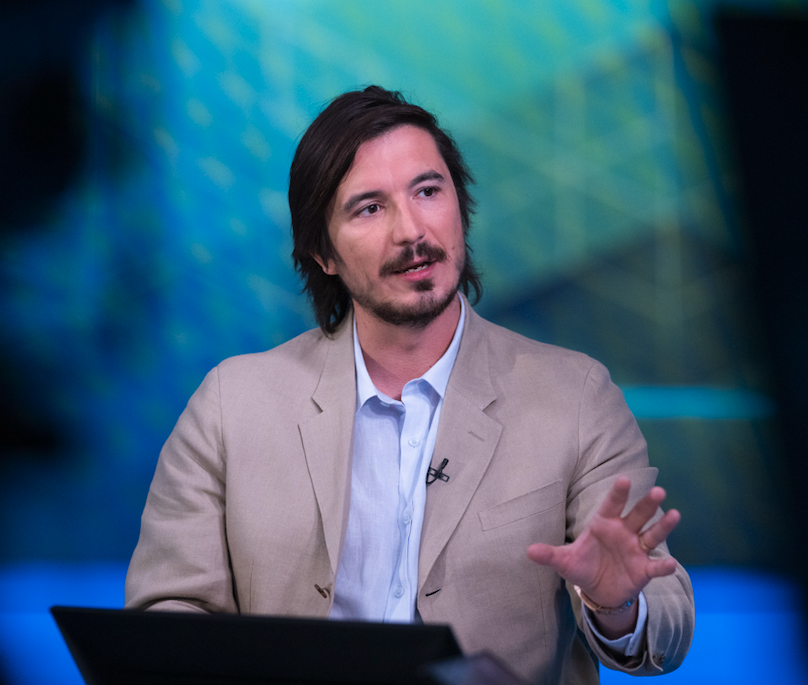
Robinhood Markets Inc. Chief Executive Officer Vlad Tenev said the firm is in talks with regulators over its offering of tokenized equities in Europe, after the launch drew rebuke from companies including OpenAI.
For those breaking into the financial industry, it’s an exciting time. The opportunity to achieve success and make an impact on an industry that could help people for years to come .
The earnings bar is fairly low for the second quarter, setting companies up for a potential easy jump—but there will likely be more focus on forward guidance.
As the second half gets underway, we think a modest overweight to risk assets is called for.
Below, we recount highlights from constituents of the ROBO Global Robotics and Automation Index (ROBO) and the ROBO Global Artificial Intelligence Index (THNQ).
Semiconductor equities and related ETFs notched impressive performances in the first half of the year. They were buoyed by ongoing enthusiasm for the AI trade and post-Liberation Day resurgence by the Magnificent Seven.
On this episode of the “ETF of the Week” podcast, VettaFi’s Head of Research Todd Rosenbluth discussed the ALPS Sector Dividend Dogs ETF (SDOG) with Chuck Jaffe of Money Life. The pair discussed several topics related to the fund to give investors a deeper understanding of the ETF overall.
In part 2 of this series, this article looks past the data center operators and focuses on the natural gas pipelines and the manufacturers of natural gas power plant equipment.
As leaders of the China-led group of emerging-market economies known as the BRICS descend on Rio de Janeiro for their summit starting Sunday, expect the usual coterie of talking heads offering prepared remarks to the media with the city’s iconic Sugarloaf mountain serving as a picturesque backdrop.
Last week, the U.S. labor market took center stage, delivering conflicting signals. The S&P 500 reached many record highs during the shortened trading week.
A pre-summer frenzy in junk loans is seeing the market start to overheat, prompting investors to get a bit more picky about deals after spreads reached the tightest levels in years.
Traders are swarming to equity-focused, exchange-traded funds listed in Taiwan, with demand from retail investors and a strong local currency driving up flows.
President Donald Trump plans to announce trade deals and deliver tariff warnings on Monday, as countries negotiated through the weekend to avoid the highest punitive measures on their exports to the US before a Wednesday deadline.
Goldman Sachs Group Inc. is leading a potential transaction for Gray Media Inc. to help the company refinance some of its existing debt, according to people with knowledge of the matter.
AstraZeneca Plc is discussing a partnership deal with Summit Therapeutics Inc. in which it could pay as much as $15 billion over time to license a lung-cancer drug, according to people familiar with the matter.