Ultimately, we believe that investors who are unaware of ESG and do not integrate ESG into their investment processes may be exposing themselves to additional, unnecessary and possibly unrewarded risks.
Markets rebounded during the second quarter, aided by monumental support from the Fed. We expect the economy to continue improving, but given the recent wave of Covid cases we also expect some bumps along the way.
Investors increasingly want to align their financial goals with a commitment to improving the lives of others. Two recent projects showcase how municipal bond investors are making an impact.
We’ll start with a dozen or so charts showing the market is either very highly valued, or extremely overvalued, or merely stretched. But in general, you will see markets are indeed at the upper end of historical valuations. Then we’ll consider some reasons why this is so, and why stocks could even go higher.
Investors must balance ongoing risks of the coronavirus against the extra yield the bonds provide.
Both gold and silver have been on a tear this week, with the yellow metal touching a nine-year high of $1,897 in intraday trading on Thursday. Silver was trading above $22.70, up 94 percent from its 52-week low on March 18.
Applying the definition of factor robustness that was established by our Research Affiliates colleagues in a 2016 award-winning paper, we determine ESG is not a factor. Nevertheless, the importance of ESG as an investing strategy is undeniable. We explore how greater clarity around defining ESG can quicken the pace of ESG integration in equity portfolios.
European measures applied to mitigate the effects of the pandemic have contained the unemployment rate in Europe more than in the U.S. While recognizing economic risks from the rising number of COVID-19 cases in the U.S., our forecast sees this success ratio reversing before the end of the year.
Investors have no chance of adding alpha by pursuing an “endowment” model. New research shows that even the most sophisticated institutions do worse when they increase exposure to alternative asset classes, and that investors would be better served with a passive, 60/40 allocation.
How would Buffett be viewed if, instead of being the chairman of Berkshire Hathaway, he ran an open-end mutual fund by the same name?
First quarter 2020 saw the U.S. economy in a tailspin; second quarter pulled out of it … but now is the recovery stalling?
At this stage we might have to discard the V-shape recovery hypothesis and perhaps look to a Nike swoosh or W-shaped recovery for both the US and the rest of the world.
In March, the Loomis Sayles Global Fixed Income Team anticipated the economy could experience sluggish growth in the third quarter after a downturn in the second. Given the ongoing vagaries of quarantines and shutdowns, how has their growth outlook changed?
Value (investing) is dead. Long live value investing. Such certainly seems to be the mantra as investors continue to pile into growth stocks while rationalizing valuations using methodologies which historically have not worked well.
Unlike passive investors, who buy at any price, active managers police markets to drive price discovery. But the active police has been defunded.
Investors have no chance of adding alpha by pursuing an “endowment” model. New research shows that even the most sophisticated institutions do worse when they increase exposure to alternative asset classes.
Automatic stabilizers prevented an economic breakdown, while trains are running empty and money stays parked.
Markets continued to rise in June, as efforts to reopen state economies across the country continued throughout the month. Investors reacted to the continued reopening with optimism, driving the S&P 500 up 1.99 percent in June following a 4.76 percent increase in May.
This review will explore why passive investing may not provide the bargain most advisors think they are getting for their clients. This is especially important as most managers have underperformed their benchmark YTD with such cyclical market performance. Although difficult to find, investors should still seek out skilled managers that stick to quality investment philosophy and process.
Our Emerging Markets Equity CIO Manraj Sekhon provides the team’s midyear outlook, including how secular trends driving opportunities in emerging markets have accelerated because of the COVID-19 crisis.
It identified 244 companies during the 2020 annual proxy season that weren’t doing enough to either prepare their businesses for a warming planet or inform investors about the climate-change risks.
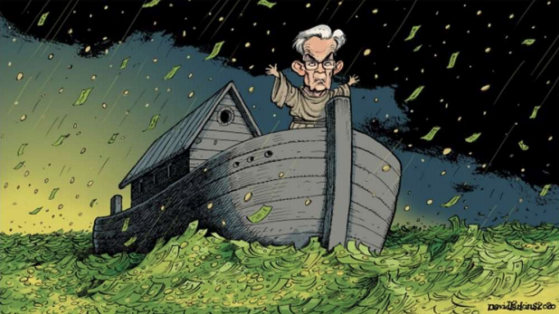
It is said that a rising tide lifts all boats, and that goes for monetary tides as well. Watching the market every day, this is exactly what it has felt like; stocks just want to go up...fundamentals be damned.
It is safe to say that expectations are low as the bottom up consensus for the S&P 500 calls for a year over year earnings decline of about 45% in the 2Q. This would be the largest year over year decline since 2008. But that is well understood at this point.
The most watered-down smart-beta ETFs have attracted the most money.
Buffett changed his mind and bought a 10% stake in all four of the largest U.S. airlines. For a few years it seemed that he was finally right about the airlines.
How can we reconcile the dissonance between economic conditions and stock valuations? I offer four theories.
Saying that extreme stock market valuations are “justified” by low interest rates is like saying that poking yourself in the eye is “justified” by smashing your thumb with a hammer.
Precious metals were the big winners for the first six months of 2020. Spot gold took the first place position, rising over 17 percent, followed in second place by silver, up nearly 2 percent. Palladium rounded out the top three, essentially flat at negative 10 basis points.
The first half of 2020 was dominated by the COVID-19 pandemic, which hit the municipal bond market hard. State and local governments experienced a sharp and sudden drop in revenue, and an increase in expenses, amid stay-at-home orders and business shutdowns.
I find it very interesting that Alexion Pharmaceuticals Inc. (ALXN) after going public in 2001, did not generate their first profit until December 2008. As we all know, this was in the throes of what is now known as the Great Recession of 2008.
With inefficiency comes opportunity, according to Franklin Templeton Fixed Income’s Nicholas Hardingham and Robert Nelson. They consider the emerging market debt landscape, and what the remainder of the year could bring for the asset class.
The market does not care about our opinion regarding what it “should” do. Right now the market does not seem to care that COVID-19 cases and positive test rates are on the rise in the US. What the market cares about now is that economic data has been better than expected...
After a decade of steady growth and rising asset prices, economies and financial markets were rocked by the COVID-19 pandemic. The global health crisis forced most governments to lock down their communities, halting economic activity almost overnight and causing financial markets to reprice lower at an unprecedented speed.
Large-scale studies have shown that actively managed funds underperform their passive benchmarks on an absolute basis. New research shows that this is also true on a risk-adjusted basis – and this is true across asset classes and sub-classes.
After years working with those age 65-plus in their transition to the Medicare system, I’ll share some ideas and tips that will lead to some great conversations between you and your clients – and, likely some added revenue for your practice.
If you haven’t heard of Modern Monetary Theory, or “MMT,” you will soon. If you recently lost your job due to the economic shut down, and received a stimulus check, you are already a beneficiary. As we will discuss in Part-1 of this two-part series, MMT’s theory falls flat when faced with reality.
More infections lead to more worry, while the commercial real estate and tourism sectors are put to the test.
For most US governors, June typically brings political fireworks when state legislatures hammer out final budgets for the next fiscal year.
Recent underperformance has led some to declare the death of value investing, but don’t be so quick to dismiss it.
Rick Rieder, Russ Brownback and Trevor Slaven contend that in the tug-of-war between the considerable economic damage stemming from the coronavirus and subsequent lockdowns, and the fiscal and monetary policy responses put in place, the latter factor is being underestimated by markets. Further, the instruments used by investors in previous years won’t be what’s required for the time ahead.
The recent poor performance of value funds has led some investors to illogically shift to products with less exposure to the value factor. The evidence that the value factor has worked over long periods of time means you want more exposure to it, not less.
A second wave of global COVID-19 is getting a lot of media attention, but the appearance of a global second wave of cases is primarily driven by the different timing of first waves across countries—rather than second waves within countries.
President Trump, like many others along the political spectrum, has derided the persistent U.S. trade deficit – particularly with China – as a waste of capital leaving our country. The view that the U.S. would benefit by correcting this imbalance is taken up in a new book, with a message that should concern all financial market participants.
The common characterization of US-China relations as a new Cold War is wrong. Instead, the most recent spike in tensions between the two countries – the second time this has happened since US President Donald Trump took office in 2016 – is primarily motivated by political considerations ahead of the November US presidential election.
Read Harold Evensky's latest NewsLetter.
Franklin Templeton’s 2020 US Retirement Income Strategies and Expectations survey revealed the importance of having a plan to help reduce financial-related stress—particularly relevant amid today’s uncertainties. Our Felix Touchard discusses some findings of the survey, and how respondents feel about their financial future.
While a near-term mechanical bounce in economic activity in response to the lifting or easing of lockdown measures looks likely, we expect the subsequent climb up to be long and arduous.
New research shows that companies that adhere to positive ESG principles have lower costs of capital, higher valuations, are less vulnerable to systemic risks and are more profitable. But beware; those higher valuations translate to lower expected returns for investors.
The returns of the 2009-2020 bull market were nothing short of extraordinary. From the 2009 low in the S&P 500 to the 2020 high, stocks gained a massive 488%, or nearly 18% on an annualized basis.
Rick Rieder, Russ Brownback and Navin Saigal contend that if a negative monetary policy endgame is to be avoided, particularly in the face of recent economic declines, it will likely be technological advances of a profound kind that get us there.