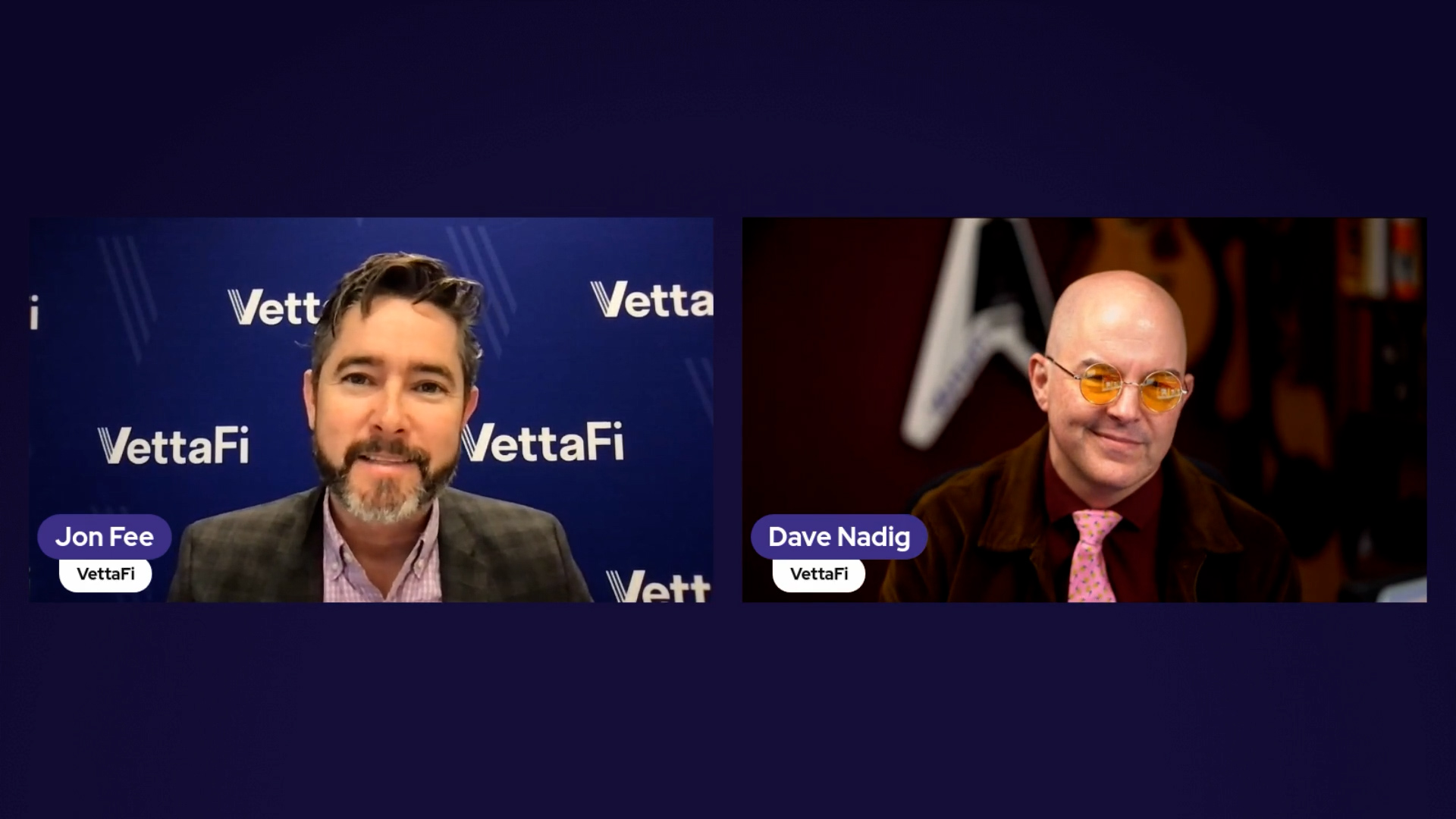
Dave Nadig, financial futurist and Jon Fee of VettaFi discuss how to introduce principals of financial planning to the next generation and the different aspects of financial education.
Once again, larger deficits and higher debt-to-GDP ratios in rich countries have become fodder for fiscal hawks and bond vigilantes to warn of a looming crisis that will demand a return to austerity. But the case for such pessimism has no logical or historical basis.
In the wake of recent underperformance, healthcare is entering the new year with compressed valuations just as innovation picks up and a post-COVID reset winds down. That should make for a positive outlook, says Janus Henderson Portfolio Managers Andy Acker and Dan Lyons.
The likes of consumer resiliency based on the earliest readings on Black Friday sales and the degree to which the Artificial Intelligence theme continues support the idiosyncratic tendencies of the markets concentrated in the Magnificent 7.
The main point under contention this year will be the phase-out of fossil fuels and the limited progress achieved so far. As more businesses make net-zero commitments, there is mounting pressure for greater government support through policies and incentives.
“Let me tell you about the very rich. They are different from you and me.” F. Scott Fitzgerald could have added that they are also generationally different from each other.
Real estate headlines seem to only focus on bad news right now, from remote work’s impact on offices to struggles for city center retail.
Drew O'Neil discusses fixed income market conditions and offers insight for bond investors.
Free-cash-flow yield is the surplus cash after expenses and investments divided by the price of the security. Free-cashflow yield has been used for a long time by active hedge funds. Now it has become part of the indexing landscape, competing for assets with other quantitative approaches. It has historically outperformed in markets that favored value stocks and shown resilience in growth markets. My guest today will explain why, in today's intangible asset-driven economy, traditional metrics like price to earnings and price to book face challenges, making free cash flow a more relevant valuation metric. We will discuss how advisors should think about free cash flow and the steps VictoryShares & Solutions has taken to enhance traditional approaches.
All investments involve some degree of risk.
The private equity industry’s push into credit is so well advanced that no one bats an eyelid when the same buyout firm is invested in the debt and equity of the same portfolio company.
While equity styles go in and out of favor, quality companies continue to serve clients as a core holding, resilient to economic headwinds and market drawdowns. For long-term investors searching for a durable equity solution, we believe quality is “the real McCoy"
As I start thinking about Christmas this year, I decided I want to be on the nice list again, so I put together some useful year-end actions and ideas for financial advisors.
Economic pain is likely in 2024, but that doesn’t mean stocks will struggle all year, especially if there is a continuation of the rolling recessions that have hit the economy.
What were the big ETF trends of 2023? David Mann, Global Head of ETF Product & Capital Markets, reviews some of his predictions for this year—and how they panned out.
The rebound in Adyen NV and its European fintech peers this month has been notable, but investors should brace for a bumpy road ahead.
The recent sharp pullback in volatility as year-end approaches creates hedging opportunities given the cloudy outlook for equities, according to Goldman Sachs Group Inc. strategists.
It’s finally time to move on from a $2.2 trillion problem by burying Bankhaus Herstatt — a half-century after its collapse.
Private equity firms that spent hundreds of billions of dollars on acquisitions at the top of the market risk a nasty hangover.
Treasury investors are turning increasingly skeptical the Federal Reserve will deliver a soft landing for the US economy next year, elevating concern of a looming recession over the risks posed by inflation and a swelling budget deficit.
Two former Goldman Sachs Group Inc. bankers want to take the $1.6 trillion private credit revolution from Wall Street to Main Street.
Doug Drabik discusses fixed income market conditions and offers insight for bond investors.
A quirk in retirement fund accounting is making corporate pensions look particularly flush now, giving them more incentive to cut risk by dumping equities and buying bonds.
Sam Altman will return to lead OpenAI less than five days after he was pushed out of one of the world’s most valuable startups, setting off a shock back-and-forth drama that transfixed Silicon Valley and the global AI industry.
Nvidia Corp. investors gave a cool reaction to its latest quarterly report, which blew past average analysts’ estimates but failed to satisfy the loftier expectations of shareholders who have bet heavily on an artificial intelligence boom.
Taxes can have a significant and ongoing impact on an investment portfolio. Advisors can help their clients minimize that impact with a tax-smart approach. Advisors can prepare for capital gains season now, and potentially maximize their clients’ after-tax returns.
The potency of monetary policy will weigh more heavily on activity in 2024.
I show how the best way to utilize bonds in retirement is not to rebalance between stocks and bonds in retirement, but rather to draw down on the bond side of the portfolio first and let the portfolio drift towards a greater equity allocation.
WeLab Ltd., backed by investors including billionaire Li Ka-shing and Astra International, a unit of Jardine Matheson, is launching a digital bank in Indonesia to tap the young and fast-growing economy.
Dina Ting, Franklin Templeton’s Head of Global Index Portfolio Management, sheds light on the benefits of single-country ETF allocations against what has been a rocky macro backdrop and discusses ways to re-evaluate potential opportunities in terms of tax-loss decision-making.
For the better part of two years, investors have been primed with hope of a “Fed pivot” that will presumably restore easy monetary policy and supportive conditions for the financial markets.
Picking the “right” stock is akin to betting on a game; not only must one pick the right team (beta), but also by how much (alpha).
It’s touted as crypto’s big breakthrough on Wall Street: The imminent arrival of Bitcoin exchange-traded funds that will kick open digital-currency investing to the institutional and retail masses.
Advisors who set up recurring withdrawals at TD need to beware. With the transition to Schwab, those scheduled January withdrawals will take effect in December instead.
Individuals are increasingly looking for more tailored investment solutions, so it makes sense for plan fiduciaries to consider a more personalized approach, according to John Kutz, National Retirement Plan Strategist. He says personalization may be the ticket to better retirement outcomes.
Portfolios with large allocations to alternatives can have many benefits. However, alternative allocations can deviate meaningfully from policy, particularly during periods of equity-market turbulence.
A burst of activity in Bitcoin derivatives has evoked memories of the period in late 2021 when the token surged to an all-time high.
Fossil fuels, particularly oil, are difficult to replace due to their availability, affordability and energy density. Low-carbon alternatives, like solar energy, need large amounts of space to produce comparable amounts of energy to oil.
A charismatic entrepreneur pulls in wealthy investors to amass a portfolio of some of the finest prime real estate. Banks and bondholders are persuaded to provide the leverage. What could possibly go wrong?
We believe that an OCIO provider should have the capability to handle any type of investment assignment. However, most OCIO providers do not have the ability to do this.
With its $33.7 trillion debt and trillion-dollar budget deficit, the US’s deteriorating fiscal situation is impossible to ignore. To simply balance the budget, a 29% across-the-board cut in spending would be necessary, even if the tax cuts enacted by the Trump administration are allowed to expire at the end of 2025.
It’s true – first impressions are everything, and when it comes to your website, they happen in a flash.
A client-centric approach, focused on empowering prospects and clients rather than directing them, is more persuasive and will lead to a more productive, meaningful relationship.
Third-quarter earnings announcements have almost come and gone, with yesterday being the last big burst of companies. Some key firms have yet to announce, like Nvidia and Walmart, but everything I’m seeing says it surpassed expectations.
We speak with ClearBridge Investments’ Jeff Schulze about a topic on many investors’ minds: the 10-year US Treasury yield and the path of monetary policy. He also shares his views on the latest US retail sales data and whether consumer resilience will last into 2024.
The price of gold just had its best October in nearly half a century, defying tough resistance from surging Treasury yields and a strong U.S. dollar. The yellow metal rallied an incredible 7.3% last month to close at $1,983 an ounce, its strongest October since 1978, when it jumped 11.7%.
It’s important not to gloss over this reality because a number of signs point to a continuing deterioration so long as the Federal Reserve keeps interest rates at a level that restrains the economy.
Every year, millions of Americans send their hard-earned money to life insurance companies, in return for a promise that it will grow and provide them with regular income in old age.
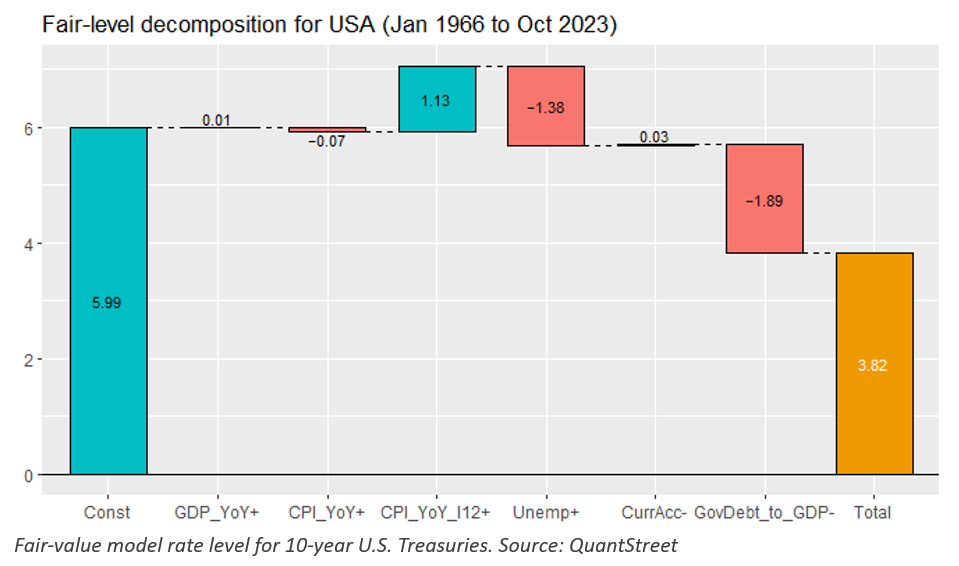
U.S. Treasury rates in the long-end of the curve are 100 basis points too high relative to a fair-value model. The risk-adjusted opportunity in long-dated, low-coupon Treasuries is attractive.
Treasury yields have dropped as weak economic data suggests the Federal Reserve may begin cutting the federal funds rate target earlier than previously expected.
Investing for growth and investing for income shouldn’t be mutually exclusive. Learn how to build a personalized income strategy that balances immediate versus longer-term cash flow needs based on the investor’s unique situation.