An analysis of Presidential Candidate Trump’s policy proposals recently suggests that tax cuts will increase the deficit. While the raw analysis is correct, as it subtracts the potential for reduced tax collections from the tariff revenue, it ignores the impact on economic growth.
Companies and governments around the globe spent the past month streaming into debt markets, seizing on declining interest rates ahead of an uncertain US presidential election that many fear will spur volatility in markets.
Like it does once every year, last week the Commerce Department went back and revised its GDP figures for the past several years. And while the top line revisions to Real GDP were pretty small, there was a larger revision to corporate profits.
The last two years brought challenges for investors across all walks of life, but particularly for retirees.
Sand. Salt. Iron. Copper. Oil. Lithium. These, not petabytes or algorithms or innovative ideas, are the building blocks of human life as we know it. At least that’s what Ed Conway, author of Material World, tells us.
Gold has forged multiple new record highs so far this year, and is now up some 30% year to date, 3.5% in the past week alone.
Following the first half of 2024, the NDX succumbed to significant selling pressure as investors fretted about AI-related tech spending.
When stock markets rise, the bullish narrative tends to dominate, overlooking the potential impact of market declines. This oversight stems from two main problems: a basic misunderstanding of math and time’s critical role in investing.
Historically, investors have struggled to add meaningful alpha through security selection. A dynamic new credit scoring approach could change that.
Schwab Sector Views is our six- to 12-month outlook for stock sectors, which represent broad sectors of the economy. The Schwab Center for Financial Research (SCFR) combines a factor-based approach with a market and economic assessment to determine the ratings. For the basics on sectors, please see Stock Sectors: What Are They? How Are They Used?
Not surprisingly, Donald Trump and Kamala Harris are floating opposite approaches to modifying the corporate tax code. If enacted, both proposals would significantly impact corporate profits and, thus, share prices. Currently, the plans are only campaign promises
Policymakers indicated that more interest rate cuts were likely in coming months.
Deal activity in private equity has slowed significantly from 2021 due to high interest rates and economic uncertainty.
With attractive valuations, emerging market equities look like a good opportunity. A factor investing strategy, designed well, may enhance performance and help manage some key risks.
The markets closed quite strong last week and were approaching all-time highs again for the S&P 500. The most recent Presidential debate shifted the odds markets, as Harris became a 55-45 favorite on the betting site PredictIt and a very slight favorite on Polymarket. It is positive for the risk markets which did not pull back with Harris gaining strength.
When buying or selling an RIA practice, one of the most important documents you'll encounter is the Asset Purchase Agreement (APA). This agreement is like the foundation of the deal, spelling out exactly what is being bought or sold, how much will be paid, and the responsibilities of both parties.
The longest continuous yield curve inversion has finally come to an end. Or has it? The answer depends on how you measure it.
Despite these positive developments, many people continue to feel uneasy about the economy.
I have looked at market data on inflation expectations, Fed Funds futures, and other factors that influence interest rates. Today, I add an unorthodox factor to the list: cash cows.
For a brief moment, when volatility picked up in early August and again in early September, we saw some appetite reappear for low volatility ETFs
Earlier this year, the Federal Reserve seemed to have time on its side. Payrolls were growing at a healthy clip and the unemployment rate hovered near a five-decade low. Even though there were signs that inflation was licked, there didn’t appear to be much harm in keeping interest rates elevated for a while longer — just in case.
How an election affects stock market performance depends more on how close and contentious it is than on whether the winner is Republican or Democrat, liberal or conservative.
While the pace of Federal Reserve cuts is in question, all roads lead to lower interest rates.
Passive fixed income index investing has evolved significantly over the previous decade, offering investors the flexibility to align risk requirements and investment goals. Learn more from our experts.
As AI's usage becomes increasingly widespread around the globe, energy consumption is soaring, along with a demand for additional power.
All signs point to a tough few months ahead for investors charting the dollar’s path, after the US presidential debate and a key inflation reading left markets anticipating heightened volatility through year-end.
Determining the age when retirement account owners need to begin taking distributions is key for heirs to understand how to implement the 10-year rule for inherited accounts. Bill Cass explains what beneficiaries need to know.
Post-Jackson Hole and now post-jobs report, the markets can settle in for a rate cut at next week’s FOMC meeting.
Here’s a quote attributed to P. J. O’Rourke, an American author, journalist and political satirist: “There is a simple rule here, a rule of legislation, a rule of business, a rule of life: beyond a certain point, complexity is fraud.”
Andrea Eisfeldt, Professor of Finance at UCLA, explains the indices underpinning two Simplify ETFs focused on companies with high levels of intangible capital. VettaFi’s Roxanna Islam discusses Tradr ETFs, the Research Affiliates Deletions ETF (NIXT), gold ETF flows, spot ether ETFs, and more.
Given the backdrop of monetary policy stimulus, the global economy is poised for growth and international stocks for continued leadership.
Last week, the BlackRock Target Allocation Team reduced their equity exposure and reduced some growth allocations in favor of value.
Part one of this series described the burgeoning bull steepening yield curve environment and what it implies about economic growth and Fed policy. It also discussed the three other predominant types of yield curve shifts and what they suggest for the economy and Fed policy.
Cloud computing has been one of the first industries to get a demonstrable boost from artificial intelligence. Oracle Corp.’s quarterly results on Monday are likely to extend that trend.
The main focus for investors should is no longer if the Fed will cut rates in 2024, but how much and how quickly the Fed will lower interest rates.
Money can still be a factor in inflation.
Labor Day weekend, marking the end of the US summer driving season, is typically the year’s last hurrah for gasoline producers. This year, the high-fives were reserved for drivers (and White House occupants): The average pre-long weekend pump price was down 13% from last year after gasoline refining margins collapsed in August. Pump prices have eased further this week.
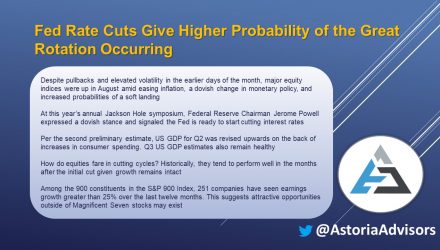
Despite pullbacks and elevated volatility in the earlier days of the month, major equity indices were up in August.
When we’re viewing markets, it’s not surprising sentiment shifts quickly if we don’t instantly see the anticipated results. Market pundits quickly point fingers and determine the Fed, economists, and participants are wrong. Reactions can be powerful in number and sway momentum for stocks and/or bonds.
A bright spot in Chinese investment could spell trouble for its financial institutions.
After a decade of consistent outperformance, Japanese small caps began underperforming their large cap peers in 2018, a trend that has accelerated since 2023.
Cliff Asness says he sounds like an “old man whinging,” but that’s not stopping him from writing 23 pages on his latest thesis: Financial markets these days aren’t what they were.
While short-term fluctuations and sudden selloffs have tested the markets, key indicators such as corporate profits, employment data, and economic resilience have held firm.
Will 2030 DC plans perform better at preparing U.S. workers for retirement?
The healthcare sector offers a compelling mix of defensive characteristics and growth potential driven by innovation. It also features ample dispersion that presents stock pickers with an opportunity to parse potential leaders and laggards in pursuit of above-market return.
With US payroll and unemployment data surprising to the downside two Fridays ago, Treasury markets quickly repriced the probability of impending recession, helping set off a volatility spike in stocks across the world. According to Bloomberg, economists’ consensus probability of a US recession in the next twelve months is now approximately 30%.
My colleague Will Keenan recommended an outstanding book, The Professor, the Banker, and the Suicide King, by Michael Craig. The book is a short and entertaining read of how Andy Beal played the best poker players in the world heads-up. He not only gambled toe-to-toe, but he also reminded them that they were doing what everyone should think poker is: gambling.
This week we take a not-so-random walk through the data, trying to simplify what is actually a fairly complex subject. I think it is quite fun, but also important. Let's dive in.
Our outlook on the 11 S&P 500 equity sectors.
After market expectations spiked to nearly five interest rate cuts in 2024 based on disappointing labor market report early in the month, reassuring data in the form of Retail Sales and Unemployment Claims have quelled market Markets have eased expectations for interest rate cuts, pricing closer to four cuts as of the end of last week.