A few months into the second Trump administration, I found myself in a packed room alongside senior officials of the Bureau of Labor Statistics. The topic, “Ensuring the Quality of US Statistics,” would have drawn little more than a collective yawn a decade ago.
Intel Corp. raised $20 billion in an upsized share sale, a third more than it was targeting when it announced the deal Monday morning.
Nasdaq Inc. agreed to buy off-exchange stock-trading venue LeveL Markets to expand its role in the equity market, according to people familiar with the matter.
GDP — for gross domestic product, the total market value of all final goods and services produced within a county’s borders — is in many ways the ideal economic statistic, both for what it measures and what it represents. It is a single number that captures so much information, with a scope and history unmatched by almost any other measure.
Good or bad, right or wrong, estimates suggest that in the past eighteen months the net flow of immigrants (including the number of illegal immigrants who were deported) may have been negative. By contrast, in the prior four years the US took in more than eight million immigrants, on net. All these numbers could be revised or argued with over time.
Despite spending much of the past three months moving sideways, the S&P 500 broke out to the upside this week, notching its 25th record high of the year. While leadership has shifted beneath the surface, one constant has been the strength of corporate earnings.
Fifty-eight billion dollars. That’s what the Department of War just awarded Lockheed Martin for PAC-3 interceptors, the missiles that have been knocking Iranian ballistic missiles out of the sky for the past five months. It’s one of the largest munitions awards in U.S. history.
Today’s equity markets are arguably the most concentrated, interconnected and exposed to correlated risks in the modern era. In this fragile environment, we believe investors need more than just exposure to stocks that have driven recent market returns. Disciplined stock selection and clear risk objectives are essential—as well as conviction in what not to own.
US equity market leadership underwent a rotation in July, with previous leaders turning into laggards and vice versa.
We provide research and advice on asset allocation, the selection and weighting of various investment categories. Subject to internal review and governance, our recommendations guide the investment decisions in our family of mutual funds and institutional client portfolios.
With earnings season entering its final peak week, investors will be focused on results from restaurant names such as CAVA Group (CAVA), Jack in the Box (JACK), Red Robin Group (RRGB) and Brinker International (EAT).
For three years, clients have asked the same question: “How do I get into SpaceX or OpenAI before the IPO?” That question just changed tense.
Given how uncertain advisors and investors are over the Federal Reserve’s plans for handling interest rates, the July jobs report was perhaps watched even more closely than normal. That being said, the latest report may not have inspired much confidence.
Here are three tips for young investors setting out to build wealth but not sure where to start.
Join Fidelity Investments for a product due diligence session to learn all about their core active equity suite of Fundamental ETFs.
What stock fund could be safer than a total U.S. stock market index fund with thousands of securities? That was my thinking for the last three decades, but things are changing.
Our thesis remains largely unchanged. Today's “exploding” CDS spreads and bond yields are pricing an Oracle problem. The question investors should be asking isn't whether Oracle is an outlier. It clearly is. The question is whether Oracle is a preview of what happens to credit markets more broadly if AI capital spending keeps outrunning AI revenue.
When data can’t give us the answer, we have to think from first principles. If your objective is to maximize the risk-adjusted return of your savings, finance theory and common sense both suggest that higher risk, all else equal, calls for cutting exposure, not adding to it.
San Juan, the economic hub of Puerto Rico, triggered a rush for its $121 million muni-bond sale this week, as investors seized a rare opportunity to get exposure to island.
The leveraged ETF boom is creating new ways to profit from sudden bursts of volatility in tech stocks.
US natural gas futures rose by the most in more than two months as an unusually large swing in weather forecasts triggered a wave of short-covering among money managers who were the most bearish on gas since 2020.
US lawmakers from both parties are seeking to boost federal funding for quantum computing as China and other countries race to transition from research to deployment of the nascent technology across defense, intelligence and cybersecurity.
Getting on an airplane has become the perfect metaphor for life in America. On the one hand, flying has become cheaper and more accessible. On the other, it has become more stratified and stressful.
“Sound money,” in its purest form, is money whose supply a government cannot expand at will. Under a gold standard, every dollar is a claim on a fixed weight of gold. You can’t print gold. So the government can’t monetize its deficits, and the money supply grows only as fast as miners pull metal out of the ground, historically around 1.5% a year.
Chris Galipeau discusses high-conviction insights that go beyond media headlines.
The AI capital expenditure cycle remains solidly on track to eclipse the telecom boom of the late 1990s and become the largest investment cycle since the railway buildout of the 19th century in inflation-adjusted terms. T
Fixed income markets continue to adjust to an evolving policy backdrop following last week’s Federal Reserve meeting.
In this video, Chuck Carnevale explains why dividend growth investing can be one of the most conservative and rewarding long-term investment strategies—especially when combined with sound valuation principles.
Lots has been written about the strength of the US economy not translating into improvement in the different measures of consumer confidence and consumer sentiment over the last several years.
While long-term interest rates have been trending higher driven by a combination of persistent inflation, Fed uncertainty and geopolitical conflict, earnings growth this year has been very strong. If the trend continues, earnings could continue to help equity markets outpace rising interest rate and inflation risks.
Stronger gold prices are happening for a couple different reasons. First of all, optimism is rising that the Strait of Hormuz may finally reopen soon. The news in Iran is certainly welcome, but new jobs data from ADP is helping gold, too.
The AI trade has faced renewed volatility as investors question AI spending and current valuations. Semiconductor stocks and related areas — including memory, networking, photonics, and chip equipment—have all been caught in the pullback.
Most conversations about artificial intelligence in wealth management begin with efficiency. The larger opportunity is using AI to build a different kind of advisory business: one that provides “growth alpha”. Harnessed smartly, AI has the potential to create capacity for the activities that actually drive organic growth.
There is no one-size-fits-all individual investment strategy. We all have different needs. Once I decided I needed a portfolio that would work for today, I became convinced that a dividend growth portfolio should be the core of my long-term investment strategy. Not an addition, but the core.
Two things are worth considering that will dramatically impact the stats moving forward, and neither of them existed as a factor a generation ago. Alternatives to a four-year degree are getting more government support too. Workforce Pell Grants, once reserved for traditional colleges, now extend to short-term job-training programs.
US 10-year Treasury yields have climbed roughly 50-basis points since the start of 2026. This is not an inflation scare. Despite the sharp rise in energy prices following the outbreak of war with Iran, market-based measures of medium-term inflation expectations have drifted lower.
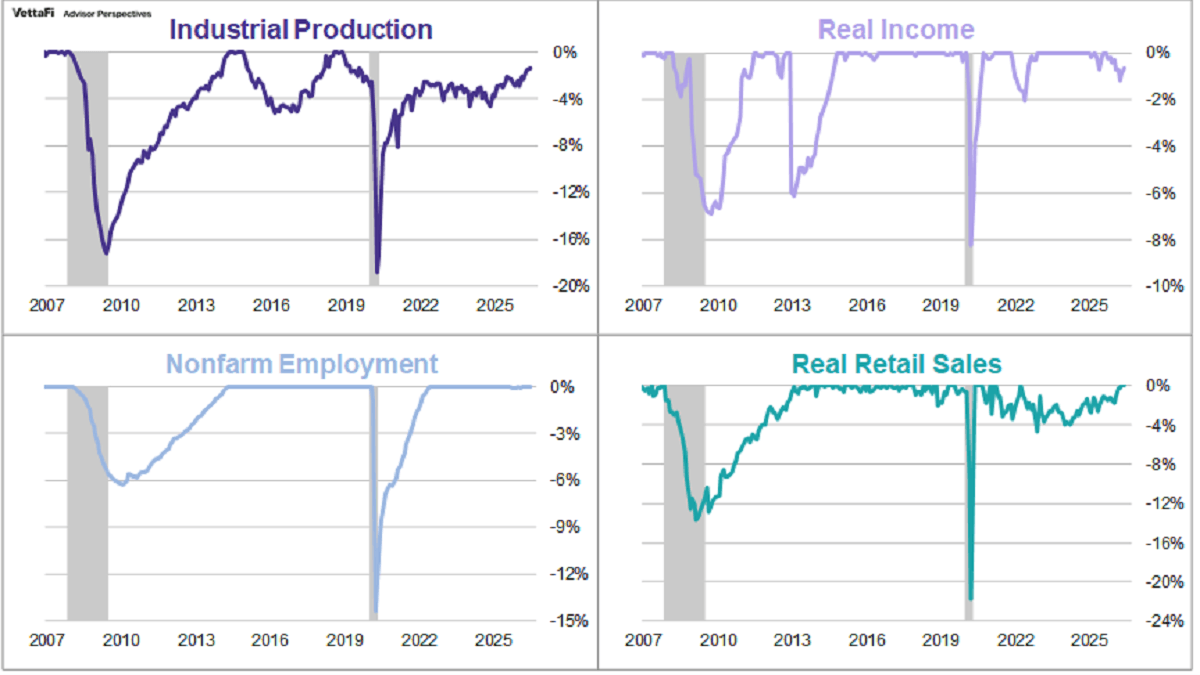
Official recession calls are the responsibility of the NBER Business Cycle Dating Committee, which is understandably vague about the specific indicators on which they base their decisions. There is, however, a general belief that there are four big indicators that the committee weighs heavily in their cycle identification process.
Morningstar research shows ETF investors gave up 1.2 points a year to poor timing, a gap advisors can help clients close through discipline.
Goldman Sachs Group Inc. is setting up a reinsurance vehicle with Talcott Financial Group that has so far raised $1 billion.
After spending much of the year in the stock market doghouse over fears about their profligate spending on artificial intelligence, the world’s biggest technology companies are suddenly leading the way once again.
US Treasuries rallied after data showed employers unexpectedly cut jobs in July, suggesting labor market challenges that could impact the Federal Reserve’s willingness to raise interest rates.
Gold jumped more than 3% after an unexpected contraction in the US jobs market, extending a rebound from its slump below $4,000 an ounce.
Given America’s political environment, you would be forgiven for thinking the country has slipped into a dark age of energy recidivism; burning oil, gas and coal left and right; and tossing wind and solar farms on the scrap heap.
The S&P 500 was flat in July 2026 as semiconductors fell 29%, energy gained nearly 13% on higher oil, and long-term Treasury yields reached their highest levels since 2007.
A good financial plan may bring together every aspect of your financial life into a coordinated strategy, providing a clear view of where you are today and helping you prepare for where you want to go. By understanding your complete financial picture, you can make informed decisions that align with your goals, values, and long-term priorities.
Investors remain cautious despite bullish positioning, as rotations curb speculation while record margin debt and high equity allocations raise longer-term risks.
As many of you know, our team at Smead Capital Management has studied the thinking and investment careers of Charlie Munger and Warren Buffett. In today’s Go-Go artificial intelligence-dominated stock market, we’d like to walk you through the concept of the Circle of Competence.
In this article, Russ Koesterich explains how the recent market rotation has pressured tech stocks while creating an attractive long-term buying opportunity.
A clear-eyed view of past experience shows that where wealth taxes have been tried, they have usually been abandoned—and for good reason. As policymakers in California, New York, France, and elsewhere revisit this old idea, they should heed the lessons of this history.
Investors are warming to systematic processes in bond markets. In this new approach, a dynamic multifactor process drives the investment decisions, using predictive factors with demonstrable links to outperformance.