Markets rose last month, continuing November’s rally as interest rates pulled back even more on expectations of Fed rate cuts in 2024.
The long-awaited recession never materialized in 2023 as the sectors of the economy rotated from hot (i.e., travel and leisure) to cold (i.e., housing) over the last few years.
Bond yields are up—that’s good news for income investors, but secular forces still pose headwinds for inflation-adjusted returns. We think an efficient way to generate income is by carefully assembling mixes of interest-rate and credit building blocks—and incorporating private-market exposure for additional diversification and return potential.
After a year when advisors were relatively cautious about taking on credit risk, sentiment seems to be shifting.
We think 2023 stressed the value of adapting to a new volatile macro regime and leveraging investment insight and structural forces to find opportunities.
I have news for you: The United States is becoming more redistributionist. Whether you like it or not.
The S&P 500 reversed its 2022 losses, and then some, closing the year near a record high.
Welcome to 2024! As we wade into the new year, you will undoubtedly read and hear a wide range of forecasts predicting what financial markets are going to bring us over the next 12 months.
Craig Burelle sets the stage for our Sector Outlook blog series with his views on the macro backdrop in 2024.
Economists are used to the idea that intervening in concrete ways — spending on development projects, for example, or on social services — can improve outcomes. But what about psychological interventions?
Enthusiasm for Japanese equities picked up in 2023 as evidenced by the 28% rally in the TOPIX (local) index through November.
Here are our 10 themes for 2024. Count on more than a few surprise ingredients throughout the year to spice up the financial markets.
Our current 10-year outlook highlights better opportunities for cash and bonds, primarily driven by higher starting yields, and a steady outlook for stocks.
Confidence in the bond markets is fueling a two-month rally in prices as the capital markets brace for rate cuts in 2024. Whether they happen at a furious pace or not is anyone’s guess, but the expectation of cuts are providing enough spark for the rally.
Exploring sustainable investing complexities, this piece categorizes ESG into screening, integration, thematic investing, stewardship, and impact. Despite conflicting reports, ESG-labeled bond funds have thrived, reaching $900.5 billion in assets. Their premium indicates robust demand, countering decline narratives and underscoring continued vitality in fixed-income sustainable investing.
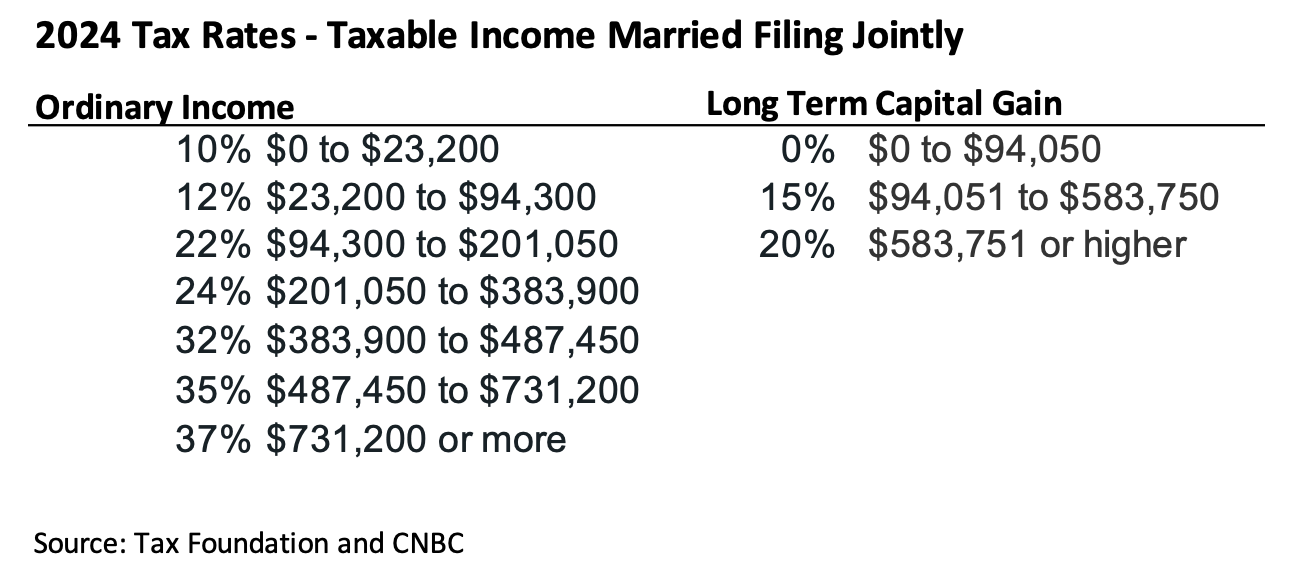
Across the U.S. wealth spectrum, $2 out of $3 of investable assets are in taxable accounts. Having a comprehensive tax management strategy is critical. In the context of separately managed accounts, tax-loss harvesting is one component of a tax management strategy. Tax-efficient or tax-aware portfolio rebalancing is a key part of that. That includes the ability to evolve or rebalance the portfolios periodically in a tax-efficient manner by minimizing the overall tax liability. The tax-efficient techniques involve pairing gains against losses or avoiding short-term gains in favor of long-term gains, or capping gains in general to minimize overall tax cost.
While overall economic inflation has slowed over the past 18 months, health insurance costs keep going up.
Economists did not believe it was possible, but they’ve been wrong a lot lately, and in their defense it has only ever happened once (or maybe twice) before: We may be witnessing that rare achievement known as a soft landing.
The surge in consumer prices that drove inflation way past central banker’s targets in recent years triggered a wave of interest-rate hikes.
Life insurance is one industry that has historically overlooked women’s buying power.
The tide has turned for bonds. Here’s what we think is in store for 2024.
The start of a new year brings a chance for reflection and re-evaluation. For investors, a chance to rebalance. Franklin Templeton ETFs’ Dina Ting and Marcus Weyerer highlight the pitfalls of overweight exposure to mega tech stocks and where in the world to look for diversification in 2024.
Tweedy Browne is one of the most respected value managers. In this wide-ranging interview with its investment team, they explain why the opportunity set they are seeing among stocks is the best in 20-plus years.
With only a week remaining to 2023, the stock market is poised to end the year up a respectable 25% or more. That’s despite a number of significant hurdles, from multiyear-high interest rates to ongoing fighting in Ukraine and the Middle East.
As 2023 comes to an end, let’s revisit the top 10 most-read AP charts of the year.
From the banking crisis to the U.S. debt-ceiling saga, from inflation concerns to recession fears, from soaring bond yields to slowing consumer spending, 2023 had no shortage of issues for investors to worry about.
A year of significant monetary policy tightening is coming to a close, making Franklin Templeton Fixed Income optimistic about muni bonds in the year ahead. Get the team’s 2024 muni-bond outlook.
The dollar is poised for its worst year since the onset of the pandemic as Wall Street bets the Federal Reserve is set to lower interest rates after reining in prices.
The year 2023 will be remembered by economists and investors as 365 days of resiliency and defied expectations. This week’s Weekly Economics will dive into the U.S. economic landscape and summarize the major factors that shaped the nation’s economic trajectory this year.
All across Wall Street, on equities desks and bond desks, at giant firms and niche outfits, the mood was glum. It was the end of 2022 and everyone, it seemed, was game-planning for the recession they were convinced was coming.
Aggregate bond benchmarks rebounded this year following some of the worst showings on record in 2022. With heightened expectations that the Federal Reserve could cut interest rates in 2024, fixed income enthusiasm is perking up.
Quarterly commentary giving an overview of the markets and the importance of having and implementing a strategy when investing in the markets.
If 2023 was the year of the “Magnificent Seven,” 2024 may be a year where small-, mid- and large-cap companies will take the spotlight, according to Franklin Equity Group.
With 2024 just around the bend, fixed income exchange-traded funds (ETFs) are offering investors bright prospects for bond exposure in the new year and capital allocation is expected to increase.
The “vibecession” that has confounded economists for the past two years is finally behind us.
If you own bond funds in a taxable account, it is possible to turn some of the SEC yield into long-term capital gains taxed at lower rates, which could save a bundle. Here’s how.
As we near the end of 2023, Head of Franklin Institute Stephen Dover reviews how his forecasts for the year panned out and shares the themes his team is watching out for in 2024.
After a year marred by the biggest US bank failures since the 2008 financial crisis, the nation’s largest lender is on familiar footing — scooping up a weakened rival, reeling in its clients and minting record profits along the way.
This year’s hottest options trade is catching on with Wall Street’s nerd contingent.
Whatever you’ve been told about your retirement, odds are that it’s wrong. Saving enough for your retirement, and investing the right way, are truly among the hardest of all financial problems. In many ways, it’s more difficult than running a large endowment or hedge fund — and yet we all must do it.
Albert Edwards, Societe Generale SA's chief global strategist, hasn't been the top-ranked Extel survey macro analyst for the past 20 years because he's an optimist.
The year-end fiscal 2023 government funding bill contained legislation that makes the most significant changes to the U.S. retirement savings system in decades. The SECURE 2.0 Act builds on retirement savings changes passed in 2019 and contains new provisions that further raise the required minimum distribution (RMD) age, shift to automatic plan enrollment and provide for new matching/emergency withdrawal opportunities.
Great articles don’t always get the readership they deserve. We’ve posted the 10 most-widely read investment and planning articles for the past year here and the top practice management articles here. Below are another 10 that you might have missed, but I believe merit reading.
Goldman Sachs Group Inc.’s head of global currency, rates and emerging-markets strategy says he’s learned two main lessons from one of the biggest — and most-common — bad calls of 2023: the bet on post-pandemic China’s reopening boom.
A recent warning by YahooFinance warns investors to sell their cash and buy bonds and stocks now as the Fed pauses.
Advisors are being asked to provide their clients with a full suite of solutions, ranging from estate and tax planning to portfolio management, and everything in between. Clients are increasingly eager to gain access to fully customizable solutions that meet their individual needs. Advisors, meanwhile, are facing constraints while grappling with a volatile market, and their relationships with clients are being tested.
To address those market challenges, SS&C Rendezvous was launched in 2023, offering advisors a turnkey, front-end investment management platform embedded in the Black Diamond portfolio management system. Featuring an open architecture model marketplace and an integrated proposal-generation tool targeting clients and prospects, Rendezvous empowers advisors with the technological resources to streamline goals-based financial planning and proposal generation, offer investment solutions and asset allocation tools that achieve clients’ goals and reclaim time to focus on building relationships.
First, let me wish you Merry Christmas, Happy Holidays or your favorite personal form of greetings for this time of year.
The market has been indecisive but with reason. 2023 has been filled with strong opinions however, many of the opinions are of contrasting beliefs. Reading the future is not easy.
Bond markets expect more cuts than the Fed is signaling, and this expectation largely reflects a return to pre-COVID dynamics of low inflation, massive central bank support, and suppressed term premia.
While 2022 was a brutal year for bonds, fixed income enjoyed many tailwinds this year, from high interest rates to lowered inflation to a less volatile economy. This made 2023 the year for fixed income. And in particular, it was a good year for Vanguard.