As the S&P 500 continues climbing, investors don't need to worry about a sudden drop, which bodes well for high-yielding dividend funds.
There was zero chance the Fed was going to cut rates today; instead it was all about what today’s meeting, the dot plot, and the press conference meant for the timing and pace of rate cuts in the months ahead.
Gold surged above $2,200 an ounce for the first time as investors grew more confident about the Federal Reserve’s path for rate cuts, boosting the appeal of non-interest bearing bullion.
Federal Reserve policymakers are largely sticking to their path of interest-rate cuts — for now — after hitting a bump on the road to low and steady inflation.
A key measure of Asian stocks rose to its highest level since April 2022, powered by technology companies and the Federal Reserve’s supportive comments on the outlook for US interest-rate cuts.
India’s equity markets are being driven by fundamentals in the form of robust economic expansion which is leading to strong earnings growth. India is also, helpfully, in the draft of favorable geopolitical tailwinds. In this paper, we make the case for India.
The Bank of Japan raised interest rates for the first time since 2007 and has eliminated the yield curve control framework. Franklin Templeton Fixed Income Economist Rini Sen expects the bulk of further tightening will likely come in 2025 as BoJ seeks to reach a sustainable 2% inflation target by end of fiscal year 2025.
The heated debate surrounding traditional 60/40 portfolios in today’s markets has dwindled in recent months. Given ongoing market volatility and the growing popularity of alternatives, does the traditional portfolio hold up today?
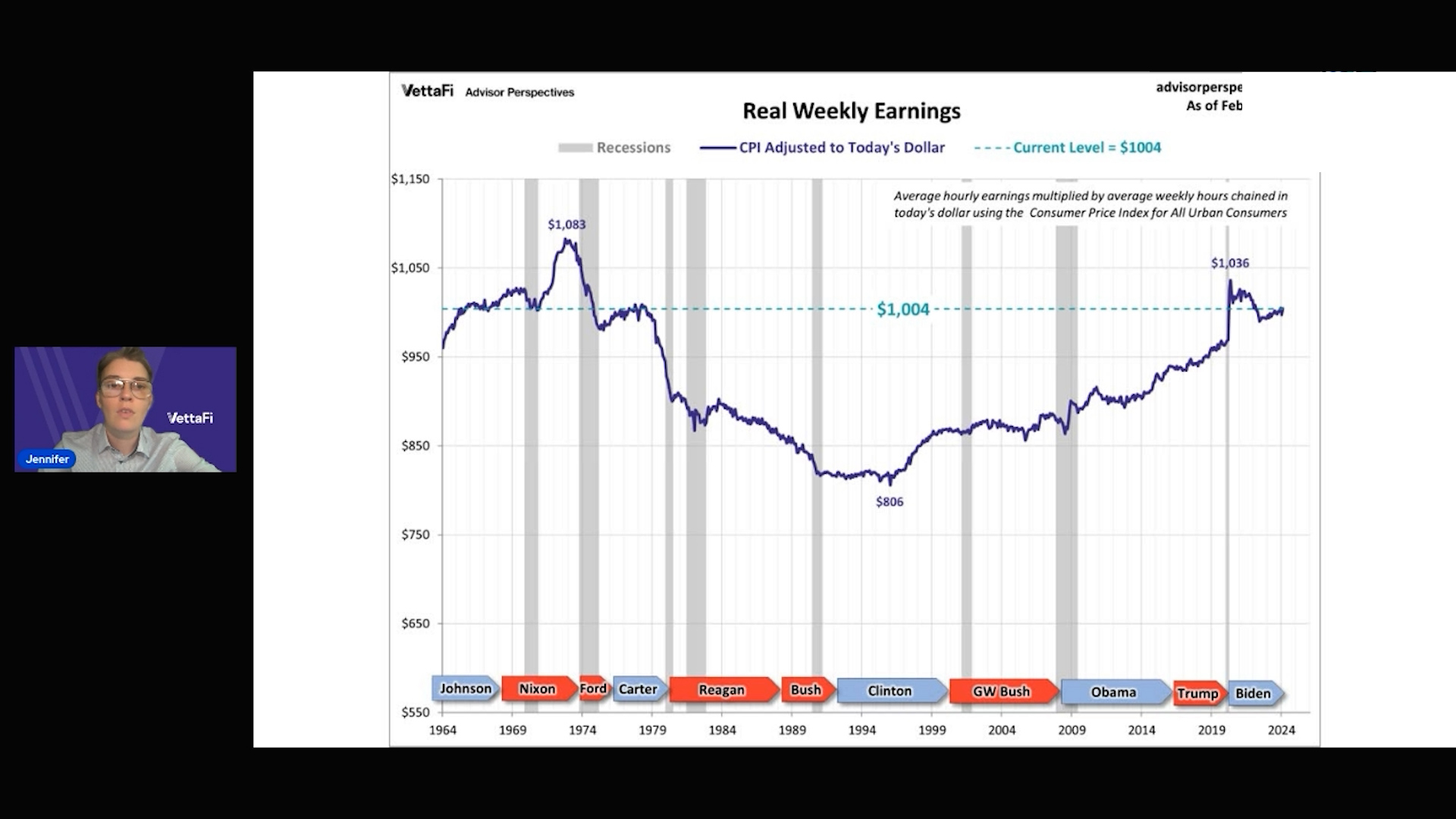
The latest hypothetical real (inflation-adjusted) annual earnings are at $50,210, down 7.3% from over 50 years ago. After adjusting for inflation, hourly earnings are below their all-time high from April 2020.
Between adjustments in Fed policy and a coming presidential election, it's going to be an emotional year, but historical data shows staying invested is the best course for investors.
Bitcoin sank to a two-week low before paring losses as demand for dedicated US exchange-traded funds dries up and investors question the Federal Reserve’s scope to lower interest rates quickly.
Household equity allocations are again sharply rising, as the “Fear Of Missing Out” or “F.O.M.O.” fuels a near panic mentality to chase markets higher.
Russ Koesterich discusses the reason that bonds are not providing the same diversification benefit to equities as in prior decades.
In recent years, private equity fundraising surged, yet exits slowed drastically in 2022, prompting institutional investors to rebalance portfolios through increased secondaries activity. Franklin Templeton Institute’s Senior Strategist Tony Davidow explains.
Planning on implementing a large portfolio change in the second quarter? You’ll want to pay attention to this calendar.
The U.S. Federal Government has set a net zero carbon goal by 2050. Tremendous resources have been applied with borrowed money to fund these goals and subsidize money-losing green investments.
In a global macroeconomic environment fraught with high inflation, consumers are stressing needs over wants, but that’s not to say they’re abstaining from the latter completely.
Rumors are floating that a new variation of QE will help bridge the Treasury’s liquidity shortfalls.
The timing and pace of Federal Reserve interest rate cuts will consume economists and market commentators for months to come. But an emerging story in 2024 is that lenders and borrowers are jumping the gun well in advance of any policy easing.
The Federal Reserve weighs the data while investors wonder: When will rate cuts begin?
At Mutual Series, we do not believe the packed and contentious 2024 global election season will upend the major long-term trends around supply-chain links, energy security and defense—all of which can further support certain value stocks.
Shelter costs are keeping inflation measures elevated.
The economic outlook in the United States is unusually murky, with different sets of indicators telling different stories. But it is entirely possible that inflation will get stuck at a level inconsistent with the US Federal Reserve’s target, reducing – perhaps even to zero – the number of interest-rate cuts this year.
The Fed meets this week, which means investors and analysts will be sifting through Wednesday’s FOMC statement, updated economic projections, the “dot plots,” and Powell’s press conference searching for any signal – real or imagined – about what our central bank will do next.
Capital markets appear content with playing the rate cut waiting game as the S&P 500 continues to rise to new highs. Meanwhile, renewed volatility could make investors reconsider adding an equal weight strategy to their portfolios.
While investing strategies should be consistent, changes in markets and the economy make some advice more relevant than it was in the past. Here are the top 10 things I’m telling clients.
Sentiment among US homebuilders climbed to an eight-month high in March as a limited number of existing homes for sale and mortgage rates that are down from their peak spurred demand.
Gold prices have done well around Fed easing cycles. In addition, inflation concerns and high interest rates make the year-ahead gold return forecast attractive.
Sentiment data is beginning to match relatively strong "hard" economic data.
For the first time in quite a while, there is an alignment between what the Federal Reserve is signaling about its interest-rate setting this year and what the markets think will happen.
Over the last few years, digital currencies and gold have become decent barometers of speculative investor appetite.
Do you know that the headline Personal Consumption Expenditures (PCE) was 2.4% in January while the core PCE was 2.8%? This is very close to the 2% target.
You may have noticed the stock market rising lately. Much of the gain isn’t so much “the market” as a handful of mega-cap stocks. Nonetheless, the bulls are clearly in charge. The question is how long they will stay there. History suggests longer than many market bears think.
Homeownership is the quintessential American dream, but it’s become increasingly elusive for many households. A multitude of factors, including soaring home prices, elevated interest rates and persistent inflation, has created the perfect storm, making homeownership a distant reality for more U.S. residents.
With the U.S. economy posting two consecutive quarters of 3%+ GDP growth, recession calls have quieted down.
Markets are showing characteristics of a bubble in the record-setting surge by tech’s so-called Magnificent Seven stocks and the all-time highs in cryptocurrencies, according to Bank of America Corp. Chief Investment Strategist Michael Hartnett.
Japan is back, China is over. Only a few years ago, such an assertion would have been dismissed out of hand. The latter was on the road to economic dominance and the former languished, characterized by endless stimulus that produced little tangible benefit, and doomed by a shrinking population.
All durable bull markets need bouts of positivity to keep them moving higher, and the next month is shaping up to be a good-news desert.
Fresh data on inflation and unemployment filings gave Federal Reserve officials more reasons to hold off on cutting interest rates, even as retail sales suggested a slowdown in consumer spending.
After years of managing household budgets through the stress of the worst inflation in a generation, US families are increasingly pressured by a different kind of financial squeeze: The cost of carrying debt.
Bitcoin extended a retreat from its latest record high amid an intensifying debate about whether the bull run in cryptocurrencies is evidence of speculative froth in global markets.
Gargi Pal Chaudhuri, Head of iShares Investment Strategy and Markets Coverage at BlackRock, and Anne Ackerley, Head of BlackRock’s Retirement Group, sat down for a conversation about women and investing – the good, the bad, and the diversified.
Stubborn core and supercore inflation will mean that the Fed will want some more evidence that their preferred measures of inflation are moving sustainably lower according to Nikhil Mohan, Franklin Fixed Income economist.
Every year or two, a new round of worries crops up. Some of them are real—the war in Ukraine, inflation, politics—but a surprising number are not. The challenge, of course, is telling which is which.
The ongoing narrative around the strength of large-cap equities will continue to center around forthcoming rate cuts. Once the Federal Reserve receives the economic data it needs to loosen monetary policy and hit its inflation goal of 2%, it could propel growth-oriented large-cap stocks into the stratosphere.
Investors appear increasingly optimistic regarding equity performance in the second half. However, frothy markets continue to create challenges this quarter and advisors looking to find opportunities within equities this year don’t want to miss the recent 2024 Equity Symposium hosted by VettaFi.
Gold has definitively broken out of the range it's been stuck in since the start of this decade, reaching a record $2,195 per troy ounce this month.
US retail sales rose by less than forecast after a steep drop to start the year, underscoring concerns about the durability of consumer spending.
After dialing back their expectations for 2024 Federal Reserve interest-rate cuts substantially since the start of the year, bond traders on Wednesday will take their next cue when policymakers release their own updated projections for their benchmark.
Municipals posted positive performance and outperformed comparable Treasuries in February. We expect supply-and-demand dynamics to turn less supportive in the coming months. After patience to start the year, we would view any material backup as an opportunity to buy.