Private credit is being sought—with the goals of income and capital preservation—to achieve real capital growth and drive portfolio returns among retail and institutional clients alike.
Earlier this October, VettaFi announced that the Susan G. Komen Foundation would be the cause of the month. October is also Breast Cancer Awareness Month. VettaFi is pleased to announce that it will be taking its support to the next level.
The calendar third quarter of 2023 was a messy one for financial markets at large, and we were not immune to its lack of charms. Nonetheless, it’s been a pretty good year for our small-cap strategy.
The longer the U.S. debt is left to grow, the harder it will be to correct.
Read our quick insight to learn why investors should be careful when Wall Street starts to feel like Easy Street.
Goldman Sachs Asset Management has seen strong net inflows in 2023 into its broad market equity ETFs and its income ETFs. Today, the firm expanded its exchange traded fund lineup to include two equity income ETFs.
In this video, Chuck Carnevale, Co-Founder of FAST Graphs, a.k.a. will illustrate how value investing is the smart way to invest in stocks. Whether you’re investing for growth or income, value investing can be highly effective.
Higher for longer. The Federal Reserve will likely maintain higher interest rates and remain open to another rate hike. Borrowing costs for households, businesses and governments have risen with soaring rates.
For the 90 days ending October. 20, the S&P 500 Energy Index jumped 6.1%, while the broader S&P 500 slumped nearly 7%. Due in part to geopolitical concerns, oil prices are trending higher, providing support to the energy equity thesis.
Human behavior can lead to irrational investment decisions, but a well-planned low-volatility strategy may be the antidote.
There are reasons to be cautious in many markets, but low volatility and high/sustainable dividend stocks can help mitigate risk while providing income and equity exposure. The Franklin Templeton Investment Solutions Team weighs in.
While the article focuses mainly on the rise in bond yields, it applies to several current market events.
In the past week, the price of physical gold has continued to rise. According to Kitco, on October 16, 2023, the price of gold was valued at around $1,922 an ounce, and it began Monday morning just above $1,970.
The strength in consumer demand has been one of the defining characteristics of a very resilient U.S. economy and September’s retail and food services sales report confirmed that the U.S. consumer is alive and well.
U.S. Treasury debt has long been considered a “risk free” asset. Gold bugs hold a different definition of risk free, but for most of Wall Street and the investing public the assumption has been that there’s zero chance the U.S. government will ever default on its debt.
Investors are accustomed to getting a snapshot of the market by looking at the latest index statistics. But today, average spreads and yields for investment-grade corporate bonds are deceptive. A look under the hood reveals that intermediate-maturity corporates are a much more compelling opportunity than long-maturity ones.
High-interest rates are keeping the residential real estate market in flux. This is due to borrowing costs making prospective buyers and even sellers think twice.
A transition away from fossil fuels is likely required to avert a significant warming of the planet. The primary risk to markets is the energy transition itself, which would require substantial capital expenditures.
We still think a recession is coming, but it definitely didn’t start in the third quarter. Instead, as we set out below, it looks like real GDP expanded at a 4.7% annual rate.
We are focusing a lot of attention on fixed income at VettaFi in October. This week, we are hosting webcasts with AllianceBernstein and State Street Global Advisors.
Investments in alternative energy have become unattractive due to higher interest rates, not changes in government policies, adoption or pricing of green technologies.
Tony Muhlenkamp shares his notes on charitable donations and income tax deductibility.
With annual deficits now in the trillions and interest payments on government debt at all-time highs, something needs to change.
In the month of October, gold’s price began to trend upward. This jump in the price of the precious metal comes after consecutive drops in its value since May.
U.S. equities have ruled the roost for the better part of the last decade, but another region may emerge as the leader if the business cycle changes.
A major investing mistake that investors often make is avoidable. We all realize that investing mistakes are going to be made. And there are some investing mistakes that are simply unavoidable and there’s really not much you can do about them.
Big tech has obviously been a major mover for the stock market in 2023. With third quarter earnings forthcoming, there should be plenty of opportunities for broad-based ETF as well as single-stock ETF plays.
Tight lending standards and rising yields, along with concern about an approaching turn in the business cycle, have put opportunistic credit in the spotlight. But what, exactly, does opportunistic credit mean? Here’s how we look at it—and what we think it may offer investors.
Discover strategies for a “higher for longer" interest rate environment and gain insights into inflation, areas of opportunity, and building a resilient fixed-income portfolio for the times ahead.
Our emerging market debt valuation metrics across all but the U.S. interest rate dimension remain unambiguously attractive. In our Quarterly Valuation Update, we provide our Q3 assessment.
Restrictive monetary conditions, from higher yields and tighter lending conditions, are the Fed’s “Waterloo.”
Some investors are rightfully pensive about employing a buy-and-hold approach when it comes to cryptocurrencies. Even when it comes to the largest members of the asset class, bitcoin and Ethereum.
It feels like Groundhog Day, with yet another challenging quarter for muni investors. The index was down about 4%, bringing year-to-date returns to –1.4% for the year. So what happened in August and September?
I was asked a pretty good question following an internal meeting late last week. The question started out by noting that we have been promoting going longer on the curve for a while now and then asking why we think longer-term rates will come down.
Term premiums have been on the rise, but should investors be concerned? Stephen Dover, Head of Franklin Templeton Institute, explains what term premiums are, and why they are worth paying attention to.
The communications sector has been one of the best-performing sectors of the year, benefiting from both the tech boost and in certain areas, from consumer spending on services versus goods.
ESG isn’t a new concept. In recent years, it’s gained more attention and assets thanks partly to the proliferation of related ETFs.
The latest inflation report raises the odds of further Federal Reserve action.
The debate between active and passive management has been going on for years. And while active management has faced headwinds over the past decade or so, it’s starting to reclaim dominance over passive.
Drugmakers don’t have to dominate a healthcare portfolio. Equity investors should cast a wide net across the sector to find innovation and growth.
With next week’s 3Q GDP report shaping up to be a blockbuster number (the Atlanta Fed GDPNow is tracking a +5.4% growth rate), it is worthwhile to reiterate our thoughts on the economy and how we expect growth to unfold over the next year.
We have been looking at big historical/economic/political cycles for the past two months.
Active ETFs have gained in popularity in recent years. However, some pundits have prematurely taken out their shovels for some funds. Even as these products show signs of vitality.
The muni yield curve has been inverted before, but not for any meaningful length of time—until now. With yields on short-term muni bonds still significantly higher than those on intermediate-term munis, what’s an investor to do?
While surface-level economic data appear resilient, details below the surface are mixed.
Russell Investments’ 2023 Manager ESG Survey, now in its ninth year, continues to offer valuable insights into the evolving landscape of ESG practices within the investment management industry.
Homeowners, drivers and other individuals in the marketplace for insurance, have a host of factors to consider to make sure they are appropriately covered in the event of a death, accident, or other untimely event, advisors shared in interviews with VettaFi.
As investors face continued macroeconomic and market uncertainty, evolving the 60/40 portfolio of stocks and bonds to include alternative investments may help build portfolio resiliency.
The long history of business cycles illustrates that rising inflation precedes recessions. Inflation accelerations don’t just happen, they are caused.
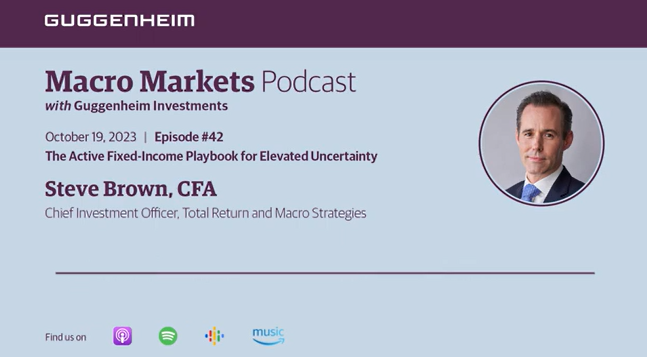
Steve Brown, Chief Investment Officer for Total Return and Macro Strategies, discusses the portfolio strategy implications of the evolving geopolitical, economic, and policy landscape.