Much like the universe, which began with a big bang nearly 14 billion years ago, but is expanding so rapidly that scientists predict it will all end in a “big freeze” trillions of years from now, our current monetary system seems to require perpetual expansion to maintain its existence.
The US government’s finances keep looking worse. The latest Congressional Budget Office projections suggest that it will need to borrow an added $400 billion this year to cover its budget deficit — and trillions more over the next decade.
Much of the current decrease in the headline retail sales number can be attributed to the decline in gasoline prices at the pump.
U.S. Treasury auctions are of interest lately due to growing U.S. debt and high interest rates. What are Treasury auctions, how do they work, and what should investors know?
In their mid-year outlook for global stocks, Head of Americas Equities Marc Pinto and Head of EMEA and Asia Pacific Equities Lucas Klein argue that while risks of an economic slowdown remain, the potential for unlocking new shareholder value is also strong.
Today emerging markets are too big to ignore. The asset class represents a large and growing proportion of the world economy, accounting for over 40% of global GDP in 2022. The asset class includes a broad spectrum of issuers, with investment opportunities of varying risk/return.
Valued for their reliability across economic regimes, investors don't have to sacrifice growth when blue chip investing with FBCG.
Higher education is one among many paths to success.
Macro worries meet AI wonderwall. Stocks have managed to climb a wall of macro worries, thanks to largely solid earnings that we believe can expand beyond AI beneficiaries and continue to support prices. As Q3 begins, we look for:
Investors often ignore geopolitics, usually to their benefit. Now might be one of those times when we should pay attention. In the past few weeks, hostilities between East and West have accelerated. It’s a worrisome trend.
With inflation still persistent, the Fed is holding back on rate cuts. Meanwhile, in Europe, the European Central Bank (ECB) is looking to cut rates, which could generate strength in International Developed markets.
It took much of the first half of the year for Treasury bond investors to fall in line with a Federal Reserve signaling higher-for-longer interest rates. Now, as they weigh the timing of a second-half pivot, they must also contend with potential wild-card risks from a hotly contested presidential race.
Over the last decade, there has been an ongoing fundamental debate about markets and valuations. The bulls have long rationalized that low rates and increased liquidity justify overpaying for the underlying fundamentals.
Recent economic data slightly underperformed expectations, though nothing dramatically concerning. Jobless claims dipped just below the 240K level, which is something to watch closely. Claims above this threshold have historically been indicative of labor market weakness, which could influence Federal Reserve (Fed) policies.
Americans remain pessimistic about the state of the economy largely because the big jump in prices overwhelmingly outweighs the drop in inflation. Unfortunately, the current state of US politics means that more attention will be paid to assigning blame, rather than debating solutions, ahead of November’s presidential election.
There is a benefit to simplified language that can help consumers understand and engage with economic issues. Yet oversimplifying nuanced concepts to the point of inaccuracy only fosters miscommunication and misunderstanding.
In his mid-year outlook, Jim Cielinski, Global Head of Fixed Income, recognizes markets were impatient in wanting rate cuts, but the offset is fresh opportunities for investors to capture attractive yields.
Financial markets have posed a number of vexing questions to investors over the past two years, not the least of which included the height to which interest rates could rise without negatively impacting US economic activity.
Back in the early days of COVID, there was one key indicator that signaled or predicted the high inflation ahead: the M2 measure of the money supply. Unlike in the aftermath of the Financial Panic and Great Recession of 2008-09, M2 surged at an unprecedented pace in 2020-21.
Market expectations for Federal Reserve rate cuts in 2024 have shifted dramatically, from six cuts expected at the start of the year, to barely one or two at this writing. Here’s why we think the US economy’s resilience and the year-to-date increase in yields may prolong an attractive opportunity in fixed income.
After the S&P 500’s incredible run—up 57% from its October 2022 lows and with an election on the horizon, its normal for investors to wonder whether to take some chips off the table or hold off on investing to see what happens.
Lower inflation does not mean lower prices.
Will the energy transition, from fossil fuel to other sources of energy, happen? It seems almost sacrilegious to suggest that it might not, or that the transition will be halting and incomplete.
I may as well just say it. Based on the present combination of extreme valuations, unfavorable and deteriorating market internals, and a rare preponderance of warning syndromes in weekly and now daily data, my impression is that the speculative market advance since 2009 ended last week.
Total net worth, or household wealth, has reached a new record high, at least in nominal terms. This has pushed many to argue that Americans have been using the accumulation in net worth to increase consumption.
The S&P 500 Index has likely logged most of the gains it will see this year as investors are growing increasingly nervous about the stock market’s rich valuations, according to the latest Bloomberg Markets Live Pulse survey.
Signs of cooling inflation are bringing bond bulls back as the Federal Reserve recently kept interest rates unchanged yet again.
Economic indicators are released every week to provide insight into the overall health and performance of an economy.
Just as optimism is growing among investors that a rally in US Treasuries is about to take off, one key indicator in the bond market is flashing a worrying sign for anyone thinking about piling in.
A well-thought-out long-game thesis can stay intact for long periods with slight adjustments when needed. Like a long and straight drive in golf, when your macroeconomic thesis proves correct, a good portion of your investing job is done.
The latest consumer survey data from the New York Federal Reserve had interesting data.
The old saw about doing the same thing and expecting a different result is less simple than it seems. Sometimes you need a few attempts to get it right.
Bitcoin could be headed for the stratosphere, according to a new report by Bernstein. The global investment firm is predicting that the world’s top digital asset could hit $200,000 by 2025, $500,000 by 2029 and—no, you’re not seeing things—$1 million per token by 2033.
On the latest edition of Market Week in Review, Director and Senior Investment Strategist Alex Cousley discussed recently released economic data from China, including home prices and credit numbers. He also covered the Bank of England’s (BoE) recent rate decision and provided an update on U.S. retail spending during May.
Senior loan ETFs have gained traction as elevated rate expectations spill over into the second half of the year.
Private credit investors in Europe are abandoning leveraged plays to try to get ahead of a potential wave of defaults.
The nonpartisan Congressional Budget Office ramped up its estimate for this year’s US budget deficit by 27% to almost $2 trillion, sounding a fresh alarm about an unprecedented trajectory for federal borrowing.
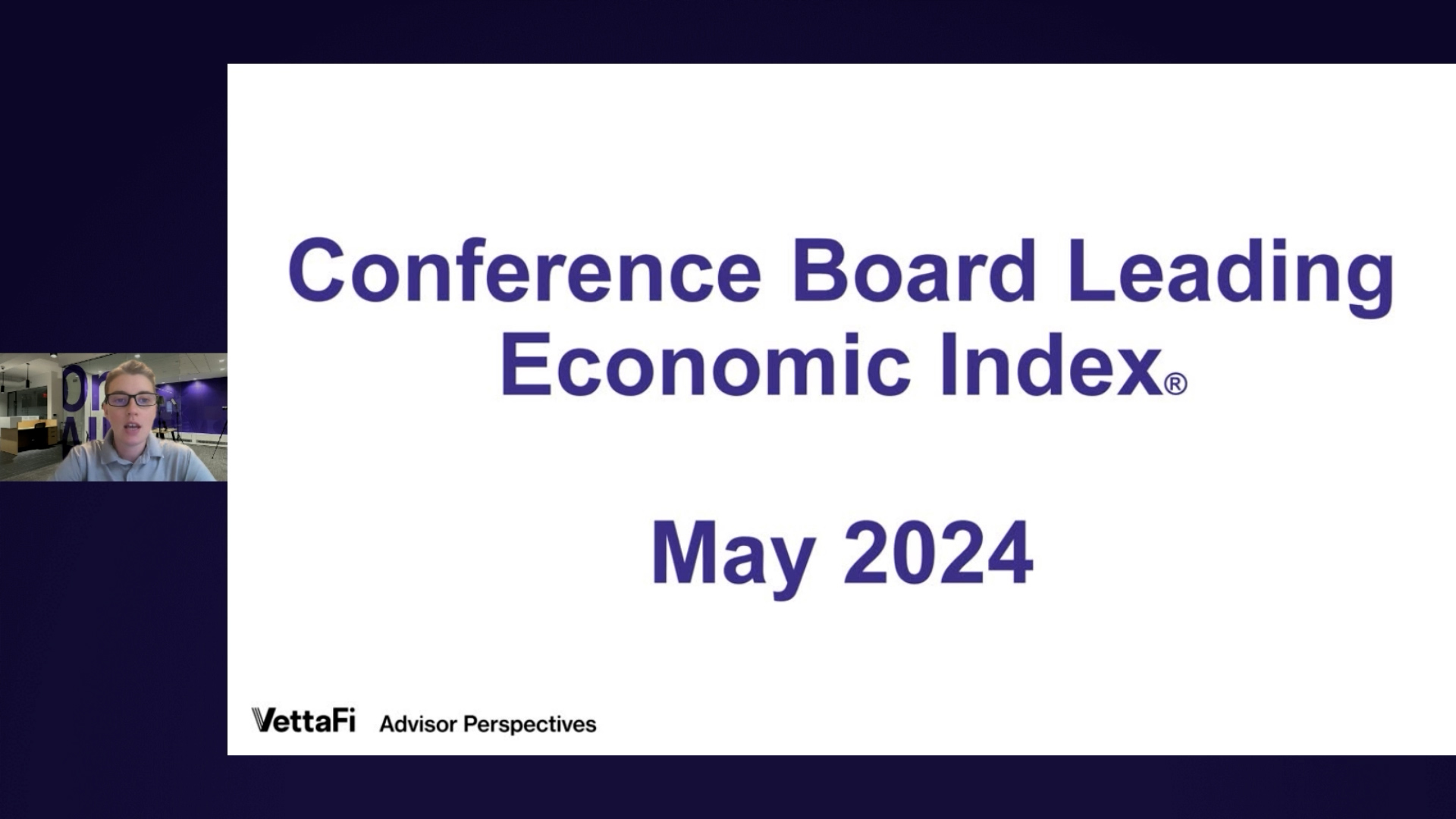
The latest Conference Board Leading Economic Index (LEI) decreased in May to its lowest level since April 2020. The index fell 0.5% from the previous month to 101.2. While the index does signal softer economic conditions lay ahead, the LEI is currently not signaling a recession.
A rising number of U.S. taxpayers are subject to an investment income surtax, introduced a decade ago in federal legislation. Here are some strategies that may help mitigate the impact of the tax.
After being on the frontline of the pandemic, then grappling with an edgy public and a spike in shoplifting, its been a tough few years to work retail. But for Walmart Inc. managers, at least, things are looking up.
First-generation low carbon equity benchmark indices were developed almost a decade ago with the goals of mitigating climate risk and preparing for the transition to a low carbon economy.
Nadeem Meghji was on honeymoon in late 2022 when the biggest storm to have rocked Blackstone Inc.’s property business hit its peak.
The health of the British economy is top of mind for voters in this election.
The Tax Cuts and Jobs Act of 2017 (TCJA) is expected to sunset at the end of next year and there is likely to be a lot of chatter about what the potential changes in tax laws could mean for U.S. taxpayers.
It could be an opportune time to take advantage of core bond exposure now before a potential rally despite latest Fed-speak.
The Federal Reserve policy can set the tone that drives interest rates across the maturity range but an earlier market rate downturn can occur as a signal of investor perception of a slowdown in the economy.
Recently, James Grant, editor of the Interest Rate Observer, was asked about his outlook for interest rates. He sees interest rates moving in a cyclical pattern, potentially rising for another multi-decade period.
GMO has published a new 7-Year Asset Class Forecast.
Morgan Stanley is increasing its investments in Latin America as geopolitical conflicts elsewhere in the world give the region increasing prominence in the global economy.
US Treasuries are on the brink of breaking even during a roller-coaster first half of the year.