Lower interest rates in Europe will favor spending over saving.
In a room filled with more than 800 sugar traders, Sally Lyons Wyatt, an executive at consumer researcher Circana, had an important message to deliver: Ozempic is coming for your industry.
I’m fresh off the plane from Las Vegas—and no, I wasn’t hitting the slots, though the city’s Harry Reid International Airport sure hit the jackpot with a record-breaking 57.6 million passengers last year.
There is no question that Fed policy remains the primary force driving the money and bond markets for the third year in a row.
JPMorgan Chase & Co. is on the hunt to buy a private credit firm to augment its $3.6 trillion asset management arm, as the biggest US bank makes more inroads into Wall Street’s buzziest sector.
One of the best parts of being a young college graduate, and naïve to the grim realities of the working world, is being deluded about how great your career will be. Maybe you’ll found the next Nvidia, or win the Nobel Prize in your field, or start a charity that will make the world a better place.
Franklin Templeton Fixed Income CIO Sonal Desai discusses why rising investment and persistently loose US fiscal policy are simultaneously pushing in the direction of higher long-term real interest rates.
Andy Acker and Research Analyst Tim McCarty discuss how artificial intelligence has enormous potential to improve healthcare delivery across the globe and point to some practical applications that could benefit patients – and investors – in the near term.
The Northern Trust Economics team shares its outlook for growth, employment, inflation and interest rates in major markets.
Strong Q1 earnings were a bright spot as sticky inflation and dimmed expectations for rate cuts cast some shade on U.S. equity markets. Fundamental Equities investor Carrie King looks beyond the headlines to offer four takeaways from the most recent earnings season.
The good news is that President Javier Milei seems to be backing away from plans to dollarize the Argentine economy. That is also the bad news.
These are only some of the exciting new applications on everyone’s lips at business gatherings these days, where the conversation often veers to artificial intelligence, which has become the latest “new new thing.”
The two largest emerging markets have taken very different paths, echoing the divergence in the economic and demographic landscape for these two countries.
The promise of independence is luring more and more advisors to the Registered Investment Advisor (RIA) channel. RIA headcount has grown rapidly over the past decade and by 2027, Cerulli estimates that RIAs will control nearly one-third of intermediary asset market share.
A surprisingly strong earnings season for big tech reaches its grand finale Wednesday afternoon when Nvidia Corp., the artificial intelligence chipmaking giant, reports its results and gives a much anticipated outlook that could set the tone for the second half of the year.
As goes the consumer, so goes the U.S. economy. As Wall Street knows, the importance of the consumer cannot be overstated. That’s because consumer spending is the main engine of growth, representing ~70% of US economic activity – nearly 10% more of the economy than it did in the early 1980s.
Nvidia faces tough competition, law of large numbers as it prepares to report Wednesday.
On the latest edition of Market Week in Review, Director of Investment Strategies, Shailesh Kshatriya, and ESG and Active Ownership Analyst Zoe Warganz discussed the U.S. inflation and retail sales reports from April, as well as the market’s reaction. They also chatted about the improving economic outlook in Europe.
ETF industry veteran Dave Nadig covers a range of topics including crypto ETFs, the multi share class fund structure, Fidelity’s “pay-to-play” scheme, Vanguard’s new CEO, meme stock ETFs, and the biggest threat facing American capitalism. VettaFi’s Kirsten Chang also offers perspective on Vanguard’s new CEO and dives into international equity ETF flows.
In this short video, I outline key actions and attitudes for advisor success on LinkedIn, then apply those lessons to one advisor’s profile.
Few advisors are prepared for the massive change coming to the advisory profession. It will not be a slow rollout over decades. In three to five years (if not sooner), how advisors do business will fundamentally change.
Idanna Appio spent 15 years at the Federal Reserve Bank of New York analysing the history of sovereign debt crises. Now, as a fund manager at the $138 billion First Eagle Investments, she’s reached a conclusion: US Treasury bonds are too risky to hold.
Inflation data has continued to fuel uncertainty about when the Federal Reserve will begin to cut interest rates. It's a question with global implications.
Geography, it’s often said, is destiny. The paths nations follow though history are written like a script on the patterns of their rocks, rivers, plains and coasts, in ways that often confound the views of the people who inhabit them. It’s rare for a country to escape that geological fate.
On Tuesday, the Biden administration announced significant tariff increases on China, targeting roughly $18 billion in strategic industries, with a sharp focus on electric vehicles (EVs). These tariffs, which quadruple to 100% on Chinese-made EVs, are designed to counter China’s unfair trade practices and overcapacity while boosting U.S. industries.
Everyone is worried about the excessively high level of US government debt. Everyone, that is, except America’s creditors.
The rise of electronic trading and growing popularity of portfolio trading has had an unintended consequence for the US corporate bond market: making private credit even more attractive.
There was white smoke over the Bureau of Labor Statistics, sort of, on Wednesday morning. The key measures of consumer price inflation for April confirmed expectations for a slight decline, and alleviated growing anxiety over a possible reacceleration. Risk assets across the world spent the rest of the day exhaling deeply.
Anticipation is one of those mental states that can result in either relief, or disappointment. We may anticipate the results of a test, for example, and feel relieved if the results are good, or disappointed if they are not.
For families saving for college, 529 plans remain popular. Our Bill Cass shares some key facts about 529 plans.
Despite the availability of advance directives, many patients still receive aggressive, life-sustaining interventions that may not align with their preferences or improve their quality of life.
The U.S. repurchase agreement, or “repo” market, provides more than $3 trillion in short-term funding each day. Most repo transactions are overnight and are collateralized by Treasuries.
Federal Reserve Chair Jerome Powell said the US central bank needs to be patient as it awaits more evidence that high interest rates are curbing inflation, doubling-down on the need to keep borrowing costs elevated.
Markets seem to have been basking in the spring sun as they wait for the approaching summer heat, so to speak.
In this issue of Sinology, Andy Rothman offers his perspective on two key questions.
The biggest US tech stocks are not only a bet on innovation but also a possible hedge against inflation, according to some respondents in the latest Bloomberg Markets Live Pulse survey.
Faced with the greatest challenge of the 21st century, America is giving up.
Here we go again. Brace for the latest dose of critical data on US inflation over the next three days, as the New York Federal Reserve publishes its monthly survey of consumers’ inflation expectations Monday, followed by the Labor Department’s report on producer prices Tuesday and consumer prices Wednesday.
Any way you care to measure it, the United States has the world’s largest economy. It is not, however, the fastest-growing economy. And growth rates matter because, other things being equal, a faster-growing economy might eventually challenge US leadership.
As an advocate of sound fiscal policy and a strong believer in the power of free markets, I find Argentina’s recent economic overhaul under President Javier Milei not just refreshing but essential in today’s world of bloated government spending.
As long as ETFs stay true to their original mindset of solving investor problems, growth is the only path forward. Current product development suggests that’s the most likely case.
As institutional investors, we most often represent risk as standard deviation or tracking error. But when we implement changes in our portfolios, the real-time risk happens much faster.
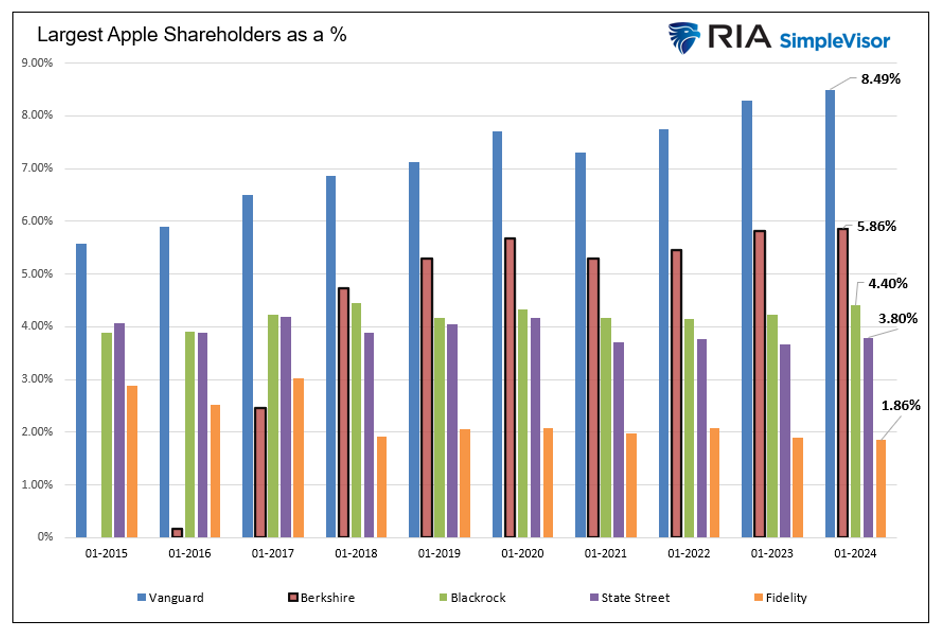
On the heels of Apple’s latest earnings report, the Wall Street Journal published an article titled “Apple is Buffett’s Best Investment,” which discusses how Apple became an oversized investment of Warren Buffett’s company, Berkshire Hathaway.
Life is full of surprises. If you don’t have a crystal ball, you can’t really predict what may come next in your life—or in the markets. That’s why we should always be prepared for any potential situation.
Over the last five years, financial markets grappled with two generational upheavals—the Covid pandemic and the subsequent inflation surge post the Russia-Ukraine conflict.
The tendency of high earners to spend their money rather than looking to build up their net worth is known as the wealth paradox.
As the market for initial public offerings bounces back after two lifeless years, investors who’ve been impatiently waiting for their payoff are finally getting some returns.
Investors often forget that nothing in the financial markets is permanent. Regardless of the hype or castigation, what’s hot eventually becomes cold and what’s cold eventually becomes hot. While we remain very skeptical of today’s market’s heroes, we think the range of investment opportunities is historically broad, historically attractive, and a once-in-a-generation opportunity.
Shifting dynamics among global economies and markets present a range of opportunities for multi-asset portfolios.