With COVID-19 cases rising and policy support fading, the recovery faces many risks.
We continue to experience an unprecedented market environment. We were able to again outperform in the third quarter, aided by the significant repositioning we had done in portfolios amidst the sell-off in March. However, we are wary of the risks to the market rally, including elevated valuation multiples...
Can bonds continue to play defense and provide income when yields are at historic lows? We think so.
The US inflation rate has hovered around 1.5% over the last decade, well below the Fed’s target rate of 2% most of the time. Such low inflation for such an extended stretch is quite unusual given historical economic relationships, especially with the economy strong and the unemployment rate near historic lows late last year and earlier this year before the pandemic hit.
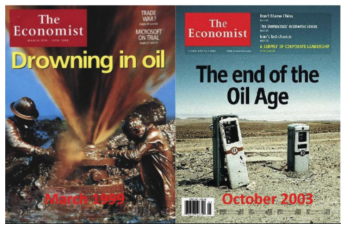
We became extremely bearish on energy in 2011. At the time, we saw interest in Seattle for hybrid and electric cars. This convinced us that 10% of the cars on the road nationwide might be hybrid and electric by 2020.
It's a new cycle for the economy, but some asset classes look decidedly late cycle in terms of valuation. What might this mean for markets through the remainder of the year?
The first of three presidential debates is set for the evening of September 29. The topics, chosen by the Chris Wallace, the moderator, will be the Trump and Biden records, the Supreme Court, COVID-19, the economy, racial tensions, and election integrity.
We have a huge economic calendar and the first of three scheduled Presidential debates. The employment report will be the last one before the election, so I expect it to get special attention. Most of the other important economic data will also be reported during the week.
A vote for stocks. After solid summer gains came September volatility. The question now is what’s priced into markets as investors zero in on COVID-19 developments and the November election.
Over the last several months, we have discussed the remarkable underperformance of value versus growth. While many investors quickly dismiss the performance gap under the guise of “this time is different,” it has important longer-term implications. In today’s missive, we want to discuss value, the margin of safety, and the real art of “doing nothing.”
A brief monthly update on what's happening in the municipal bond market.
Markets have been walking a fine line, with a still-struggling economy on one side and hopes for a COVID-19 vaccine breakthrough on the other. Heading into the fourth quarter, there are both encouraging signs and cause for caution.
Chief Economist Scott Brown discusses current economic conditions.
In a challenging year dominated by the COVID-19 pandemic, the municipal market is recovering on the strength of unprecedented federal support.
One of our favorite natural resource companies, Ivanhoe has returned more than 146 percent in the past six months alone as investors anticipate the start of production at the Kakula Mine, which has the potential to become the world’s second-largest copper mining complex, with annual output projected to be 800,000 metric tonnes a year.
The U.S. stock market hit pause in early September, as investors took a harder look at market overconcentration and frothy sentiment. Meanwhile, global economies may be entering a new phase, and the Federal Reserve’s newly announced inflation policy is likely to keep U.S. rates lower for longer.
The Northern Trust Economics team forecasts the U.S. economy’s recovery from COVID-19.
After a wicked stock market decline into late March and impressive 60% advance off the low, it seems a stretch to expect still higher equity prices. However, a major extension to the post March rally is definitely supported by the five reliable long-term indicators featured in this research note. Their current position is far more consistent with a major long-term buying opportunity than a selling one.
The Fed’s strategic review added to a bevy of policy research revealed last week.
Supply is getting tight. Helium is notoriously difficult and expensive to store, for the very good reason that it escapes every known container over time.
There are technical distinctions between investing versus speculating. Nevertheless, both concepts are often thought about or utilized interchangeably. Moreover, there are nuanced distinctions between a rational or well-thought-out speculation versus outright gambling.
The Kansas City Fed’s annual Monetary Policy Symposium at Jackson Hole is a signature event for those of us who follow central banks. The conference typically doesn’t generate much front-page news: the subject matter is usually more technical and conceptual than a broad audience would appreciate. But 2020 is not a typical year.
Bond investors face a challenging environment. The federal funds rate is back near zero, the 10-year Treasury yield remains stuck in a 0.5%-to-0.75% range, and inflation-adjusted (real) yields are deep in negative territory.
The number of Americans filing for initial jobless claims this week spiked above 1 million, while the number of deaths attributed to COVID-19 remains above 1,000 a day. But there was much else to celebrate.
I realized that it’s been so long since I started my NewsLetter, most of you won’t know its origins. To bring you up to date, here’s the intro to the first one.
There are numerous factors which can cause the price of gold to rise significantly, but I don’t believe inflation fears are the main driver behind gold’s recent surge. I believe it has much more to do with uncertainty and fears surrounding the COVID-19 pandemic. But I’m getting ahead of myself.
We have a light economic calendar with a sharp focus on housing data. Earnings season has ended, and Congress is out of town. There is plenty of space for journalists to fill in a quiet, mid-summer week. Perhaps the housing data will fill some of that space.
Our Head of Equities Stephen Dover explains why he thinks possible changes to the US political landscape could lead to further bouts of market volatility.
The price of gold had its first down week since early June, ending a spectacular nine-week rally. The yellow metal briefly fell below $1,900 an ounce on Wednesday as stocks neared their all-time closing high and the 10-year Treasury yield jumped on record supply.
Although certain high-frequency data haven’t improved markedly, the threat of the virus has started to recede.
Some emerging markets have been coping with the COVID-19 crisis better than others, and their economies are in different stages of recovery. Our emerging markets equity team highlights a few—and offers thoughts on why the pandemic has accelerated some existing fundamental and technological trends.
For the week, airlines stocks increased 9 percent, its best weekly performance since early June. Wheels up!
Several months into the Covid-19 era, Howard Marks takes a step back to consider the global health crisis, the economic fallout and the U.S.’s response to date. He also shines light on how one might – or might not – view the current circumstances in the framework of a market cycle.
The U.S. dollar has fallen by about 7% against a broad basket of currencies since its mid-March peak. After a nearly decade-long bull market that saw it appreciate by more than 40%, we believe the dollar could be headed for a longer-term decline.
The Commerce Department will release its first estimate of second quarter Gross Domestic Product on Thursday of this week, and it is widely expected to be really bad due to the economic lockdown earlier this year. Most forecasters expect 2Q GDP to be down 30-50%, making it the worst quarterly downturn since the Great Depression.
Our Fixed Income CIO Sonal Desai unveils the first insights from the new Franklin Templeton–Gallup research project on the behavioral response to the COVID-19 pandemic and implications for the recovery.
When you are in a financial euphoria episode, like the one we are in currently, it is hard to visualize the impact it has when it breaks. Historically, it is the leading cause of stock market failure. We thought it would be helpful to discuss the secondary impact of the euphoria on common stocks.
Over the weekend the world learned of the Senate Republican’s “opening bid” for the next round of fiscal stimulus in the United States. That number came in at a nice, round $1tn. Now, as large as that number is, it still pales in comparison to the $3.5tn House bill that already passed.
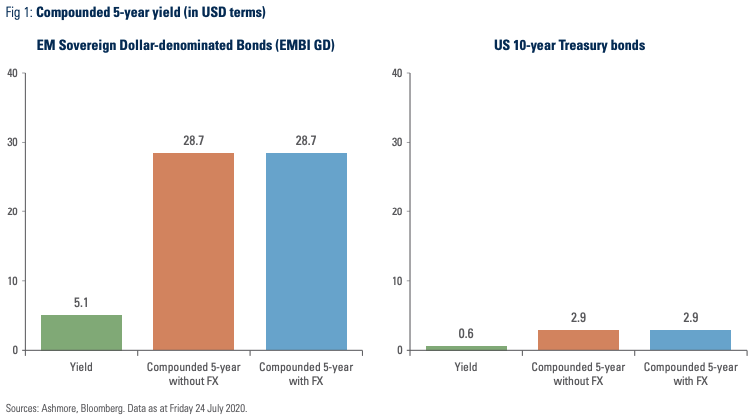
Does 9 times higher yield in EM than in US bonds make for an attractive investment proposition? We lay out the arguments.
We all know that past performance is no guarantee of future results, but you can see in the chart below that the white metal could possibly be setting up for another epic run-up. At this stage of the bull market, silver’s current price appreciation is ahead of any previous rally.
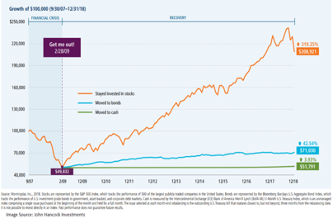
In March, at the height of panic selling, investors pulled $326 billion from mutual funds and ETFs. Although it ended more than decade ago, the global financial crisis was the last real bear market.
Markets thus far in 2020 have been, to use an overused word, unprecedented. In a matter of months, we have witnessed economic and market moves that typically take an entire market cycle of many years to unfold. So, we truly do see 2020 as a year when investors are gaining “dog years” of experience.
The economic calendar is light with a focus on home sales. Unemployment claims data remains an especially important indicator. Second quarter earnings reports will be more important than the economic data, but I do not expect much fresh information on COVID-19 and earnings outlook.
Value (investing) is dead. Long live value investing. Such certainly seems to be the mantra as investors continue to pile into growth stocks while rationalizing valuations using methodologies which historically have not worked well.
The value of this year’s annual hedge fund performance survey was turned on its head when a pandemic shut down the global economy and sent securities plummeting. But a deeper look at consistently performing funds revealed managers that as a group have largely been able to weather the storm better than the market and their peers.
The economic calendar was thin. Investors remained concerned about rising cases of COVID-19. A return to a full lockdown appears unlikely, but the pace of improvement in the economy is expected to slow.
When looking at the acceleration in the price of the Nasdaq, and particularly within the small group of stocks driving that advance, you can begin to fathom our concerns. Furthermore, the divergence between the Nasdaq and the S&P 500 index is emulating the late 90’s.
Precious metals were the big winners for the first six months of 2020. Spot gold took the first place position, rising over 17 percent, followed in second place by silver, up nearly 2 percent. Palladium rounded out the top three, essentially flat at negative 10 basis points.
The first half of 2020 was dominated by the COVID-19 pandemic, which hit the municipal bond market hard. State and local governments experienced a sharp and sudden drop in revenue, and an increase in expenses, amid stay-at-home orders and business shutdowns.
In a new white paper, the GMO Emerging Markets Equity Team argues that Emerging Markets in aggregate are more resilient today than in prior periods, an important consideration as investors evaluate the rebound the asset class has experienced since late March.