In part two of this series, I review three additional robos: Albert, Ellevest, and Stash.
The Delta variant’s impact on supply chains and domestic spending slowed economic activity in the third quarter. Consumer confidence dipped noticeably, and businesses’ outlook dimmed somewhat. Rising inflation, the product of goods and labor shortages, has been a concern.
There was another “disappointing” gain in nonfarm payrolls in September (up 194,000, vs. a median forecast of +500,000), but it’s not as bad as it looks. Less hiring at the start of the school year resulted in a decline in (adjusted) education jobs.
We do not expect widespread contagion across China’s real estate or banking sectors despite the challenging outlook.
Gold’s average daily trading volume for the one-year period was $183 billion, compared to the S&P 500 with nearly $235 billion. That dollar amount is enough to beat currency swaps as well as all government and corporate debt.
A three-party coalition could soon govern Germany for the first time in the country’s history following recent elections. Matthias Hoppe, senior vice president and portfolio manager, Franklin Templeton Investment Solutions, believes uncertainty caused by coalition talks is likely to increase volatility in Europe’s financial markets, but changing a conservative attitude to public spending is the real challenge for a new government as Germany wrestles with the reality of increasing macro-economic imbalances and a stated aim to achieve carbon neutrality by 2045.
Against the backdrop of a potential Evergrande failure, gold and Bitcoin look very attractive as stores of value, and both happen to be on sale right now.
Today, I want to show you how richly valued the market is and then review some of the top risks that could force it downward. Like those sandpiles I talk about, we don’t know exactly what will trigger a collapse. We know something will do it. Sandpiles don’t grow to infinity.
Using a risk tolerance questionnaire to establish a retirement income strategy is akin to your doctor checking your pulse to measure your cholesterol. There is nothing wrong with checking your pulse, but it is an inappropriate test for the situation. We propose an alternative test – the RISA – to select the best deaccumulation approach.
It’s becoming more and more difficult to be in the fossil fuel business. On both sides of the Atlantic, lawmakers and unelected bureaucrats are turning up the heat, so to speak, on companies over the issue of climate change.
The Northern Trust Economics team shares its outlook for the U.S. economy.
Over the past 70 years, rising government debt generally has been accompanied by weaker economic activity. But it’s not a simple relationship.
Several policy-related risks loom in September and October that may lead to an increase in market volatility. The debt ceiling needs to be raised (likely by mid-October), the government needs to be funded to avoid a shutdown by the end of September...
There are several “paradigm shifts” impacting markets today, according to Templeton Global Macro CIO Michael Hasenstab. He outlines how central banks might approach tapering of pandemic-driven asset purchases, and the potential investment risks and opportunities he sees.
It’s unfortunate but true: Influential Republican politicians are playing another round of political chicken that could easily lead to a damaging brush with default on the national debt.
So much of life is managing risk. That’s true on a micro, personal-level scale as well as a macro, country-level scale. Crises often can’t be prevented. It’s how you deal with them that makes all the difference.
The next time you apply for a job, how would you feel if the person doing the interview asked to see your Uber rating?
The 10-year Treasury yield finished 2020 at 0.917% and then climbed to 1.765% before topping on March 30. The 30-year Treasury yield rose to 2.505% on March 18 after ending 2020 at 1.646%. In the January 11 Weekly Technical Review (WTR) I noted that Treasury yields had broken out to the upside and that the 10-year Treasury yield would likely climb to 1.75% to 1.95% in 2021. “Treasury yields broke out on January 6 as expectations of more fiscal stimulus and technical selling kicked into gear. At some point in 2021, the 10-year Treasury yield could spike up to 1.75% to 1.95%.”
Each year, the Social Security Board of Trustees releases a report which analyzes the current and projected financial health of Social Security and Medicare. We should all care about what the annual reports say because these programs provide essential benefits for seniors. The latest and previous reports have issued dire warnings of coming benefit shortfalls.
As the Fed started to talk about “taper,” the “bulls” sent a stern warning with a 2% “crash” they shouldn’t. After a couple of weeks of several Fed speakers discussing the need to reduce monetary accommodation, a quick sell-off brought had Powell singing a “dovish” tone at the recent Jackson Hole summit.
Business travel as we’ve known it is a thing of the past.
"Getting older is fine. There is nothing you can do to stop it so you might as well stay on the bus." John Byrne
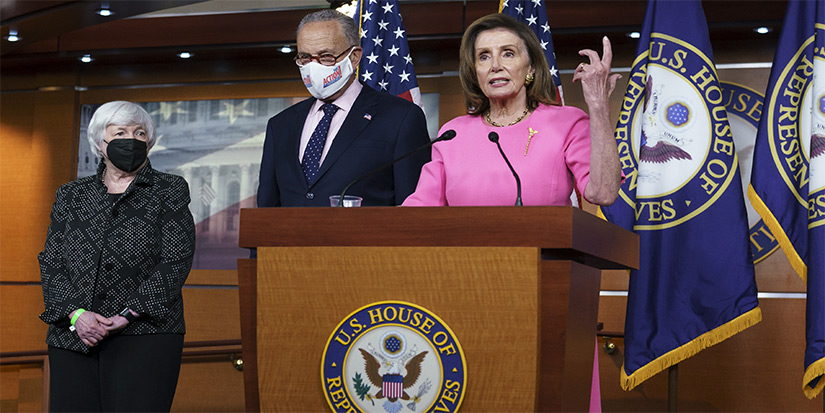
A busy summer on the fiscal front in Washington that’s seen progress on budget and infrastructure legislation could soon give way to another showdown over the U.S. statutory debt ceiling, potentially signaling volatility for investors in the months ahead.
Inflation remained in check following the global financial crisis for over a decade despite a massive expansion of the Fed’s balance sheet.
The country sits atop what could be one of the world’s largest reserves of various metals and minerals, including not just gold but also platinum, silver, copper, iron, aluminum and uranium. It’s believed to have so much lithium, an increasingly important metal that’s widely used in battery technology, that Afghanistan could one day be known as the “Saudi Arabia of lithium,” according to a 2010 memo by the U.S. Department of Defense.
For the third year in a row, the top 50 hedge fund managers, relying on a variety of strategies, generated net returns comparable to the S&P 500 with significantly less risk and performance that was largely independent of the market. Hedged equity, multistrategy, and global macro funds led the way with more than half the funds in the top 50 managing less than $1 billion.
So many headlines right now are instilling FUD in investors’ minds, which stands for Fear, Uncertainty and Doubt—from the Afghanistan news to fears on cryptocurrency and the delta variant disrupting travel plans. But don’t fall for it.
In a recent post I opined how the stock markets internals are weakening, whilst also briefly touching on how a couple of leading economic growth indicators are beginning to roll over.
“Past Performance Is no guarantee of future of results.” Such is the disclaimer below every performance chart produce by the financial marketplace.
You may not be familiar with the term metaverse, but if you’ve been a consumer of popular books, movies and video games over the past 30 years or so, you probably are aware of the concept.
Howard Marks doesn’t make bets on economic predictions. That’s especially true now when the biggest wildcard is inflation – a phenomenon no one fully understands. But just because something is unknowable doesn’t mean it’s unimportant. That’s why Howard has devoted his latest memo to a topic he largely disavows: macro forecasting.
What is the degree of Emerging Markets (EM) stocks’ undervaluation relative to United States (US) equities?
We will touch on several topics as we go along today, beginning with the economy.
I provide guidance on the “equity-like” risk of buffer and floor strategies when included in a diversified portfolio, assuming an S&P 500 underlying index.
Tweedy Browne is one of the most respected value managers in the world, with a legacy that includes having Benjamin Graham and Warren Buffett as clients. In this interview, members of its investment committee explain why value investing is on the cusp of a resurgence.
The imminent return of the U.S. debt ceiling is causing angst for money-market traders once again.
The title of this comment may seem odd, given that – as I write this on July 14, 2021 – the S&P 500 is at a record high.
“I continue to believe that the American people have a love-hate relationship with inflation. They hate inflation but love everything that causes it.”
Be forewarned – we are going to empty the quote bin this quarter.
Many investors with exposure to the Chinese renminbi (RMB), having enjoyed a strong rally in the second quarter, are worried that policy uncertainties could hurt the currency’s short-term outlook.
Bond yields are sending an economic warning as this past week 10-year Treasury yields dropped back to 1.3%.
Our Chief Market Strategist Stephen Dover explores blockchain and digital assets through an equity-investor lens with Anthony Hardy and Christophe Vande Walle.
The pristine surface of a lake on a perfectly calm and sunny day is easy on the eyes. Yet it usually offers no insight as to what lies beneath.
“Warnings From Behind The Curtain” almost sounds like the title of a good “Cold War” fiction novel.
This article is about an exception to a rule – an exception that, I believe, has ceased to be. And so the rule has become stronger, and there is a little less joy in the investing world.
There may be many reasons why people spread misinformation about Bitcoin. Much of the misinformation may originate from Ripple, which is currently under investigation by the Securities and Exchange Commission (SEC). The fintech firm is believed to employ a great number of bots on Twitter and other social media platforms with the intent of tearing Bitcoin down in favor of its own XRP coin.
Most of Latin America is still far from the horrific conditions prevailing in Venezuela, where output has fallen by a staggering 75% since 2013.
There is always a lot of controversy around the implications of high and rising government debt. Over the past 70 years, rising government debt has generally been accompanied by weaker economic activity.
The Fed meeting last week led to higher asset price volatility across asset classes.
Senate Budget Committee Chairman Bernie Sanders is proposing to partially revive the federal deduction for state and local taxes in an draft outline of a budget resolution designed to fast-track much of President Joe Biden’s economic agenda.