Passive equity portfolios continue to gain popularity, but some investors might not know that a small group of outperforming stocks have driven most of the gains in recent years.
In a complete reversal from what was expected roughly a year ago, the outlook for muni issuers is much brighter.
Investors following an ESG mandate can achieve their goals only if they can accurately and consistently identify stocks that meet their criteria. But new research shows that those criteria have been subject to arbitrary revisions and that there are wide discrepancies among the vendors providing the data.
I don’t question Elon Musk’s good intentions, but I respectfully disagree with the underlying insinuation that crypto miners in particular are a threat to the climate. It’s just not true, for reasons I explain below.
This week’s fund-raising round for online brokerage Wealthsimple Inc. shows how Power Corp. of Canada’s fintech investments will pay off for the financial conglomerate, IGM Financial Inc. Chief Executive Officer James O’Sullivan says.
It is a particularly good time to invest in the commodities markets.
A host of impediments stand in the way of allocating funds to annuities. Some issues relate to brokers or advisors, and others involve their clients. Some are valid, but others are questionable and reflect irrational behavioral biases.
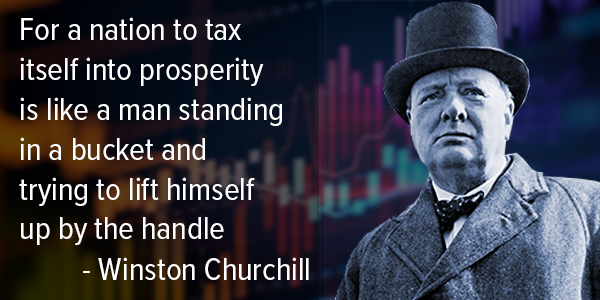
One of my all-time favorite quotes comes from Winston Churchill, who was just as witty as he was a great leader: “We contend that for a nation to try to tax itself into prosperity is like a man standing in a bucket and trying to lift himself up by the handle.”
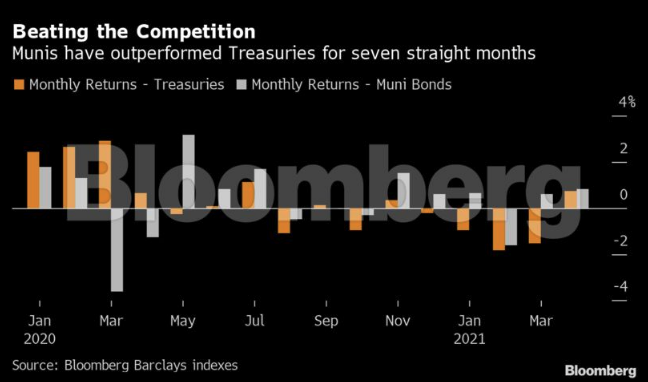
America’s municipal bonds are staging their longest winning streak against Treasuries in seven years.
Climate research informs us that in 2017 anthropogenic global warming reached1.0° C above pre-industrial levels (IPCC, 2018).
This “fat, juicy pitch down the middle” stock-picking opportunity could stretch many months into the future. Professional managers and investors should embrace this opportunity for as long as it lasts.
In less than four months, investors have already poured more cash into ETFs tracking U.S. stocks than they did in all of 2020.
The exchange-traded fund revolution sweeping through U.S. money management is eliciting little more than a shrug from a European cohort arguably next in line for disruption.
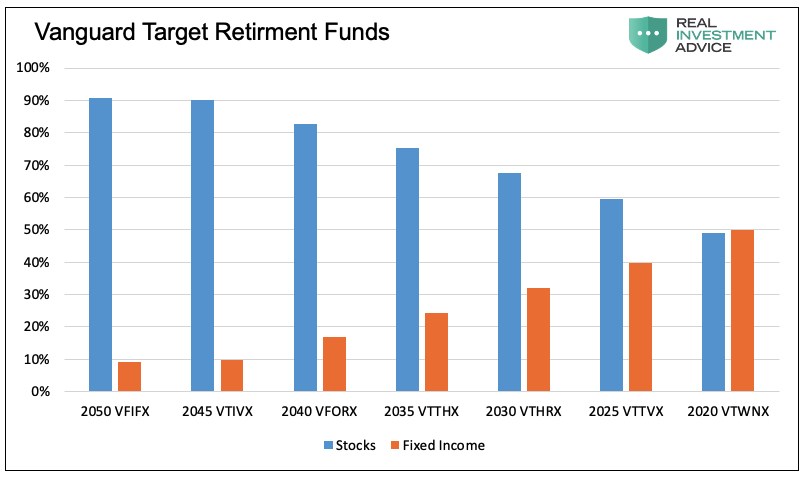
For those who elect to take passive strategies, like TDFs, assess your risk profile and that of the markets and invest accordingly.
A flexible bond strategy can deliver strong performance with low volatility by diversifying across global markets.
From 1949 through 1964, the S&P 500 enjoyed an average annual total return of 16.4%. In the 8 years that followed, through 1972, the total return of the index averaged a substantially lower 7.6% annually; strikingly close to the 7.5% projection that Graham had suggested based on prevailing valuations, yet still providing what Graham had suggested would likely “carry a fair degree of protection” against inflation, which averaged 3.9% over that period.
Yes, the housing market is a bit overheated, but for reasons that make far more sense than the rationalizations of stock market bulls. Some buyers are certainly overpaying and may regret it. Nonetheless, I don’t foresee another 2008-style housing crash in the near future, nor anything like the subprime crisis. There are altogether different fundamentals working here.
Green funds have gained a reputation of benefiting from the tech rally during the pandemic. As the economy recovers and investors shift to cheaper stocks, those products might still be able to thrive.
In retail investing, do the “blind lead the blind?” Such was a question I asked recently about young investors who are “Long Confidence And Short Experience.”
My generation, millennials (those born from 1980 to 2000), have been noted for much of the last 10 years to be a risk averse group.
I recently discussed why “Free, Isn’t Really Free” regarding the retail investor. While “free trades” have certainly reduced the transaction costs, the selling of data to the highest bidder has likely cost investors more than they saved.
Someone must pay for rampant federal spending.
Data has shown that investment strategies that address ESG issues constitute a third of professionally managed U.S. assets. That has led some to claim that asset prices have been driven up to the point where investors should expect poor performance going forward. That narrative is false.
Is it time to give newer or smaller exchange-traded funds (ETFs) a look?
During these challenging times, growing a financial advisory firm is a study in the fundamentals: understanding your clients and building relationships.
Wall Street thought 2020 was the Year of the SPAC, or special purpose acquisition company (SPAC).
As the COVID-19 pandemic wears on, women investors are more concerned about their finances and feel less prepared than they’ve been in years. Nearly three in four women with investable assets of $100,000 or more said the pandemic has negatively impacted their ability to retire. Ann Bair and Lori Hall present the findings from Nationwide’s sixth annual Advisor Authority study, powered by the Nationwide Retirement Institute®, reflecting the responses of more than 2,500 individual investors, advisors and financial professionals.
Wall Street thought 2020 was the Year of the SPAC, or special purpose acquisition company (SPAC). Turns out, this title was premature.
One year ago this month, our world changed in some pretty dramatic ways.
The word “bubble” is tossed around quite a bit in the financial markets, but it’s rarely used correctly.
There are many ways to go wrong in choosing a TAMP. Here are two no one is talking about.
Covered call strategies can help investors manage short-term volatility and may provide better long-term outcomes while seeking to provide attractive monthly income to investors.
As the latest COVID-19 relief bill winds through the U.S. Congress, some economists have been warning that too much stimulus could lead to the economy overheating
“Bull markets are born on pessimism, grow on skepticism, mature on optimism and die on euphoria.” -Investor and mutual fund manager Sir John Templeton
Treasury yields rocketed higher in February, with the move again concentrated in longer maturities. Volatility spiked as liquidity dried up in the Treasury market, especially after a very weak 7-year auction that briefly pushed 10-year Treasury yields to 1.60%. The news flow was largely the same direction: an improving economy, increased vaccine rollout with deaths and hospitalizations turning sharply lower, and a continued march toward a substantial fiscal stimulus plan.
What’s a “zombie company”? You may have heard the term in the financial media recently and wondered if it’s something you should be worried about.
Gold hasn’t been getting much love from investors lately due to rising bond yields, and bullion-backed gold mutual funds and ETFs have seen significant outflows so far this year through the end of February.
Our Fixed Income CIO Sonal Desai has been ahead of the curve in flagging the risks of inflation and rising rates that have now entered the mainstream debate.
With very low inflation expectations for this year, Rich analyzes the shifts in the global and US economies that could impact inflation and explains how to position your portfolio for this change.
A small mutual-fund provider is slated to make history later this month as the first to convert its products into exchange-traded funds.
What normalcy will it be? I don’t expect to simply go back to the way things were. The economy as it was structured in December 2019 is gone forever. The world is different now. The economy will be different, too.
Turmoil in mega-caps like Apple Inc. is stirring investor anxiety. But for professional stock pickers, it’s mostly good news when the market’s biggest companies loosen their grip.
It’s tempting these days for some investors to question the role of fixed income in portfolios. After all, real yields have plunged, potentially leading to less income today and smaller capital gains tomorrow.
Quantitative investment firm Dimensional Fund Advisors is already making waves in the $5.9 trillion exchange-traded fund market.
On October 2, 2019 brokerage firm Charles Schwab announced they were no longer going to charge commissions on stock and ETF trades. Before the day closed E-Trade and TD Ameritrade followed suit. And just like that, commissions were dead.
This is a new type of exchange-traded ETF that is built differently from a traditional ETF.
I don’t say this often, but Fed Chairman Jerome Powell is wrong. Regular readers of our investor letters and other publications will recall that we regularly cite Chairman Powell as doing the best he can with the levers he has while arguing correctly for others to do their part.
When companies take positive ESG steps, they attract asset flows from fund managers, according to new research. But the price spikes from those flows may not result in outperformance for long-term investors.
2021 has certainly started off interesting. From Reddit readers chasing the most heavily shorted stocks, to the new Administration discussing more stimulus, investors have had plenty to deal with. A market review seems appropriate as the bulls seem to remain bulletproof even as the mania grows.
Treasury yields continued to march higher in January, with the move again concentrated in longer maturities. Mortgage spreads tightened slightly, while corporate bond spreads were mostly mixed. The market remains stuck between the push/pull of the prospect for greater fiscal stimulus and ongoing vaccine rollout versus continued lockdowns and the greatest one-month mortality rate since the pandemic began nearly a year ago.