After three decades of watching market cycles play out from both sides of the trade, I’ve come to a simple conclusion: Wall Street’s love of simple rules is one of the most dangerous aspects of investing.
Fast-tracking mega IPOs into major indexes and the case for active preferred ETFs were both on the agenda for this week’s ETF Prime. Host Nate Geraci welcomed Rich Lee, head of program trading and execution strategy at Baird, and Douglas Baker, portfolio manager and head of preferred securities at Nuveen.
Despite the move lower late last week, U.S. Treasury yields are still holding well above recent lows and close to highs not seen in more than a year. By contrast, risk assets are firmly bid: U.S. equities have been routinely touching new historical highs, and credit spreads over Treasuries remain tight.
Gold has dropped more than 11 percent from its all-time high of just over $5,102 an ounce in January, and selling pressure continues to dominate the market. A well-established mainstream narrative is driving the bearish sentiment.
Despite these higher costs, a projected 45 million Americans are expected to travel at least 50 miles from home this weekend, setting a new record. Close to 40 million will drive while some 3.7 million will fly.
You don’t have to go very far to find lots of negative commentary in the popular press about the current state of the US economy. High gas prices (due to a “war of choice”) are squeezing consumers’ budgets, and so the economy is headed for a ditch.
Yes, we have been there before, only to be disappointed. But the market smells a real settlement to open Hormuz, and WTI oil briefly dipped below 90 for the first time in weeks. If an opening occurs, expect the market to continue its march upward, as the momentum trade gathers strength.
Despite headwinds from rising oil prices, fundamentals have remained strong. The S&P 500 has notched 18 record highs year to date and, more importantly, surpassed our prior target of 7,250. Following a standout 1Q earnings season, we are raising our 2026 earnings per share (EPS) estimate to $326 from $300.
New AdvizorPro data shows RIAs broadened their ETF lineups in Q1 2026, leaning into real assets, active managers, and defense strategies.
As Kevin Warsh takes the helm at the Federal Reserve, bond investors are betting he’ll prioritize the central bank’s inflation-fighting credibility over President Donald Trump’s push for lower interest rates.
Last Friday closed with the 10-year Treasury yield at 4.60%, a one-year high, and the doom commentary about rising interest rates was waiting before the bell even rang. Hyperinflation. Bond market breakdown. Paradigm shift. A 1981 fair-value retest.
Private markets (private equity, private credit and real estate) have historically delivered an “illiquidity premium”. Institutions and family offices have recognized this illiquidity premium and have historically allocated significant capital to capture it.
In this video, Chuck Carnevale explains why he believes a diversified dividend-growth stock portfolio can be a better long-term strategy for retirees than the traditional 60/40 stock-and-bond allocation. Using a real-world portfolio he created in August 2021, Chuck demonstrates how an all-equity income portfolio can provide both rising income and capital appreciation while helping investors stay ahead of inflation.
After a slowdown earlier in the year, stronger April and May data support the view that weakness in January and February, followed by a rebound in March, was largely weather-related rather than the start of a broader deterioration in housing demand.
I have often written about one of the few indicators in economics that has earned its reputation over the years, and for good reason. It has preceded virtually every US recession since World War II. I’m talking about the inverted yield curve.
Now, that prospect feels much farther off. Indeed, as government debt grows and macroeconomic pressures and inflation reemerge, investors face a complicated rate environment. Dividends can provide a solution.
There is currently a stark contrast between everyday consumer confidence and financial market behavior. On one hand, persistent inflation and elevated living costs have driven consumer sentiment to historic lows. On the other hand, financial market participants are exhibiting aggressive risk appetite, with margin debt surging to an all-time high record on the heels of major equity market gains.
In this second quarter update, Western Asset believes global fixed-income markets face a more complex backdrop as geopolitics, rapid AI adoption and private credit scrutiny intersect.
By moving beyond benchmark constraints, active portfolios can access off-the-run bonds, specific securitized tranches, and maturity buckets with superior risk-reward profiles. They also have the flexibility to adjust positioning throughout the market cycle — reallocating across sectors, ratings, and issuers as conditions evolve to capture opportunities and mitigate drawdowns.
I still don’t think the Fed is close to a rate hike, but for the upcoming June FOMC meeting, a shift in the language of the policy statement from an easing bias to one of a ‘balanced’ outlook seems to be the most likely scenario. However, the fed funds futures market has now fully priced in a rate hike for March 2027, a remarkable shift from its pre-war status of discounting almost three rate cuts for the same timeframe.
Industry discussions on Janus Henderson’s ETF lineup are typically centered around its fixed income funds given the firm’s history in this asset class. However, the issuer also has equity ETFs that are garnering attention, which include a fund that’s close to crossing the $1 billion assets under management (AUM) threshold: the Janus Henderson Small-Mid Cap Growth Alpha ETF (JSMD).
Stephen Dover shares key insights from the Franklin Equity team about how artificial intelligence is changing the economics of the software industry.
Some institutional investors who had grown accustomed to outperforming the broader private equity composites are finding they have not done so consistently in recent years. Their diagnoses of the problem often center on specific decisions or biases they made in their recent manager selection, whereas a likely culprit is a falloff in the persistence of outperformance among private equity managers.
There is a growing risk of economic overheating in the US as the artificial intelligence boom expands beyond semiconductors and spills into the broader economy — never mind the tame wage growth and house prices that would typically point in the opposite direction.
The average size of a single-family house built in the 1960s was about 1,500 square feet, and homes within multifamily units were about 800 square feet. Now those figures are more than 2,000 square feet and more than 1,200 square feet, respectively.
Recently, Matthew Bartolini, global head of research strategists at State Street Investment Management, sat down with VettaFi to discuss where inflation stands, opportunities within portfolio construction, and much more.
The U.S. stock market is extremely expensive. In the past, stock markets have not remained expensive for long. Is it because of artificial intelligence? Perhaps, but a similar argument was made during the dot-com bubble.
Put succinctly, the world today requires substantially more electricity than only a few years ago. AI, electrification, reshored manufacturing, and population growth in the developing world are converging into a demand curve that the existing global power system simply cannot meet.
US stocks advanced as investors struck an upbeat tone ahead of a long holiday weekend, with optimism fueled by hopes for resolution of hostilities in the Middle East, resilient economic data and relentless enthusiasm for artificial intelligence-linked trades.
From the April payroll report released on May 8, we realize that not all industries are equally impacted by AI. Diagnostic imaging centers, an area where AI is thought to replace humans, have increased demand for workers, whereas bookkeeping demand has declined in recent years.
Global bond yields are reaching frightening levels due to the continued war in Iran and the effective closure of the Strait of Hormuz. Continued high oil prices and the threat of reverberating inflation are causing investors to demand higher yields on government bonds.
Hedge funds have been selling the scorching rally in US semiconductor stocks to book profits, while keeping their overall exposure to the AI theme, according to traders at Goldman Sachs Group Inc.
Equities advanced in April, but hedges remain few and far between, as traditional risk mitigants like bonds and gold continue to show a correlation with stocks.
While most institutional investors recognize that private equity and public equity share similar economic risks, they often seem to ignore how their aggregate equity portfolio is affected by their substantial allocation to private equity.
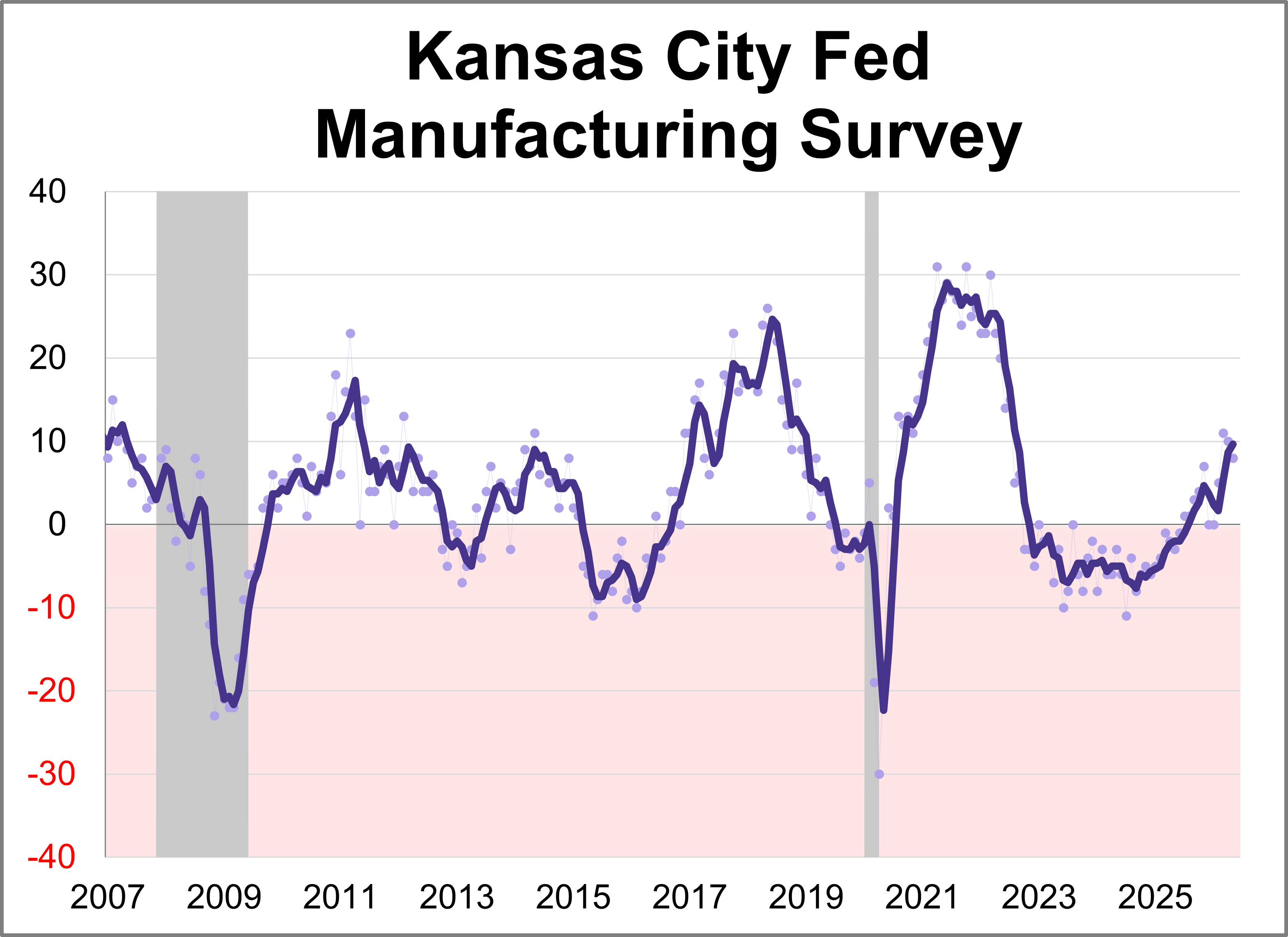
The Kansas City Fed Manufacturing Survey revealed regional activity continued to increase in May. The composite index came in at 8 this month, down slightly from 10 in April but still indicating continued expansion.
There’s a whiff of panic among investors these days. US Treasury yields have climbed to levels unseen in more than a year at the same time as a furious rally has left stocks near all-time highs. Surely, both moves can’t coexist for long, goes the narrative.
Najimah Roberson, a lifelong renter, spent the past two years searching around Harrisburg, Pennsylvania, for a home she could afford — getting outbid nearly 30 times along the way.
In the past year, new models from industry leaders have continued to boost AI’s capabilities. According to various capabilities tests, Anthropic’s Mythos model has leapfrogged other AI models – including in the ability to thwart or support cyberattacks.
Institutional investors have spent years hearing about the promise of artificial intelligence. That phase is giving way to a more practical question: not whether AI can create more scale, but whether that scale can be governed, validated, and translated into better fiduciary decisions. For OCIO providers, AI without discipline is not an advantage.
The consumer is still spending, but with a higher level of caution. Inflation remains a persistent pressure point, particularly for lower- and middle-income households. This has caused the U.S. personal saving rate to fall to 3.6% as of March 2026, leaving significantly less breathing room for discretionary purchases.
LPL Research examines rising inflation risks amid geopolitical tensions, while resilient growth and strong investment support continued expansion.
Inflation surged higher in April, with the Consumer Price Index (CPI) jumping 3.8 per cent from 3.3 per cent in March and the Producer Price Index (PPI) up six per cent from four per cent in March. The increase in the CPI owed much to energy and food prices.
The next generation may inherit substantial assets. Whether they inherit the health to enjoy them — or the burden of managing preventable family health crises — may matter just as much. Advisors who broaden the definition of legacy planning may be better positioned to protect both.
Turns out, loading up on technology giants isn’t the only route to better returns. Value companies, too, stand a decent chance of trouncing the market — as long as several conditions are met.
For much of the year, chip stocks have been powering the market higher. Now, Nvidia Corp.’s earnings have a chance to confirm that the rally has more room to run — or add another brick to investors’ wall of worry.
Although a lot has changed since our last quarterly, its central theme – dispersion – feels like it’s only become more pronounced. We wrote last time that ‘‘we believe we’re entering a new era of dispersion in the performance of financial assets.’’
Veteran strategist Jeff Currie said the world is in the early stages of a commodity supercycle that may last another decade or more as the artificial intelligence buildout collides with chronic underinvestment in energy and materials capacity.
On Friday, May 15, the 10-year Treasury yield closed at 4.59%, its highest level since February 2025. The 30-year Treasury yield closed near 5.12%, a level last seen in 2007. Those are significant moves because they reflect a repricing of the market’s inflation, growth, and Federal Reserve expectations.
Nineteenth-century oil processing plants used simple, column distillation of crude oil to produce kerosene, which was in high demand for lighting lamps. The process also yielded a dangerously flammable byproduct called gasoline which had no obvious use.
Chris Galipeau discusses high-conviction insights that go beyond media headlines.