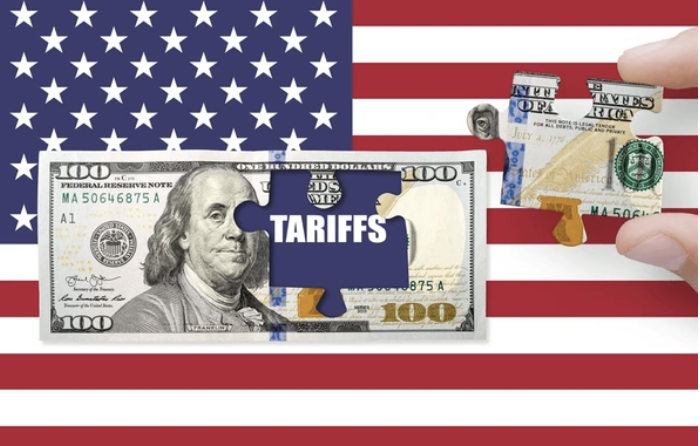
U.S. customs duties topped $100 billion for the first time ever in a single year this month. That number is even more remarkable when you consider that most of President Donald Trump’s new tariffs haven’t even taken full effect yet.
Baby boomers in TDFs should consider getting out and moving to safety. Stock investors should consider less expensive stock markets, and safer asset classes like TIPS and Treasury bills.
Few are as candid and historically accurate as hedge fund manager Kyle Bass when identifying structural breaks in the global economy. In a recent interview, Bass painted a grim but telling picture of China’s economic condition, warning.
Unfortunately, the lush financial terrain we enjoyed from 2008 to 2022 was more like artificial turf. It wears out, gets ugly holes, and eventually needs replacement. But how to replace it without causing other problems? That turns out to be a real problem.
On this week’s edition of Market Week in Review, Global Chief Investment Strategist Paul Eitelman discussed key drivers behind the stock market rally.
Current volatility and optimism are some of the topics being discussed in this new roundtable from Royce Investment Partners.
The capital markets have become an increasingly complex space for investors, complexities that are heightened by the sheer number of ways one can invest.
Chief executive officers in the US and beyond are becoming accustomed to the policy swings of President Donald Trump and are deciding they can pursue growth ambitions regardless.
As 2025 progresses, investors and policymakers are navigating a highly complex economic landscape shaped by three powerful and interrelated forces: evolving trade policy, a cautious U.S. Federal Reserve (Fed), and growing concerns over U.S. fiscal discipline.
We continue to believe we are seeing a rare opportunity in EM local debt, and our conviction has been strengthened by the Trump administration’s trade and economic policies, which suggest continued dollar weakness and relative strength for EM local currencies.
It is easy to invest when markets are rallying, but it can be tough for investors to stay in their seats when markets inevitably decline again.
Every year around this time, we update our Periodic Table of Commodities Returns to reflect the performance of raw materials in the first six months. I’m biased, but few tools do a better job of providing a clear, interactive picture of the commodities landscape than ours.
Our advice to Fed Chairman Powell is to consider both sides of the argument and act to lower inflation over the longer term.
Bond investors worried about rising fiscal deficits are turning to an unusual haven: emerging markets.
Apple Inc. is facing pressure to shake up its corporate playbook to invigorate its struggling artificial intelligence efforts.
Next week, the Q2-2025 earnings season will begin in earnest as a barrage of S&P 500 companies report, starting with the Wall Street money center banks on Tuesday and Wednesday. Since earnings drive the market by supporting investor expectations, what should investors expect? Let’s dig into the details.
Fixed income benchmarks have two fundamental flaws. First, their exposures prioritize the needs of borrowers rather than investors. Second, they tend to expose investors to the biggest risks at the worst times.
The resilient job market has supported stock gains, but Washington policy has been a primary market driver so far this year.
Uncertainty has not impaired overall economic performance.
A multibillion-dollar capital markets experiment is unfolding on Wall Street, as entrepreneurs use blank-check companies and reverse mergers to take their holdings of digital assets public.
After mid-level performance in Q1, financials sector earnings are seen slowing in Q2, according to analysts, though favorable signs like the yield curve could help margins.
Franklin Mutual Series shares its mid-year outlook, focusing on corporate fundamentals as a catalyst to unlock value in the midst of ongoing market volatility.
Liberation Day seems like a lifetime ago. But the 90-day pause is almost over, and—thus far—there are few deals that have been consummated.
A new era of regulation is bound to bring high hopes for the crypto bulls. House Republicans are now gearing up for “Crypto Week” – during which the committee has agreed to prioritize digital asset legislation and review several crypto-related bills.
Our strategy work and quantitative insights suggest the conditions behind more than a decade of U.S. equity outperformance are starting to shift.
Advisors who rely solely on instinct or inertia will get left behind, because having a real business plan is a powerful differentiator. But any plan is only as strong as its execution.
So many businesses are stuck in this endless cycle of chasing leads, hoping that persistence will eventually pay off. Here’s the truth: chasing leads is not only ineffective, it’s damaging your business.
If you’ve been following the mainstream financial media lately, you might think the airline industry is in crisis. From headlines about tariffs and labor costs to geopolitical tensions and delays at Newark Airport, it sounds like air travel should be tanking.
We upgrade equities to neutral from underweight as falling interest rates and improving economic conditions in emerging markets offset uncertainty over US tariff policies.
As the second half gets underway, we think a modest overweight to risk assets is called for.
Tariffs have been the dominant theme in economic policy this year. While President Trump has long held protectionist views, his administration’s approach to international commerce has been more belligerent than was seen in his first term.
After a tumultuous few months, June of 2025 saw a strong rally which took global markets to (or close to) new highs. The rally was broad-based, with international and U.S. markets all up strongly.
From investing to economics to politics, patterns emerge, lessons resurface and the past becomes a powerful guide for navigating today’s unpredictable landscape. Timing, perspective and adaptability can make all the difference in managing the complexities of modern markets.
AstraZeneca Plc’s Chief Executive Officer Pascal Soriot wants to move the drugmaker’s stock listing to the US, the Times reported, in what would be another sign of the UK’s waning status as a magnet for global capital.
If the Trump administration’s tariff policies result in higher overall inflation, a scenario that will play out in the coming weeks, the question is who will pay for it.
We began the year optimistic that an environment of slowing growth, disinflation and easier monetary policy would be favorable for fixed income markets. Now at midyear, we maintain that view, while acknowledging that policy uncertainty and geopolitical risks may likely result in continued volatility.
An economy cannot subsist on services alone.
On the latest edition of Market Week in Review, Global Chief Investment Strategist Paul Eitelman explored key drivers behind the strong performance in markets. He also provided an update on a proposed U.S. tax measure.
With the first half of 2025 in the books, it’s been a very interesting six months — emphasis on “V” because the S&P 500 saw a nice V-shaped formation following the April sell-off. As markets always reveal, interesting times call for interesting ETF trends to follow.
When the Fed increased the M2 money supply by over 40% during the COVID crisis, our instinct was that the implications would extend far beyond a temporary boost to the U.S. stock market and higher inflation. That intuition is proving accurate. We’re now seeing the long-term ripple effects play out in real time across multiple asset classes and global markets.
For good reasons, many investors have a love-hate relationship with commodity investments. Operationally, the annoying K-1 form complicates tax filing, although thankfully the industry has started to launch “no K-1” funds.
This year’s formidable challenges have clarified strategic lessons for equity investors to apply in the coming months
For sophisticated investors, this technical shift marks a subtle but powerful pivot in monetary mechanics. It could create demand for Treasuries, improve market liquidity, and push yields lower at a time when the economy is slowing.
The European Union is willing to accept a trade arrangement with the US that includes a 10% universal tariff on many of the bloc’s exports, but wants the US to commit to lower rates than that on key sectors such as pharmaceuticals, alcohol, semiconductors and commercial aircraft.
Readers of a certain age will no doubt recall President Ronald Reagan launching one of the most ambitious military buildups in American history.
Growth is expected to decelerate, but not come crashing down.
Are we experiencing an energy transition? According to geologist and fund manager Jane Woodward, we are — and it’s proceeding more quickly than almost anyone expected.
The Fed’s credibility rests not on never being wrong, but on being adaptive and forward-looking. Inflation has cooled, wage growth has moderated, and economic momentum is slowing. Now is the time for the Fed to focus not on headline fears, but on real-time data.
Until recently, commercial real estate appeared poised for a long-awaited rebound. However, 2025 has revealed a new reality: Uncertainty has become structural.
It’s often said there are only two certainties in life: death and taxes. However, the tax landscape may become somewhat murkier, as the recently passed U.S. House budget bill may potentially lead to some non-U.S. investors paying more taxes than previously anticipated.