Digital assets have the products. They have access to vehicles such as ETFs, separately managed accounts, and direct custody. What they still lack is the foundational layer underneath those products: the agreed-upon definitions of what the market is, how its components are classified, and how performance is measured.
Government bonds are back in focus, as investors reassess where value lies in global fixed income. With markets wavering over how quickly interest rates will fall, sovereign debt in several developed economies is starting to look attractive again to us.
When you measure home affordability today against the metric that actually governs the check you write each month, the picture flips. By that measure, buying a home may be easier now than it was for the Boomers and Gen Xers who get blamed for everything.
The second-quarter earnings season kicked off last week with a resounding statement from Wall Street, led by stellar results across the nation's six largest banking institutions.
AI is changing the investment landscape, but fundamentals still matter, and we remain focused on quality companies with growing free cash flow.
Whenever I speak at investment conferences, I like to point out that we invest in a number of publicly traded airports. I even list them: Spain’s Aena. Aeroports de Paris. Zurich Airport. Airports of Thailand. Two of the world’s largest operators, Grupo Aeroportuario del Sureste and Grupo Aeroportuario del Pacifico, trade in Mexico.
There are several market headwinds that warrant attention, as well as a tailwind that may be large enough to keep the boat moving forward. Fully understanding the headwinds and tailwinds will help you better monitor the market barometer, allowing you to assess and adjust risk levels with more awareness going forward.
A holistic approach to retirement planning involves careful thinking and conversation around investment strategy, tax efficiency, income needs, and estate planning. The goal, of course, is to minimize the drag of taxation on lifetime earnings and wealth accumulation while maintaining both compliance and attention to the client’s priorities and values.
Andy Burnham pledged a “new economic model” for the UK as he sought to reassure Britons that his ascension as their seventh prime minister in little over a decade would bring an end to the country’s political instability.
Bond traders and Federal Reserve Chairman Kevin Warsh are in agreement on a crucial point: The central bank’s fight against inflation still seems far from over.
Whether you admire him or cringe at the mention of his name, US President Donald Trump has long had a penchant for putting his name on things. Once it was condos, steaks and Bibles.
Decades of data across global markets reach the same verdict: the more frequently retail traders trade, the worse they perform. The infrastructure has never been more inviting. The losses have never been more documented. Here are some key statistics we will dive into further.
It seems to be the end of the Great Moderation Era for the U.S. economy. The Great Moderation Era—which marked most of the two decades leading up to the COVID-19 pandemic—is drifting away into what we call the new Temperamental Era.
The first half of 2026 reinforced the importance of balance, selectivity and income generation. Franklin Income Investors Chief Investment Officer Ed Perks discusses how markets have evolved, where opportunities are emerging, and why diversification remains critical heading into the second half of the year.
For physicians, major financial decisions may rarely affect just one area of their financial life. The real potential risk is failing to understand how those decisions impact everything else.
I have been tracking the ETF industry for a long time. I remember when the SPDR S&P 500 ETF Trust (SPY) made history as the very first ETF to hit the $100 billion mark. Since then nearly two dozen have joined SPY.
A handful of key economic data points dropped last week, painting a picture of an economy that is successfully downshifting from its recent inflation peaks even as consumers keep their footing.
Something unusual is happening in the US equity market. AI infrastructure winners continue to power market gains, yet more stocks are moving against the S&P 500. That doesn’t necessarily signal widespread fundamental weakness, though it may reflect AI-driven market imbalances creating opportunity beyond today’s leaders.
As the forces shaping bond markets become more local, the opportunities become more global. From energy stress to fiscal policy to advances in AI, today’s defining market forces are likely to play out differently across regions, sectors and issuers.
For many investors and families, tax planning may become a year-end exercise squeezed into November and December. But by the time the calendar turns to the fourth quarter, many of the most effective opportunities are already limited.
Tax-aware long-short strategies are no longer the exclusive domain of institutional investors. As separate account delivery has expanded access, more advisors are asking whether tax-aware long-short belongs in their clients’ portfolios. Here are five practical considerations to help you decide.
Big Pharma has a $300 billion problem, and biotech developers with promising drugs are becoming the fix. Major drugmakers are spending at a pace not seen since 2019 to replace medicines that will soon lose patent protection.
The good news is real. The easy trade is not. Growth has held up, artificial intelligence investment is showing up in earnings and capital spending, and fixed income is offering yields that create serious cushion for portfolios.
The bonds sold by hyperscalers to fuel their artificial intelligence ambitions have become a drag on investor portfolios from London to Tokyo.
Investors love an oligopoly. Imagine an industry dominated by a few large, long-standing players. They can earn outsized profits in boom times and avoid crashes thanks to rational capital spending. The existential questions, though, are whether these firms might turn on each other, and is the industry’s entry barrier high enough.
Our baseline outlook still sees the Fed on hold through 2026 amid gradually easing price pressures. But Waller’s comments suggest that after a string of firmer Personal Consumption Expenditures (PCE) inflation prints, the Fed now places greater emphasis on responding if inflation surprises sharply to the upside or proves more persistent than expected, regardless of which factors are driving the inflation. And this raises the stakes for incoming inflation data throughout the year.
Midyear is a useful moment in investing—not because it tells us where we are going, but because it offers a clearer view of how little we truly knew at the start. Six months is often enough time for confident forecasts to meet reality, for consensus narratives to fray, and for the distinction between what sounded plausible and what proved durable to come into focus.
Beyond the obvious differences such as contribution limits, ability to take loans and eligibility requirements, here are some other, lesser-known differences many savers may not be aware of.
Gold and silver traded in a volatile fashion over the past several days as investors weighed conflicting signals from the Federal Reserve, economic data, and geopolitical developments in the Middle East.
David Solomon, decked out in full academic garb, bobbed his head happily and wagged his index finger to the beat of his own AI-generated music.
Private debt is increasingly valued for its potential to help insurers operationally and strategically: support liability matching, improve portfolio design, diversify underlying exposures and, when underwritten well, add resilient excess return.
A hawkish pivot by the Federal Reserve and resilient U.S. growth could keep the dollar strong, but its gains could be limited by any narrowing of the U.S. interest rate advantage.
Discover the top 10 most-read charts from the first half of 2026, covering historic market valuations, record margin debt, recession indicators, and global index performance.
Hoisington Investment Management Co., the bond manager known for its bullish stance on US Treasuries going back more than 30 years, has turned bearish.
Is it a bubble or isn’t it? That’s what everyone seems to be asking about the US stock market. I say it isn’t. A bubble to me is when price becomes disconnected from any rational, articulable value, the way people chased opaque schemes in the Roaring 1920s or the blind faith in new internet companies in the 1990s.
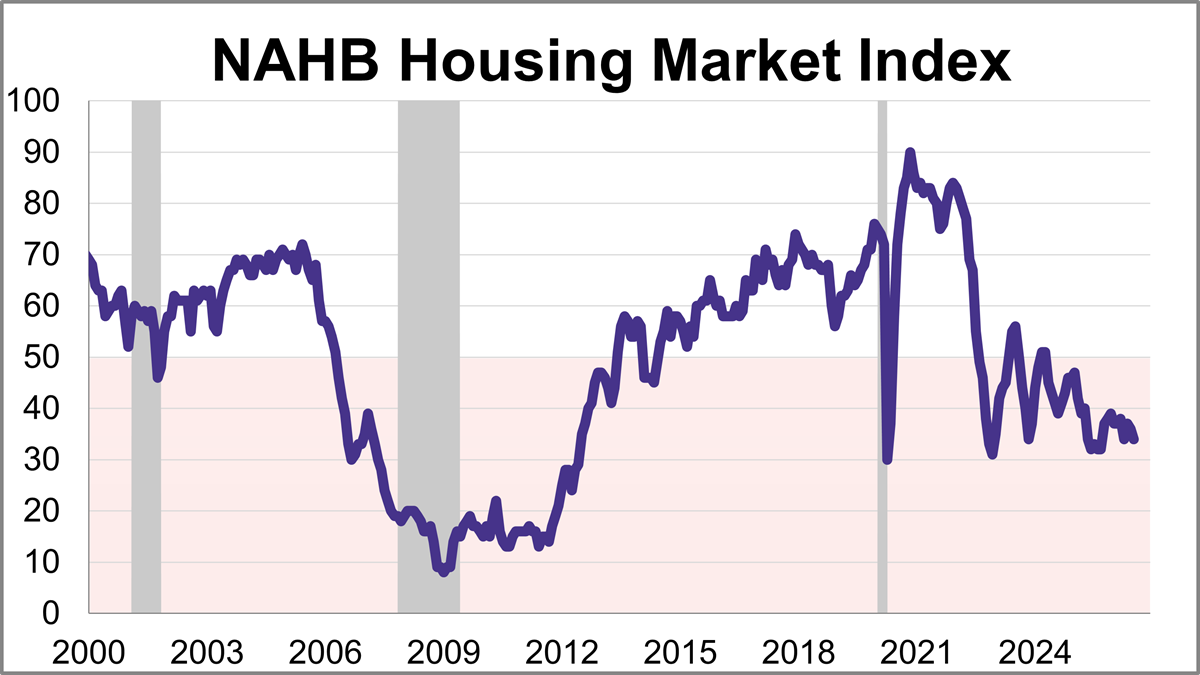
Builder confidence edged lower in July as ongoing affordability challenges continue to affect the housing market. The National Association of Home Builders (NAHB) Housing Market Index (HMI) fell 2 points from June to 34 this month, marking the 27th consecutive negative reading.
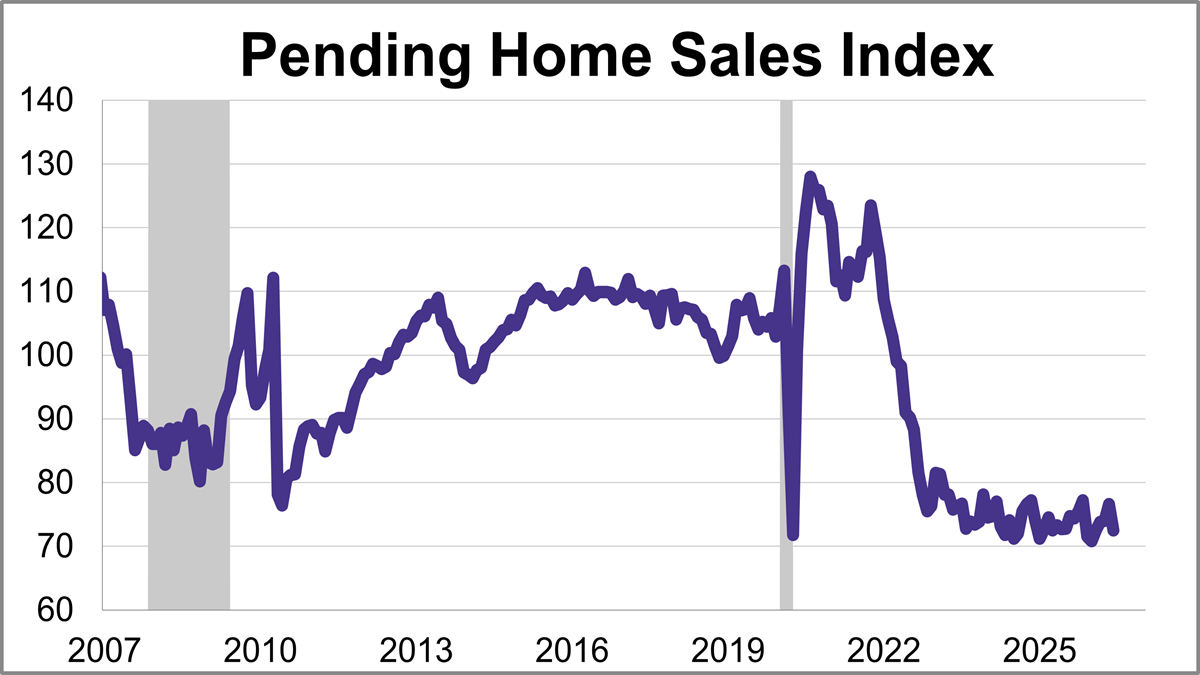
The National Association of Realtors® (NAR) pending home sales index sank 5.4% in June to 72.5, the lowest level since January.
Captain Ahab never caught Moby Dick, but Morgan Stanley shows how tracking billionaire tech whales like Elon Musk can eventually land a fortune. Not long ago, the bank appeared to have shot itself in the foot as lead lender on the disastrous $44 billion buyout of social media platform Twitter, now known as X.
General Douglas MacArthur once remarked that “rules are mostly made to be broken.” He was at odds with U.S. President Harry Truman over the conduct of the Korean War, feeling that the restrictions placed on his forces weren’t supportive of success.
Eli Lilly & Co. agreed to buy AtaiBeckley Inc. for as much as $3.8 billion, underscoring growing interest from large drugmakers in the once-fringe area of psychedelic medicine.
This paper presents the case for emerging market (EM) allocations within the broader context of global investment strategy. In a period of heightened geopolitical complexity—spanning the 2026 US-Iran conflict, challenges to globalization, political transformation and ongoing great power competition—we believe the case for engaged emerging markets exposure has never been stronger.
In June we pointed out that Health Care looks cheap. Even though it has been rallying hard of late, the sector continues to trade at a 59% price-to-sales discount to the S&P 500, despite having an 18% return on equity (ROE) that is just a hair below the 19% ROE accorded the S&P 500.
Although economic conditions did not change much between the first and second quarters, investors were far more bullish in the second quarter.
For decades, traditional index-based ETFs have served as the low-cost foundational anchor for core allocations, consistently demonstrating that outperforming a broad market index is an uphill battle.
After a difficult start to the year, investor sentiment reached a low point near the end of March as concerns around inflation, geopolitics, and rising interest rates weighed on risk assets.
We had a data center at my first banking job. It was a dusty room filled with old Federal Reserve Bulletins, Economic Reports of the Presidents, and annual reports from the International Monetary Fund. I was the search engine, and the operation was powered by caffeine.
What were the key takeaways from last month’s numbers? Our corporate bond specialists look back at the market’s performance and provide incisive commentary to help you make sense of what drove the market—and what may be on the horizon for fixed income investors.
BlackRock Inc. pulled in $192 billion of net client cash in the second quarter, with investors pouring money into exchange-traded funds and pushing total assets above $15 trillion for the first time.
The median house price in Nantucket, Massachusetts, is nearly $4 million. It was just $500,000 in 1995. This sounds like a stunning increase in one of the hottest and least accessible real estate markets in the country.
The current level of stock market valuations remains – easily – the most speculative extreme in U.S. financial history, beyond both the 1929 and 2000 extremes. Our baseline estimate is that the S&P 500 has a material risk of losing something on the order of 75% over the completion of this cycle.