In the context of fighting inflation, the “‘final mile”’ represents the successful and sustainable achievement of a central bank’s inflation target. Stephen Dover, Head of Franklin Templeton Institute, opines on the Fed’s ability to reach it.
The Northern Trust Economics team shares its outlook for U.S. growth, employment, interest rates and inflation.
In the latest episode of the Alternative Allocations podcast series, Franklin Templeton’s Tony Davidow has an insightful conversation with the firm’s CEO, Jenny Johnson, regarding the burgeoning opportunities in alternative investments, especially in the current financial climate.
In our 2024 outlook, bonds emerge as a standout asset class, offering strong prospects, resilience, diversification, and attractive valuations compared with equities.
The Chicago Fed National Activity Index (CFNAI) is arguably one of the most important and overlooked economic indicators.
On Wall Street, there’s always a lot of excitement around the latest inflation report. Tuesday’s better-than-expected number was an extreme example — bond yields plummeted and stocks surged.
Professional traders entered November wagering Jerome Powell’s campaign to tame inflation was a long way from being won. Now they’re being forced into risky bets that the battle is over.
For Meta Platforms Inc. bulls, the biggest one-day stock wipeout in history is a fading sight in the rear-view mirror.
A normal day for markets became something extraordinary after a hotly anticipated report on US inflation gave traders the greenlight to declare that the Federal Reserve’s most aggressive interest-rate hiking cycle in decades is over.
Third-quarter earnings announcements have almost come and gone, with yesterday being the last big burst of companies. Some key firms have yet to announce, like Nvidia and Walmart, but everything I’m seeing says it surpassed expectations.
Like some advances earlier this year, the market's current surge hasn't been defined by strong breadth underneath the surface—which will be key for a sustained, durable advance.
As I write this, we’re just about three months out from kicking off Exchange 2024 in Miami, Florida. Obviously, I and the whole team here at VettaFi would love it if you came.
We speak with ClearBridge Investments’ Jeff Schulze about a topic on many investors’ minds: the 10-year US Treasury yield and the path of monetary policy. He also shares his views on the latest US retail sales data and whether consumer resilience will last into 2024.
The price of gold just had its best October in nearly half a century, defying tough resistance from surging Treasury yields and a strong U.S. dollar. The yellow metal rallied an incredible 7.3% last month to close at $1,983 an ounce, its strongest October since 1978, when it jumped 11.7%.
More than two years after economists divided into opposing camps over the nature of the post-pandemic inflation, we now know which side was right. Disinflation has confirmed that the earlier price increases were “transitory,” driven largely by supply disruptions and sectoral shifts in demand.
It’s important not to gloss over this reality because a number of signs point to a continuing deterioration so long as the Federal Reserve keeps interest rates at a level that restrains the economy.
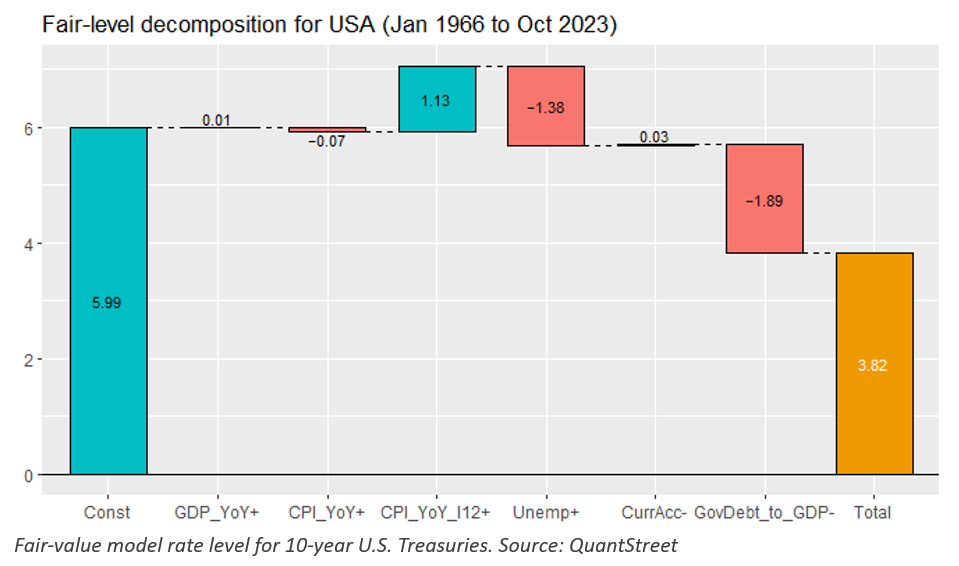
U.S. Treasury rates in the long-end of the curve are 100 basis points too high relative to a fair-value model. The risk-adjusted opportunity in long-dated, low-coupon Treasuries is attractive.
Good news – the earnings recession is over! After three consecutive quarters of negative earnings growth, 3Q S&P 500 earnings are on pace to climb 5% YoY. If sustained, this would be the best quarter of earnings growth since 2Q22.
Treasury yields have dropped as weak economic data suggests the Federal Reserve may begin cutting the federal funds rate target earlier than previously expected.
Starting in mid-2020, we began worrying about and forecasting higher inflation. The reason behind this was our belief in Milton Friedman and his view that inflation is “too much money chasing too few goods.”
A China ‘Recovery’: How important is the loss of confidence within China itself?
In an economic environment characterized by rising interest rates and a forecasted slowdown, the fixed income asset class has emerged as a beacon of opportunity.
On October 24, 2022, precisely a year ago, we published an article by Allan Roth in Advisor Perspectives, The 4% Rule Just Became a Whole Lot Easier. The idea for that article came from a conversation that Allan and I had. I noted that real rates, as expressed by TIPS, were about 1.75%. I thought that it would be possible to lock in the proverbial 4% safe withdrawal rate. Allan did the analysis and found that, indeed, a 4.36% safe withdrawal rate was possible. That article received widespread attention throughout the financial media. Perhaps it even had a role in the introduction of BlackRock’s new suite of defined-maturity TIPS ETFs.
Higher interest rates and inflation are likely to usher in a decade of policy restraint, limited liquidity and macro volatility, pressuring equities and motivating investors to reconsider tactical asset allocation and embrace real assets.
Interest on our federal debt is 2% and heading towards 5%, which will crowd out other expenditures and escalate deficit spending.
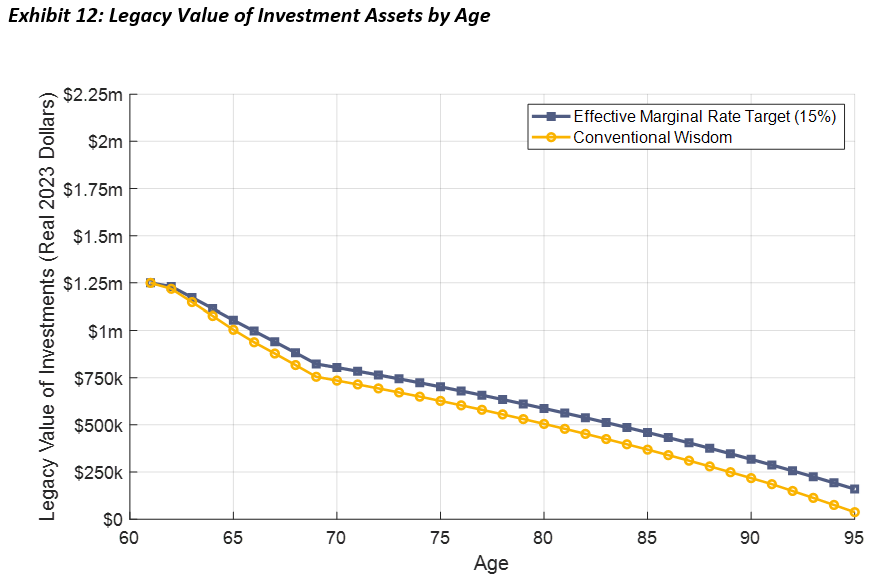
Research on tax-efficient retirement distribution strategies aims to sequence withdrawals from taxable, tax-deferred, and tax-exempt accounts to maximize after-tax spending. That can be either in terms of meeting an after-tax spending goal for as long as possible or preserving the most after-tax legacy after meeting spending needs over a specified timeframe.
As it turns out, the big economic story of 2023 is not a recession, as many had predicted — it’s the disconnect between consumer sentiment and behavior.
Is the bond bear market finally over? That is the question everyone is asking now that bond prices rallied sharply following the November FOMC policy meeting.
Emerging-market borrowers are piling back into global bond markets, selling about $20 billion in dollar notes in just a few days, all too aware that the window of opportunity may snap shut as suddenly as it opened.
Worries about an economic downturn aren’t enough to dissuade market participants from being bullish on risky debt as their top contrarian trade, according to the latest Bloomberg Markets Live Pulse survey.
Starting in 2024, IBM will replace its 401(k) plan matching contributions with a new benefit earned within its overfunded DB plan, which has been frozen since 2008. This move essentially un-freezes the tech giant's DB plan.
CNBC Journalist Laments How the Fed Now Essentially Controls the Market.
With less than two months left in 2023, this maybe another disappointing year for broad-based ex-US developed market equity funds. This includes a slew of passive exchange traded funds.
The doves lined up last week guiding the S&P500 up 5.85%, marking the best week of performance for the year. A busy week of data began with the quarterly refunding announcement from the Treasury.
Rising interest rates and inflation have kept emerging markets (EM) bulls from charging. But an improving macroeconomic environment could potentially be underway after the Federal Reserve’s recent rate pause.
The bond market giveth and the bond market taketh away. The S&P 500 Index closed in the red Thursday, blowing its widely-hyped chance at a nine-day winning streak, which would have been its best run since 2004.
Exploring federal budget data is a journey through endless rabbit holes, some of which are eerily close to Alice in Wonderland insanity. Countless variables interact in unexpected ways. Seemingly small changes can cascade into billions of dollars within a few years.
I am not a fan of one-size-fits-all financial strategies. Yes, I see the value of making investment as simple as possible, but the right balance of risk and reward is a personal decision, and the most common strategies are either arbitrary or agnostic about crucial details.
Moody’s Investors Service recently released a report bluntly entitled, “Private equity exposure increases credit risk for universities with limited wealth.”
Federal Reserve Chair Jerome Powell said the US central bank will continue to move carefully but won’t hesitate to tighten policy further if appropriate.
It’s the buzz word on Wall Street and in the hallways of the Federal Reserve and Treasury Department. It’s blamed for triggering bond selloffs, shifts in debt auctions and interest-rate policy.
Our Franklin Templeton Fixed Income CIO Sonal Desai sees this market reaction as an excess of exuberance that sets the stage for more volatility. She shares her latest insights on the policy outlook and the implications for investors.
The potential for a Fed pause presents an opportunity for investors to consider adding duration back into their portfolios. In this market regime, we believe duration serves well as hedge and equity diversifier.
If you're close to retiring, beware of the little-known sequence-of-returns risk that could take a huge slice out of your retirement income.
For this edition of Bull vs. Bear, Nick Peters-Golden and James Comtois debate whether this is truly the year active ETFs turned pretty.
Weakness in US equity markets since July reflects ongoing uncertainty about the macroeconomic outlook. Despite the concerns, stocks with quality and defensive features have performed relatively well and could help portfolios surmount shaky conditions ahead.
As we head into the final stretch of quarter four and the beginning of 2024, inflation remains at the forefront of investors’ and financial advisors’ minds. With so many different narratives in the marketplace today regarding the financial market’s current outlook, it can leave many investors and advisors questioning what exactly is going on with inflation.
On this episode of the “ETF of the Week” podcast, Tom Lydon discussed the Vanguard Consumer Discretionary ETF (VCR) with Chuck Jaffe of “Money Life.” The pair discussed several topics regarding the fund to give investors a deeper understanding of the fund overall.
Despite substantially tighter monetary policy, the strength of jobs and retail sales stumped expectations of a recessionary downturn in 2022.
The inflation scare is barely behind us, and it is already time for the Federal Reserve to focus on recession risks. The recent trajectory of job growth means policymakers can no longer rule out unemployment snowballing in 2024, which should force a shift in how they think about managing their dual mandate.