There is no one-size-fits-all individual investment strategy. We all have different needs. Once I decided I needed a portfolio that would work for today, I became convinced that a dividend growth portfolio should be the core of my long-term investment strategy. Not an addition, but the core.
Two things are worth considering that will dramatically impact the stats moving forward, and neither of them existed as a factor a generation ago. Alternatives to a four-year degree are getting more government support too. Workforce Pell Grants, once reserved for traditional colleges, now extend to short-term job-training programs.
US 10-year Treasury yields have climbed roughly 50-basis points since the start of 2026. This is not an inflation scare. Despite the sharp rise in energy prices following the outbreak of war with Iran, market-based measures of medium-term inflation expectations have drifted lower.
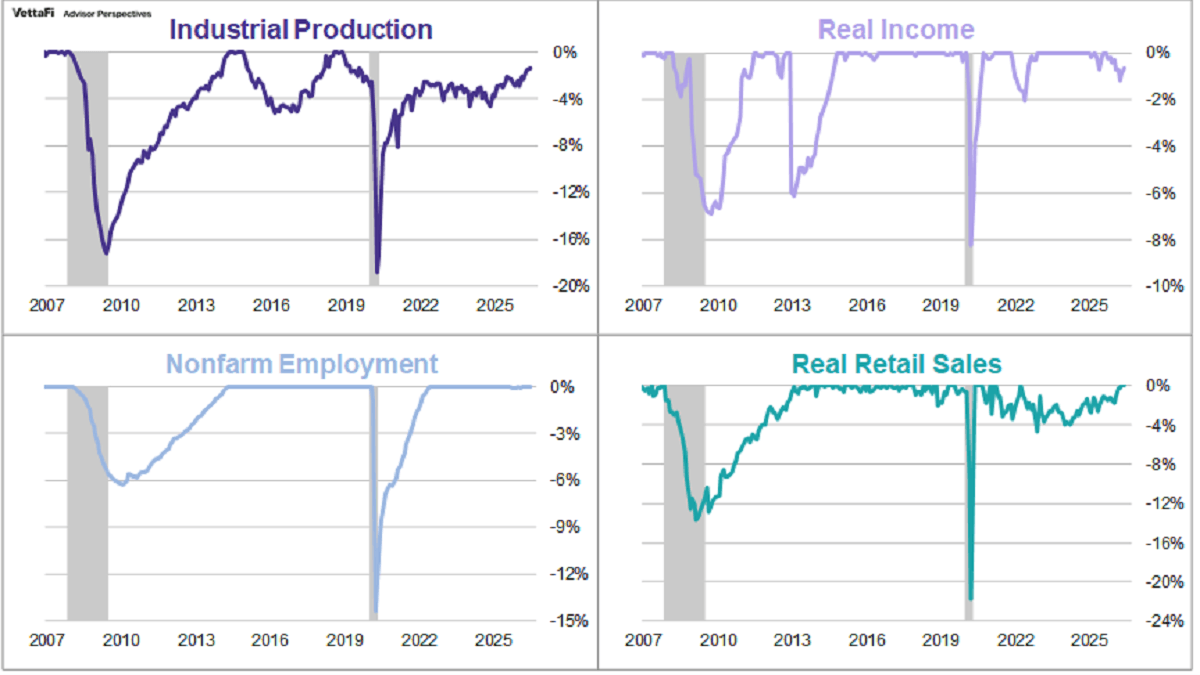
Official recession calls are the responsibility of the NBER Business Cycle Dating Committee, which is understandably vague about the specific indicators on which they base their decisions. There is, however, a general belief that there are four big indicators that the committee weighs heavily in their cycle identification process.
Morningstar research shows ETF investors gave up 1.2 points a year to poor timing, a gap advisors can help clients close through discipline.
Gold jumped more than 3% after an unexpected contraction in the US jobs market, extending a rebound from its slump below $4,000 an ounce.
A good financial plan may bring together every aspect of your financial life into a coordinated strategy, providing a clear view of where you are today and helping you prepare for where you want to go. By understanding your complete financial picture, you can make informed decisions that align with your goals, values, and long-term priorities.
Investors remain cautious despite bullish positioning, as rotations curb speculation while record margin debt and high equity allocations raise longer-term risks.
As many of you know, our team at Smead Capital Management has studied the thinking and investment careers of Charlie Munger and Warren Buffett. In today’s Go-Go artificial intelligence-dominated stock market, we’d like to walk you through the concept of the Circle of Competence.
In this article, Russ Koesterich explains how the recent market rotation has pressured tech stocks while creating an attractive long-term buying opportunity.
A clear-eyed view of past experience shows that where wealth taxes have been tried, they have usually been abandoned—and for good reason. As policymakers in California, New York, France, and elsewhere revisit this old idea, they should heed the lessons of this history.
Investors are warming to systematic processes in bond markets. In this new approach, a dynamic multifactor process drives the investment decisions, using predictive factors with demonstrable links to outperformance.
Reducing or eliminating debt might feel like the ultimate financial milestone, but paying off debt early – or avoiding it entirely – can limit future opportunities for building or preserving wealth. During periods of volatility, it may be tempting to get rid of debt for short-term relief, but this could compromise your long-term plan. Staying the course may be crucial to your goals – no matter the market.
Discover why higher Treasury yields, strong ETF demand, and active management are creating new opportunities in muni bonds for advisors.
Given the current state of inflation and interest rates, it’s probable that many advisors and investors are considering alternative ways of fostering income within their portfolios.
Reflecting on the first half of 2026 provides a clear roadmap to strategize for the remainder of the year. Before that can occur, however, it’s imperative to check the pulse on the current state of the market and posit what may happen next.
Alphabet Inc. is looking to raise as much as $25 billion from its latest US investment-grade bond offering, a deal that will test investor appetite for AI-related debt following a July selloff.
On Wall Street, money speaks louder than words. The way Big Oil is currently allocating dollars suggests the supermajors are, quietly, preparing for leaner times. It’s the right approach: Oil is a cyclical business, and lower prices are always around the corner. This time, they may be even closer.
While the outcome of the July FOMC meeting itself was in line with expectations, the aftermath has proven to be far more challenging for the money and bond markets, especially for longer-dated maturities, a.k.a. duration. Investors, as well as Fed Chairman Warsh, have quickly discovered something we have been highlighting about over the last few months: a lack of forward guidance can have unintended consequences.
In the span of a few weeks, a new college student takes on loan debt, gets their first credit card offer, and starts managing daily expenses on their own. They're buying groceries, splitting costs with roommates, saying yes to things they probably can't afford yet. No other period of life throws that many financial decisions at someone with that little experience.
On Wednesday afternoon the Federal Reserve held interest rates steady for a fifth consecutive meeting, and stocks buckled: the Dow fell 1,153 points, its worst day since April of last year.
The AI question is not really a technology question for your firm; it is a documentation question wearing a technology costume. Your advisors are already using it, and the SEC has already told you it is watching how you handle it. The only open question is whether, when an examiner asks, you can show your work.
One of my most controversial opinions is that the 401(k) is one of the great financial inventions of the 20th century. It is not a view shared by many people — including, apparently, the inventor himself, Ted Benna, who argues that the 401(k) has mainly benefited the wealthy.
Investors hanging onto SpaceX shares after a plunge below their IPO price are bracing for the next potential hit, when $101 billion worth of stock becomes available for trading on Thursday.
High-net-worth investors and institutional managers continue to allocate heavily to muni bond ETFs to lock in attractive yields.
Developing economies must move fast in adopting artificial intelligence for their governments and businesses, the World Bank said, urging countries to adapt existing tools to local needs.
The numbers are in, and the story of ETF adoption goes on undeterred. In July, ETFs saw their third month this year of asset inflows exceeding $190 billion. If 2025 was a record-breaking year for ETF asset creation, 2026 is promising to upstage it.
Many of the most critical components of AI infrastructure are produced by a small and increasingly consolidated group of highly specialized companies.
While the Fed left interest rates unchanged, Treasury yields moved notably higher throughout the week, with 30-year yields eclipsing their highest levels in nearly two decades as investors reassessed the outlook for inflation and monetary policy. The S&P 500 ended 1.06 percent higher to close a volatile week of trading, recovering from a mid-week sell-off.
Kevin Warsh considers fewer Fed meetings, the Fed holds rates steady, the Senate moves to avert a shutdown, a new BLS chief is confirmed, and midterms near.
LPL Research highlights strong corporate earnings, AI-driven growth, and a favorable equity outlook while monitoring inflation, oil prices, and risks.
July was an eventful month for both domestic and international markets, with US-Iran tensions flaring up, increasing energy prices and changing investor expectations for the Federal Reserve (Fed) cutting rates.
The financial markets expected the Federal Reserve to leave interest rates unchanged at its recent meeting, and it did just that. However, three members of the FOMC dissented, voting to raise rates by 25bps in an effort to combat stubbornly high inflation.
The Federal Reserve’s preferred gauge of price inflation is set for a methodological update, as the Bureau of Economic Analysis (BEA) is expected to implement revisions to its price index for Personal Consumption Expenditures (PCE) as early as September.
State Street's July Flash Flows report highlights record ETF inflows, and a major rotation into value and dividend strategies.
The concept of the 530A accounts is sound, and the initial $1,000 deposit is worth having. So claim the seed money if your child qualifies. But before you make additional contributions, compare these accounts to the other options and choose what is appropriate for your circumstances.
Social Security’s short-term financing crisis is no longer a distant actuarial projection — it is a near-term event with direct implications for current retirees, individuals approaching retirement, and younger workers. Advisors must understand not only the potential fixes, but also the hard constraints that sharply limit what Congress can realistically do in the next several years.
Treasuries rose on Tuesday as signs of progress toward a diplomatic resolution of the Iran war sent oil prices lower, curbing expectations for more than one Federal Reserve interest-rate hike in the coming year.
Just as important, the dollar and U.S. Treasuries have continued to behave like hedges in periods of broader market unrest (driven by geopolitics or other conditions). When risk assets come under pressure, Treasury yields have generally fallen, or the dollar has tended to find support.
Lately, it seems like you can’t open a financial publication without stumbling across another article declaring the 60/40 portfolio dead. The pitch is everywhere: bonds are broken, the old rules no longer apply, and investors should modernize by swapping the bonds in their portfolio for Bitcoin, gold, or whatever alternative the asset management industry is currently selling.
You spent years building your retirement savings with one goal in mind: having enough to live comfortably when you stop working. The strategy that got you here probably leaned heavily on growth. But as retirement gets closer, that same approach may not be the right one to carry you through it.
S&P 500 companies are turning in their strongest earnings season in five years. And a handful of sectors are doing most of the heavy lifting.
Advisors and investors of all kinds are used to closely watching the outcome of each of the Federal Reserve’s meetings, given how critical interest rates are to equity and fixed income markets alike. However, the recent July Fed meeting was particularly crucial. Many were uncertain what direction the central bank would go with interest rates.
The US economy grew less than expected during the second quarter of the year, up 1.5% quarter over quarter, dragged down by strong growth in imports. However, final sales to private domestic purchasers increased by 3.9%, underscoring the strength in domestic demand, which continues to rely too heavily in AI investment spending and strong spending from high-income consumers, or what has been called the K economy.
Market volatility—and the feelings of uncertainty that follow—tend to frighten investors. Yet for investors with an overlay program, one approach to volatility is evergreen—rebalancing.
Electricity has become a major global focus. It essential to powering the modern economy: regions with capacity will generate growth, while those without adequate supplies may be vulnerable to shocks.
As companies race to capitalize on the AI boom, water security is emerging as a material risk across the value chain. While data centers attract headlines, semiconductor fabrication remains one of the value chain’s most water-intensive activities, requiring reliable supplies of high-purity water.
There are 38% fewer companies listed on U.S. exchanges today than at the peak in the mid-1990s. The forces behind that decline—regulatory burden, the abundance of private capital, and the quiet disappearance of mid-sized public companies—are structural, not cyclical.
Growing demand for AI-savvy workers has led some companies, including software makers International Business Machines Corp., Shopify Inc. and Cloudflare Inc., to ramp up entry-level hiring, betting that recent Gen Z graduates will be able to do more with AI tools than existing employees.
JPMorgan Chase & Co. is vowing to funnel $750 billion into housing over the next decade, nearly 40% more than it has over the past 10 years, as part of Chief Executive Officer Jamie Dimon’s push to invest more money in US communities.