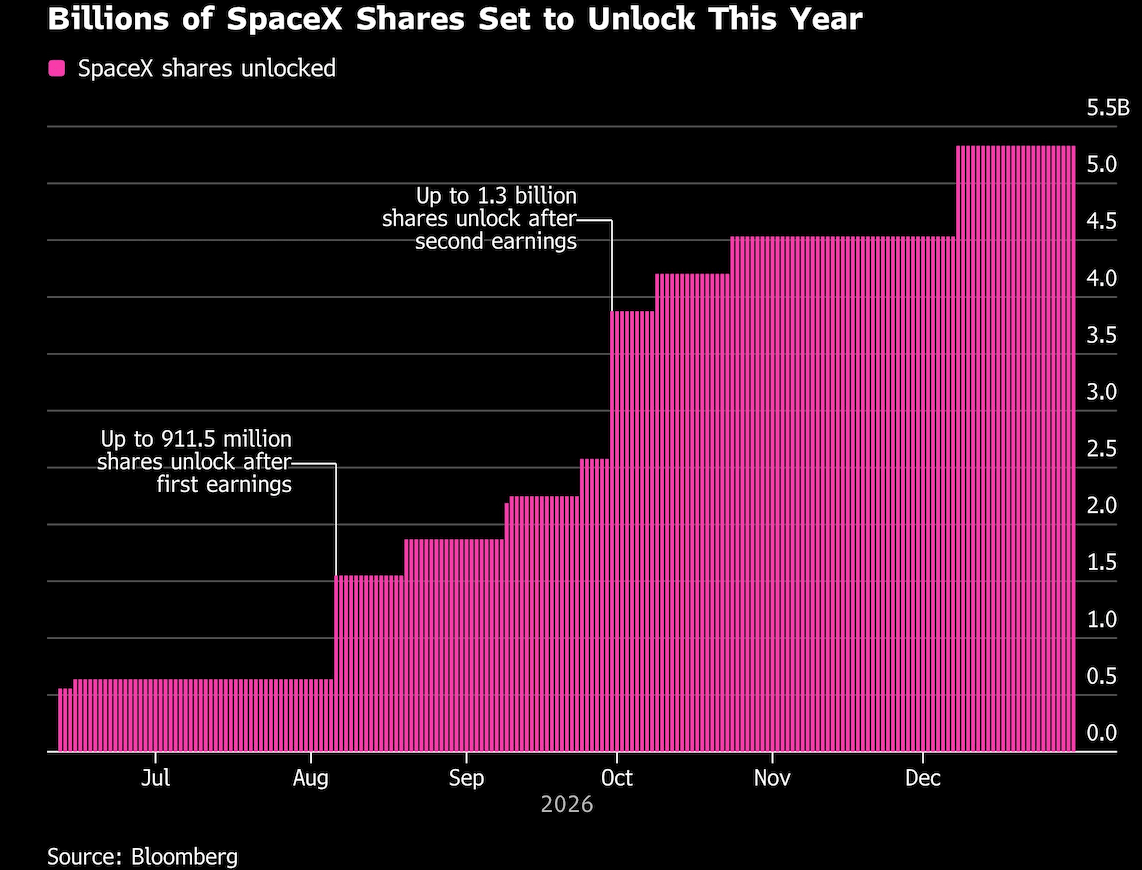
Investors hanging onto SpaceX shares after a plunge below their IPO price are bracing for the next potential hit, when $101 billion worth of stock becomes available for trading on Thursday.
The scheduled ending of a lockup agreement restricting insider share sales until a specified period after an initial public offering is nothing new. But given the staggered nine-stage structure — designed in an effort to dilute the impact of the vast amount of shares locked up — and the sheer size of the first stage, even SpaceX’s veteran backers aren’t keen on making predictions.
“We’ve never seen anything like it, we’ve never seen anything of this scale, we’ve never seen a lock-up being phased in this way,” said Peter Singlehurst, head of the private companies team at Baillie Gifford, which first invested in Elon Musk’s company in 2018. “We’re in uncharted waters.”
The lifting of restrictions on up to 911.5 million shares comes as volatility whips the shares after its first quarterly earnings report triggered a 13% slide to reverse a two-day surge that added in excess of $250 billion to its market capitalization to start the week.
SpaceX’s more than two decades as a private company, and the acquisition of xAI earlier this year — preceded by Musk’s Twitter buyout — has left the rocket, satellite and artificial intelligence company with a sprawling list of existing investors. Many are sitting on paper gains, even at prices well below the $135 per share seen in the record $86.2 billion IPO for Space Exploration Technologies Corp., as it’s formally known.

See more: Can SpaceX Fire on All Cylinders?
Ending restrictions on some insiders will more than double the number of shares available, to as many as 1.55 billion shares from about 639 million shares now, according to the IPO prospectus.
The highly-anticipated unlocking paired with a lofty valuation has drawn a swarm of short-selling investors with 35% of shares currently available for trading are being sold short, according to data compiled by S3 Partners through Tuesday’s close. That skepticism has paid off to the tune of $5.3 billion in paper profits, the data show, after the stock closed 38% below a June 16 closing high before the results.
Shares erased the majority of a two-day rally on Wednesday, slumping more than 10% to trade back near $110. Analysts maintained their bullish views on the stock’s long-term promise with a 14th launch of SpaceX’s Starship rocket — a project central to delivering on data centers in space — tentatively scheduled for later this month as the next catalyst.
The stock’s reversal was partly fueled by higher-than-expected spending on AI with Wall Street more focused on orbital data center launches as soon as next year and ambitious plans to use its Starlink network to compete directly with the largest US mobile phone carriers. Quarterly revenue topped analyst estimates powered by its Starlink satellite-internet service — its only profitable business.
“Many investors are simply unwilling to buy SpaceX shares in the interim based on fundamentals and the lock-up overhang that’s going to exist until December,” said David Wagner, portfolio manager at Aptus Capital Advisors. “Bluntly put, we are in that same exact boat.”
Cash In
Even the most dedicated long-term SpaceX backers will be tempted to cash in some chips. The deal for xAI, now known as SpaceXAI, gave the combined company a valuation of $1.25 trillion, Bloomberg News reported, versus a market value of about $1.5 trillion today.
Some bought into special-purpose vehicles to acquire even fractions of shares in xAI and SpaceX in the run-up to the June IPO, their desire to get in early outweighing the product’s relative lack of transparency compared to the stock market. Many of those investors will now await initial distributions from the managers of the SPVs in the days and weeks after Thursday’s lockup expires.
“There’s probably a reasonably good chance that this will be the biggest single increase in the supply of shares for a single company in a single day ever,” said Baillie Gifford’s Singlehurst. “And so what happens on that day? I don’t know.”
The unique lockup structure was pieced together by SpaceX and its bankers in an effort to dull the risks surrounding a traditional share unlocking after 180 days, which could have resulted in a free-for-all selloff.
Thursday’s lockup expiration will be just the start of what Bernstein analysts called “an unusually complex scheme with nine main unlock points instead of one traditional 180-day expiry.” A number of backers will need to wait for their chance to exit until early December, when the number of shares available to trade will soar to 5.33 billion, according to the regulatory filing.
Expecting volatility in the immediate wake of the IPO when the float was small, investors including Baillie Gifford decided to take some profits even before SpaceX went public. In the end, SpaceX saw its market value soar by nearly $1 trillion in a matter of days before plunging by $1.2 trillion, and Wall Street is positioning itself for another bout of wild swings.
“These questions still matter deeply for us, but we’ve already kind of been able to take some things off the table,” said Singlehurst.
A message from Advisor Perspectives and VettaFi: Discover something new! Click here to register for our upcoming webcasts.
Bloomberg News provided this article. For more articles like this please visit
bloomberg.com.
Read more articles by Bailey Lipschultz