High-yield investors put off by today’s narrow spreads could be missing out.
On the latest edition of Market Week in Review, Investment Strategist BeiChen Lin assessed the state of the economy, including the health of the services and manufacturing sectors, and the likelihood of a big rate cut at the upcoming Federal Reserve meeting.
The main focus for investors should is no longer if the Fed will cut rates in 2024, but how much and how quickly the Fed will lower interest rates.
Recent growth data have been muddled and subject to conflicting interpretations. There have been mixed signals from leading indicators and hard data and divergent readings across major economies.
In this video, Chuck Carnevale, Co-Founder of FAST Graphs, a.k.a. Mr. Valuation and Professor Nathan Mauck, Phd. are going to talk about how to approach dividend growth stocks-focusing on the health of the dividend, the growth of the dividend. Smart investing with research-driven principles.
As market sensitivity to economic data continues, investors would do well to consider active strategies amidst ongoing volatility.
We think the decline in the S&P 500 Index on Tuesday may be more technical than fundamental.
The concept of portable alpha is over 40 years old. And while it has evolved through various forms over that time, it continues to be a valuable portfolio tool for institutional investors. Arguably, the most popular iteration right now is adding alpha expected from hedge funds on top of synthetic beta exposure.
Gold is typically an asset that doesn’t generate yield, but there are ETFs that deliver yield on a gold position through options.
In a recent discussion with Adam Taggart via Thoughtful Money, we quickly touched on the similarities between the U.S. and Japanese monetary policies around the 11-minute mark. However, that discussion warrants a deeper dive. As we will review, Japan has much to tell us about the future of the U.S. economically.
Money can still be a factor in inflation.
Candidate tax policies could affect municipal bonds, but the bigger picture is important too.
With Labor Day now in the rearview mirror, the money and bond markets will no doubt become laser focused on the September FOMC meeting. Yes, Fed Chair Powell telegraphed that a rate cut is forthcoming, but he also emphasized how monetary policy is still data dependent.
Recent changes to the FAFSA form and process include a simpler form, fewer questions and a revised eligibility formula. Our Bill Cass highlights what you need to know to apply for federal financial aid for college.
Presidential elections tend to have limited impact on market performance, regardless of party win (although markets prefer Democratic switches). Investors should capitalize on the uptick in market volatility, which investors can use for strategic investing.
We often write about the opportunity for fixed income investors to lock in relatively attractive long-term rates. And we would argue that investment consultants and financial advisors have no more important charge than to convince their clients to take advantage of this while they still can.
High interest rates have had the predictable effect of restraining the performances of dividend stocks and related exchange traded funds.
Private assets are the fastest-growing market in the financial world, but could be the most challenging field for ETF providers to penetrate.
The Federal Reserve is creating the potential for extreme bouts of volatility surrounded economic data releases.
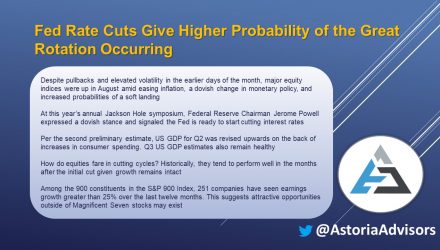
Despite pullbacks and elevated volatility in the earlier days of the month, major equity indices were up in August.
Investors should be careful what they wish for in hoping for an aggressive Fed rate cutting cycle, given stocks tend to do better when cuts are slow and steady.
When we’re viewing markets, it’s not surprising sentiment shifts quickly if we don’t instantly see the anticipated results. Market pundits quickly point fingers and determine the Fed, economists, and participants are wrong. Reactions can be powerful in number and sway momentum for stocks and/or bonds.
A bright spot in Chinese investment could spell trouble for its financial institutions.
After a decade of consistent outperformance, Japanese small caps began underperforming their large cap peers in 2018, a trend that has accelerated since 2023.
This week’s data reflects the resilience of the U.S. economy. Currently, the economy is holding steady with jobless claims in the 230,000 range and recent inflation data showing stability. Friday’s inflation report was essentially at expectations and indicates that the Federal Reserve (Fed) will make a rate cut of at least 25 basis points (bps) at the September meeting. Whether the cut is 25 or 50 will depend mostly on this week’s employment report.
The stock market as measured by the S&P 500 is trading at a very high valuation. In this video, Chuck Carnevale, Co-Founder of FAST Graphs, a.k.a. Mr. Valuation is going to share 10 extremely high-quality stocks that are not overvalued, and offer good growth and long term total rates of return.
We’ve always admired the great artistry of David Byrne from the Band Talking Heads. My favorite song of theirs is “Once in a Lifetime.” We think this song can tell our readers a great deal about how to look at our portfolio as we navigate an expensive and maniacal S&P 500 Index environment.
In this edition, Harold Evensky explores the challenges facing sustainable and active funds, the implications of the new DOL Fiduciary Rule, and the value of long-term performance projections. With candid observations and critical analysis--read on to gain perspective on navigating the complex world of investing, the importance of risk management, and the role of fiduciary advisors in securing your financial future.
The case for infrastructure investment is rising, but so are its costs.
A soft landing for the U.S. economy still appears to be the most likely outcome.
With his Jackson Hole speech, Federal Reserve Chair Jerome Powell all but promised rate cuts were coming. That’s cool. But it is why that matters.
In this video, Chuck Carnevale, Co-Founder of FAST Graphs, a.k.a. Mr. Valuation and Professor Nathan Mauck, Phd. are going to show you our approach to value investing and how stock picking 101 is based on value investing principles and through the use of FAST Graphs! We actually don’t like to start with value, we like to start with fundamentals. Fundamentals first, value second.
As more Chinese companies get comfortable paying dividends, investors may find new sources of equity return potential.
On the latest edition of Market Week in Review, Director and Senior Investment Strategist Alex Cousley and ESG and Active Ownership Analyst Zoe Warganz discussed key takeaways from the U.S. Federal Reserve’s (Fed) annual economic symposium in Jackson Hole, Wyoming.
After a bit of an early-August swoon, the stock market came roaring back in the last few weeks of the month. The S&P 500 finished up 2.4%, though certainly in the early days of August, that did not feel like a particularly likely outcome. In client conversations a few days into the selloff, our feeling was to stay put and not tinker with the portfolios we suggested in early August.
In our view, stagflation scenarios tend to be worse for balanced portfolios than recessions.
This week saw a nontech giant cross a unique milestone and a tech giant’s earnings report become a Mainstreet sensation.
As noted in this past weekend’s newsletter, following the “Yen Carry Trade” blowup just three weeks ago, the market has quickly reverted to more extreme short-term overbought conditions.
I asked my great friend and business partner David Bahnsen, who is about as politically wired as anyone and one of the truly great economic and investment minds, to reflect on the intersection of politics and markets. It is a quick, balanced, and reasonable read...
As I write this, gold continues to trade above $2,500 an ounce after surging past the psychologically important level for the first time ever in mid-August. For seasoned gold mining investors, this should be a moment of validation. After all, the yellow metal has long been seen as the ultimate hedge against economic uncertainty.
The forthcoming presidential election is certainly adding a healthy dose of intrigue into the municipal bond space.
A number of myths exist about value investing as it pertains to timing the economic cycle, interest rates, and elections.
Establishing the optimal workplace retirement plan follows a pecking order, which starts by prioritizing plan design over investments. Our Mike Dullaghan discusses the process.
The US economic data released in early August not only triggered a brief, but dramatic episode of financial-market volatility. It also fueled an abnormal degree of instability in forecasts by leading Wall Street economists, suggesting that they, like the Federal Reserve, may have lost their strategic bearings.
Copper has been trending lower since the middle of May, but supply disruptions in Latin America could help reverse that trend.
As tax season draws nearer, advisors and investors increasingly look to their portfolio to optimize exposures for taxation purposes.
When you see that behavior at extreme valuations, it tends to be a sign of underlying skittishness and risk aversion. When valuations are setting record extremes because the news can’t get any better, even a slightly less optimistic outlook becomes a risk.
China's economic transformation presents both challenges and opportunities for global markets.
Many recent studies have been done on the economics of different generations. Researchers want to know if Millennials and Gen Z are in fact worse off than their Boomer and Gen X parents. There are quite a few ways to look at this data.
When global equity markets tumbled in early August, investors got a glimpse of what a deeper correction could like for the US giants, and it wasn’t pretty. The so-called Magnificent Seven have dominated US and global equity market returns since late 2022—and valuations have soared—as earnings growth rebounded and on expectations that they will be the big winners from artificial intelligence (AI).