The US Federal Reserve faces a crucial decision at its policy-making meeting this week: Ease off slightly on monetary restraint with a 25-basis-point interest-rate cut, or go for a rare 50-basis-point cut to fend off a recession.
As we move into the final stretch of 2024, many investors may be asking themselves: Is it time to give airline stocks another look? According to a new report from Bank of America (BofA), the answer might very well be yes
States enter fiscal 2025 maintaining stable reserves and moderating fixed costs, yet we expect many will need to make modest spending cuts due to exhaustion of federal pandemic aid.
“Fracking” is an expletive in environmental circles. Yet the spirit of shale is creeping into a business with transformational potential for the energy transition. Schlumberger NV, the industrial giant best known for sucking oil and gas from shale, the seabed (and other places besides), this week announced a breakthrough in direct lithium extraction, or DLE.
Japan's currency is enjoying an epic rally, heading for the biggest quarterly advance in years. That's quite a shift from a few months ago, when yen bulls were few and far between. Who can claim credit for this turnaround?
OpenAI Chief Executive Officer Sam Altman and Nvidia Corp. CEO Jensen Huang met with senior Biden administration officials and other industry leaders at the White House, where they discussed steps to address massive infrastructure needs for artificial intelligence projects.
How are bull and bear markets defined and how should you approach them as an investor?
Earlier this year, the Federal Reserve seemed to have time on its side. Payrolls were growing at a healthy clip and the unemployment rate hovered near a five-decade low. Even though there were signs that inflation was licked, there didn’t appear to be much harm in keeping interest rates elevated for a while longer — just in case.
The Federal Reserve is likely to lower interest rates by a quarter-point next week and at each of the two meetings that follow, according to economists surveyed by Bloomberg News.
Investors are using their massive cash piles to lock in attractive yields in global bond markets, helping to limit losses in the asset class, according to Mohamed El-Erian.
While the pace of Federal Reserve cuts is in question, all roads lead to lower interest rates.
As we approach the end of 2024, the latest Consumer Price Index (CPI) report from the Bureau of Labor Statistics (BLS) has provided us with critical insights into the health of the U.S. economy, particularly concerning inflation.
Balanced risks to inflation and employment indicate it’s time for the Fed to normalize interest rates, enhancing a positive backdrop for bonds.
Passive fixed income index investing has evolved significantly over the previous decade, offering investors the flexibility to align risk requirements and investment goals. Learn more from our experts.
Recent Fed commentary and economic data have crystallized investor confidence in rate cuts coming in less than a week
Gold climbed to a record after another faster-than-forecast US inflation print and an uptick in applications for unemployment benefits substantiated bets that the Federal Reserve will cut interest rates next week.
All signs point to a tough few months ahead for investors charting the dollar’s path, after the US presidential debate and a key inflation reading left markets anticipating heightened volatility through year-end.
In some ways, central banking requires a trader’s instincts. Policymakers need to marry academic rigor with quick reflexes. There is a time for rumination and a time for action.
Fed officials must recalibrate their policy stance to ensure the economy stays on solid footing to achieve that elusive soft landing they have been aiming for after their quest to quash inflation.
Post-Jackson Hole and now post-jobs report, the markets can settle in for a rate cut at next week’s FOMC meeting.
Forecasters expect a monthly report on US consumer prices to show another month of muted increases, possibly playing into a Federal Reserve debate over how much to cut interest rates.
US Treasuries rallied ahead of a closely watched inflation reading that could cement bets on the size of the Federal Reserve’s interest-rate cut this month.
The next U.S. president will face immediate fiscal challenges.
Investors may find themselves prognosticating about future rates relative to current rates in an attempt to optimize their portfolio.
We learned a long time ago that we wanted to know what smart professional investors were doing. It’s always better to know who is smart rather than being smart yourself. Therefore, we’ve constantly kept track of insider buying, what great investors like Warren Buffett and Carlos Slim were doing, and what the most successful hedge funds were up to. A recent chart stopped us in our tracks.
In a recent interview, Timothy Crawmer, global credit strategist at Payden & Rygel ($156.8 billion AUM), says it is the firm’s view that the Federal Reserve is going to start the rate cutting efforts in September with a 25 by 25 basis points, likely followed by another two 25 basis point cuts in November and December.
The safest way to ensure retirement security is to match, on a year-by-year basis, future spending needs with a reliable stream of inflation-adjusted income and maturing fixed-income assets. As we’ve already seen, a conventional stock/bond portfolio may not cut that mustard.
Investors weighing election risks ahead of the first US presidential debate between Vice President Kamala Harris and former President Donald Trump are already a lot more jittery than they were before Trump and his onetime opponent, President Joe Biden, met onstage in June.
On the back of recent cooling in economic growth, an uptick in unemployment, and moderating inflation, the Federal Reserve (Fed) looks set to begin its rate-cutting cycle at its September meeting.
August’s employment report, which was weaker than markets were expecting but stronger than our call, cements our view that the easing cycle will begin during the next FOMC meeting, September 17-18.
Friday’s employment report suggests the US economy may be slowing down faster than most investors think
78 million baby boomers are about one-third of the voter-eligible population and 77 percent of them vote, so there are 60 million baby boomer votes. That 60 million is 38 percent of the 158 million votes cast in the 2020 presidential election. The baby boomer voters’ bloc is a big deal.
US Bitcoin exchange-traded funds have posted their longest run of daily net outflows since listing at the start of the year, part of a wider retreat from riskier assets in a challenging period for global markets.
Bond traders who struggled to predict how high the Federal Reserve would raise interest rates are finding the way down just as vexing.
Stock buybacks have boomed in recent years. With corporate cash flows remaining high and potential rate cuts from the Fed, the trend appears set to continue.
Since the end of the “Yen Carry Trade” correction in August, bullish positioning has returned with a vengeance, yet two key risks face investors as September begins. While bullish positioning and optimism are ingredients for a rising market, there is more to this story.
We are entering a time I think will include a deep crisis. We are going to need each other. We really do need to “find our tribe.”
The U.S. economy may be heading into choppy waters, and investors might be wise to buckle up.
On the latest edition of Market Week in Review, Investment Strategist BeiChen Lin assessed the state of the economy, including the health of the services and manufacturing sectors, and the likelihood of a big rate cut at the upcoming Federal Reserve meeting.
The main focus for investors should is no longer if the Fed will cut rates in 2024, but how much and how quickly the Fed will lower interest rates.
Recent growth data have been muddled and subject to conflicting interpretations. There have been mixed signals from leading indicators and hard data and divergent readings across major economies.
Despite what you may have heard from the doomers, the US labor market is hardly falling apart at the seams. Layoffs are still extraordinarily low and a report Friday showed that the overall unemployment rate slipped to just 4.2%.
OPEC+ is like a teabag – it only works in hot water. The late Robert Mabro, one of the savviest oil-market observers, liked to say the cartel only got the job done when it was under prolonged financial pain. To judge by its latest actions, OPEC+ has yet to realize it’s inside a warming kettle.
US hiring fell short of forecasts in August after downward revisions to the prior two months, a development likely to fuel ongoing debate over how much the Federal Reserve should cut interest rates.
In a recent discussion with Adam Taggart via Thoughtful Money, we quickly touched on the similarities between the U.S. and Japanese monetary policies around the 11-minute mark. However, that discussion warrants a deeper dive. As we will review, Japan has much to tell us about the future of the U.S. economically.
Money can still be a factor in inflation.
With Labor Day now in the rearview mirror, the money and bond markets will no doubt become laser focused on the September FOMC meeting. Yes, Fed Chair Powell telegraphed that a rate cut is forthcoming, but he also emphasized how monetary policy is still data dependent.
The bold bet from the likes of Citigroup Inc. and JPMorgan Chase & Co. that the Federal Reserve will slash interest rates by a half-percentage-point this month faces its biggest test yet from Friday’s US jobs report.
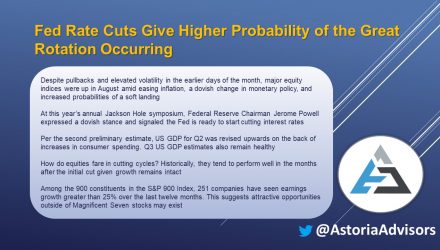
Despite pullbacks and elevated volatility in the earlier days of the month, major equity indices were up in August.
A key segment of the US Treasury yield curve briefly turned positive as weaker-than-anticipated labor-market data bolstered bets on steep interest-rate cuts by the Federal Reserve.