Search Results
Results 3,101–3,150
of 4,353 found.
Technically Speaking: Time To Sell Oil/Energy?
Over the last several weeks, in both the daily blog and weekly newsletter, I have been laying out the technical case for a breakout above the downtrend. As I stated, while such a breakout would demand a subsequent increase in equity risk in portfolios, I didn’t like it.
Sign O’ the Times: Sell in May and Go Away?
by Liz Ann Sonders of Charles Schwab,
As most readers know, I always title my reports with a fitting song title. Sadly, this year I’ve opted to choose one to honor a fallen music legend, like David Bowie and Glen Frey. This week, it’s an ode to the late-great Prince—a life gone too soon.
Bruce Greenwald: The Crisis Bigger than Global Warming
by Robert Huebscher,
Manufacturing is dying on a global basis, according to Bruce Greenwald, and its collapse will mean the demise of economies – like China – that are highly dependent on exported goods. Contrary to what Robert Gordon and others have contended, productivity is growing in the manufacturing sector – roughly twice as fast as the demand for those products. If third-world countries don’t adjust their economies to reflect this reality, Greenwald said it would be a “crisis greater than global warming.”
On My Radar: Glut – The U.S. Economy… in the Age of Oversupply
Today, my plan was to highlight two of my favorite analysts, Dr. Lacy Hunt and Dr. Gary Shilling. But that plan has changed and importantly, I believe, what I share this week can give us a better understanding of the structural issues we face. And how they might be fixed. Listening to Bloomberg’s Tom Keene early this week, I stood quiet as he interviewed Daniel Alpert.
Earnings Remain Key to Equity Forecast
Equities climbed yet again last week, with the S&P 500 Index rising 0.5%.
Corporate earnings were mixed, and the biggest market story was ongoing
strength in commodities, particularly oil and metals. Bank stocks rallied
strongly for a second week, while defensive market segments struggled to
keep pace.
The New All-Time High in SPY That Was Considered Impossible
by Urban Carmel of The Fat Pitch,
SPY made a new all-time high on Tuesday despite falling margin debt, the end of QE, negative household fund flows, flat profit growth and a host of other reasons. In other words, exactly as a rationale and objective investor should have expected.
On My Radar: First, Do No Harm
My 18-year-old son, Matthew, came to me asking about how the economy works. This summer he will be an intern and task one prior to his start date is to read “How the Economic Machine Works.” There is much we can learn from history and it makes sense to study the research from some of the brightest amongst us. From there, he and I will begin a dialogue.
Weighing the Week Ahead: Time to Sell the News?
The economic calendar is moderate. Fed Heads are mostly on the bench. The Doho oil conference (combining OPEC and non-OPEC producers) will be the first major news for the week ahead. Markets have already anticipated the outcome, just as they have the trend of first- quarter earnings. It is a classic test of the theme:
Is it time to sell the news?
If You’re Not Following this Energy Trend, You’re Being Left in the Dust
This week our office was visited by my friend, investor and author Gianni Kovacevic, who is at the halfway point of a cross-country book tour to promote the latest edition of “My Electrician Drives a Porsche?” As part of the tour, he’s driving a Tesla Model S from Boston to Palo Alto, California—Tesla’s hometown—to demonstrate the potential of green energy and spread his message that “the future is now.”
On My Radar: A Powerful and Reliable Determinant of Long-Term Investment Return
In my view, the bet today comes down to this: you believe the Fed can hold the market up (aka “the Fed Put”), you believe politicians can accomplish structural reform and you believe that the same holds true in Europe, China and Japan. Essentially, “whatever it takes” wins. Alternatively, you believe that extremely high equity market valuations matter, excessive debt is problematic and that it is ultimately impossible for central bankers, try as they might, to repeal economic business cycles.
What Will Drive the Next Emerging-Market Supercycle?
by Sammy Suzuki of AllianceBernstein,
After lagging for years, emerging equities are back in the winner’s corner. Investors are wondering if the stocks are nearing a durable turn for the better. It’s worth thinking about how the next upcycle may unfold.
Recession: Your Time is Gonna Come … But Not Yet
by Liz Ann Sonders of Charles Schwab,
Two events recently triggered renewed concerns about a U.S. economic recession. The first was the continued deterioration in Atlanta Fed’s GDPNow model—now down to only 0.1% for expected first quarter real gross domestic product (GDP) growth, after being as high as 2.7% in early February. The second was the pronouncement of a pending “very massive recession” by presidential candidate Donald Trump. Shortly after the latter I tweeted that there was little indication we were headed into a “very massive recession,” and boy did that elicit a very massive response from fellow tweeters. Many agreed that a severe recession was unlikely; but at least as many took the Trump side of the argument—with much “passion” I might add.
Mile-High Merger: Alaska Airlines Buys Virgin America, Expanding Market Reach
The $2.6 billion deal, awaiting shareholder approval in June, would create the fifth-largest U.S. airline by traffic and result in a much more competitive player, especially on the West Coast. (Alaska is based in Seattle, Virgin in San Francisco.) According to the Wall Street Journal, Alaska’s annual revenue could grow 27 percent because of the deal.
Fed's Janet Yellen Does An About-Face On Interest Rates
On Tuesday of last week, Fed Chair Janet Yellen delivered a surprising speech at the Economic Club of New York. Back in December, the Fed raised short-term interest rates for the first time in over eight years and told us to expect four more hikes in the Fed Funds rate in 2016.
90% Psychological, 10% Logical
So here we are with very modest global economic growth, seemingly excessive gains in stocks over the past several years, potentially flawed monetary policies around the world, and mediocre readings on the sentiment indicators I follow. Although this may sound like a prescription for flat—or possibly even falling—stock prices going forward, I continue to be the “nervous bull” that I’ve been for quite a few years.
The Positives Outweigh the Negatives for the U.S. Economy
The U.S. equity rally resumed last week with the S&P 500 Index climbing 1.8%. Although expectations for the upcoming corporate earnings season are low, investors chose to focus on the positives. Specifically, investors reacted to dovish comments made by Federal Reserve Chair Janet Yellen in her speech at the Economics Club of New York, which counteracted some more hawkish comments made by Fed officials the previous week. Other asset classes came under pressure, including commodities and oil, causing some skepticism about the recent rebound. The oil sell-off was due to heightened doubts about the ability of major producers to formalize a production freeze agreement.
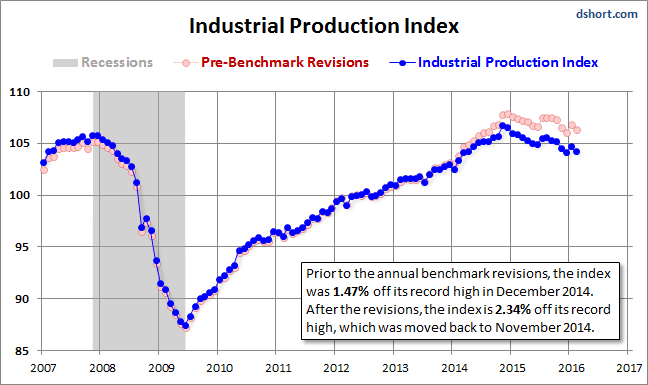
Industrial Production: Those Ugly Annual Benchmark Revisions and the Heightened Risk of Recession
by Doug Short,
The big economic news on Friday was the Department of Labor's Employment Report for March. The mainstream press focused on two numbers: the 215K new jobs and the 5% unemployment rate. Over the next few days we'll dig in a bit deeper to look at some of the underlying employment demographics, which in many ways give a greater understanding of employment conditions. But the much more significant economic news on Friday was the Federal Reserve's noon release of the disturbingly negative annual benchmark revisions to Industrial Production.
On My Radar: Fed Stuck Between Three Rocks and a Hard Place
“Now these monetary institutions are expected to continue producing miracles. But their ability to repeatedly pull new rabbits out of their policy hats has been stretched to an increasingly unsustainable degree.” -Mohamed A. El-Erian, The Only Game in Town
What a Quarter! What’s Next?
The first quarter was the proverbial roller coaster, with stocks experiencing extreme volatility, but ultimately ending up back where they started. We continue to believe U.S. stocks are in a secular bull market; but in a more mature phase which will be dotted with volatility and pullbacks. Corporate earnings likely need to recover before stocks can move demonstrably higher. More clarity from the Fed and a better political environment would help, but both seem unlikely in the near term. However, a more dovish tone from the Fed has aided in some recent dollar weakening, which has boosted emerging markets’ performance. While it is an encouraging development, stay disciplined and diversified as we watch to see if global growth can improve.
First Quarter Odds and Ends
by Carl Tannenbaum of Northern Trust,
Four months after terrorist attacks struck the streets of Paris, Europe was hit again, at its heart – Brussels. The sophistication of the attacks amid tightened security has once again raised questions around intelligence-sharing across Europe’s borders, and added fuel to the migration debate.
April Fools in March
by Peter Schiff of Euro Pacific Capital,
It may be almost impossible to underestimate the gullibility of professional Fed watchers. At least Lucy van Pelt needed to place an actual football on the ground to fool poor Charlie Brown. But in today's high stakes game of Federal Reserve mind reading, the Fed doesn't even have to make a halfway convincing bluff to make the markets look foolish.
A Different Take on Brexit
by Team of Absolute Return Partners,
With 2 1/2 months to go before the Brexit referendum it is anybody's guess what the outcome will be. In this month's Absolute Return Letter we take the rare opportunity to comment on a political event. Regardless of where you reside, the result is likely to be important for you. Like most things in life, the choices are not black and white. Enjoy the read.
The Archetypes of American Foreign Policy: A Reprise
In this report, we briefly describe and discuss the four archetypes of American foreign policy as detailed in Walter Russell Meade’s book, Special Providence. By using these archetypes of American foreign policy, one can more easily anticipate how a candidate might act if they were to occupy the Oval Office. With presidential elections less than eight months away, I hope this discussion will assist readers in examining the candidates and their potential foreign policy positions, using these archetypes as a guide. The report concludes with my characterization of the current leading candidates.
Emerging Markets Update: Is Now the Time for Emerging Markets?
by Roger Edgley, Ajay Krishnan, Andrey Kutuzov, Scott Thomas, Matthew Dreith of Wasatch Global Investors,
Why emerging-market stocks have generally performed poorly over the last five years—and why selectively chosen emerging-market businesses are now attractive in our view. We outline catalysts that could lead to sustainable advances in certain EM stocks and discuss the “new reality” that the opportunity set for truly great emerging-market investments has narrowed. This opportunity set includes high-quality growth companies in Internet technologies, health care, business-process innovation, and products and services for the expanding middle-class consumer segments in emerging markets.
Is Economic Growth in Its Final Innings?
The start of baseball season is still several days away, but a recent survey conducted by Bank of America Merrill Lynch found that 59 percent of U.S. fund managers believe the current stretch of economic growth is in its “final innings.” This is the highest reading since the financial crisis in 2008.
Market's March Madness
by Burt White of LPL Financial,
The NCAA Men’s College Basketball Final Four is set. North Carolina, Oklahoma, Syracuse, and Villanova are headed to Houston, TX to determine this year’s hoops national champion. In that spirit, we share our own Final Four for the stock market this year: China, earnings, the Federal Reserve (Fed), and oil. Stock market investors may not storm the court at the end of this year, but we do continue to expect mid-single-digit total returns for the S&P 500 in 2016 based on our assessment of our “Final Four.”
The Détente Agreement
“Corporate sector metrics have been disappointing of late… Companies are scaling back expenditures of all kinds (capital expenditures, hiring, and inventory-builds, for example), as their top-line revenues and earnings decelerate. Though first-quarter numbers may come in better than beaten-down forecasts, firms are finding that top line revenues are still hard to grow significantly.” Rick Rieder, Head of Global Fixed Income, BlackRock
Open Letter to the Next President, Part 3
by John Mauldin of Mauldin Economics,
Today we continue my series of open letters to the presidential candidates. In the meantime, we’ve drawn a little closer to knowing whom the two major parties will nominate. A few people are vowing to consider minor parties, too.
The Fed's Spring Surprise
by John Canally of LPL Financial,
As 2016 began and 2015 ended, global financial markets faced plenty of uncertainty in the wake of the first rate hike by the Federal Reserve (Fed) in nearly nine years. Although the rate hike was well anticipated and priced in by many market participants, the Fed’s move forced markets to focus on imbalances in the global economy and financial markets that had been simmering for years. The fears about how (and when, if ever) those imbalances would be resolved led to an extreme bout of financial market volatility over the first few months of 2016.
Here’s the Cost of Global Terrorism
We were saddened this week to hear that at least 30 people were killed and many dozens more injured in ISIS-related suicide bombings that targeted an airport and train station in Brussels. The Belgian and European Union capital joins Paris, San Bernardino, Ankara, Jakarta and too many other cities in the past year alone that have come under fire from the Islamic terrorist group.
Extinction Burst
by John Hussman of Hussman Funds,
When a given behavior stops being reinforced, one might expect the behavior to be abandoned. Instead, and particularly when no substitute behavior is available, you’ll actually see an initial “extinction burst” - a nearly frantic increase in the frequency and the intensity of the behavior. Consider central bankers.
Rising Global Taxes and Regulations (Indirect Taxation) Are Chipping Away at the Benefits of Low Int
Compliance and regulation measures have intensified from the financial sector to the food industry, from the U.S. all the way to Brazil. Many CEOs of banks, as well as brokers that I have spoken with recently, have lamented on the financial burden of excessive regulation and the indirect taxation that comes along with this rise in rules on steroids. Regulations are fueled with good intentions; however, the unexpected consequences like slow global growth need to be adjusted.
Five-Year Outlook: Make Headwinds Your Tailwinds
This outlook report informs BMO GAM’s longer-term strategic portfolio allocations and has been distilled into three possible scenarios expected to dominate the global economy over the next three to five years. The report helps drive BMO GAM’s investment strategies and often plays a role in guiding active global asset allocation opportunities across the firm’s global investment centers. The firm’s primary case calls for a broadening of U.S.-led global growth into key geographies, particularly Europe and Japan.
Results 3,101–3,150
of 4,353 found.