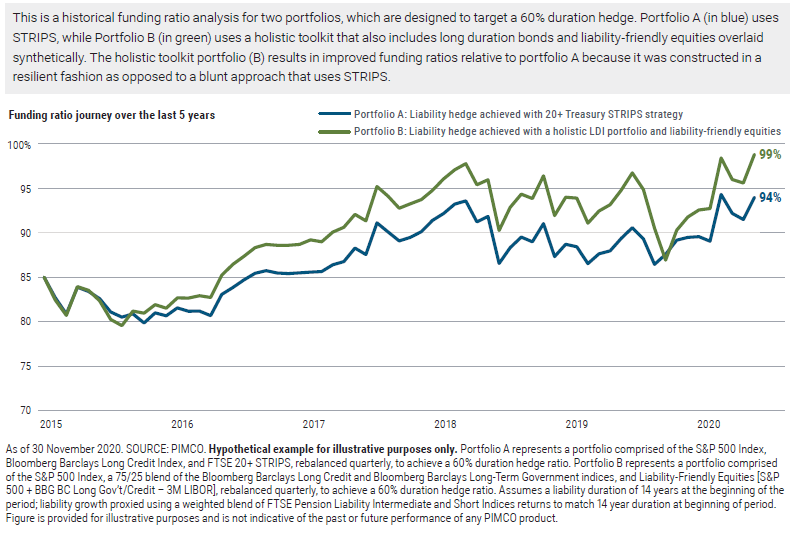
A holistic LDI portfolio may provide a superior liability hedge.
You can take active steps to protect your practice, clients, and employees by following this checklist.
Despite seeing major market swings following the 2016 Brexit referendum, we don’t expect Britain’s departure from the European Union (EU) to have any major economic effects in our baseline outlook for 2021 and beyond. Far more important are COVID-19, fiscal policy, and bigger questions around future productivity growth.
The new year kicked off with a sharp rise in Treasury bond yields, despite unprecedented political turmoil and signs that the economic recovery is slowing.
Judging by recent phone calls and email queries, inflation is a serious concern among investors this year.
Emerging-market stocks rebounded in 2020 even as the COVID-19 pandemic spread globally. As vaccines and other favorable conditions unfold, investors have good reasons to consider EM equities in 2021 while strategically considering their potential risks.
In September 2019, I wrote “NFIB Survey Trips Economic Alarms,” Of course, it was just a few short months later the U.S. economy fell into the deepest recession since the “Great Depression.” The latest NFIB survey is sending a strong warning to investors piling into small-cap stocks.
House Speaker Nancy Pelosi is seeking to impose fines of as much as $10,000 for representatives who violate new security screening rules. Oklahoma lawmakers and their staffs are being told to stay away from the state capitol building in Oklahoma City over potential protests. Washington is temporarily shutting some subway stations near the Capitol to deter travel while security is on high alert.
Global output and demand are likely to rebound strongly in 2021, but we see risks that call for careful portfolio positioning.
The sage advice to “know what you are investing in” is being dangerously overlooked by both novice and seasoned investors when it comes to bitcoin. A former bitcoin miner explains why the price of BTC is nearly certainly a bubble and likely manipulated. Investors should proceed with extreme caution.
In his forecast for 2021, Jeffrey Gundlach predicted a “regime change.” Investors should prepare for themes that reverse prior trends: U.S. equities will underperform the rest of the world, inflation will rise, volatility will be higher, and the dollar will weaken.
I spend a lot of time studying about how financial advisors should differentiate themselves. But perhaps this is a waste of time for several reasons.
The Loomis Sayles Emerging Markets Debt Sector Team shares their views on corporate spreads, foreign exchange and leverage in 2021.
It’s right there in the first few pages of “Trump University Branding 101”: “The truth is, everything you say and do is important,” he wrote in the 2008 book’s foreword. “Actions matter.”
Most people are probably happy to waive goodbye to 2020 amid the COVID-19 pandemic, which played out in ways few could have possibly predicted. David Mann, our Head of Global Exchange-Traded Funds (ETFs) Capital Markets, isn’t going to make predictions about vaccines, mask-wearing or other such matters, but does offer his insights on ETF industry trends he sees taking shape.
Whereas commodity production had been a major economic driver in emerging markets, we think technology is now the leading force. Semiconductor advancement is the “new oil.” semiconductor companies are so far ahead of their competitors that supply is in fact a constraint—and therefore a major investment consideration.
This week’s letter is the first part of my 2021 forecast. There is simply too much to cover in one letter, and today we’ll start with the most important factor, a known unknown, that I think will be the driver for 2021.
I'm going to assess the state of the profession as we emerge, exhausted, from our tumultuous 2020 experience.
Raymond James Chief Economist Dr. Scott Brown reflects on the trials and tribulations of 2020 and discusses his outlook for the new year.
The performance of ESG funds has been unimpressive, according to new research, and the occasional outperformance is driven mainly by funds’ expenses, exposures to certain industries and factors.
In the current bull market advance, few people are willing to sell, so buyers must keep bidding up prices to attract a seller to make a transaction. As long as this remains the case, and exuberance exceeds logic, buyers will continue to pay higher prices to get into the positions they want to own.
Gold and Bitcoin had a very good 2020. Investors, worried about currency debasement from all the money-printing, sought stores of value. Gold surged over 25%, its best year in a decade, while Bitcoin was up more than 300%.
Although some on the committee agreed with the market consensus for a moderate continuation of economic growth and equity markets, the majority agreed with a more positive scenario in which the global economy outperforms market consensus, while equities, especially those outside of the US, rally sharply.
Rick Rieder and team describe how revolutionary changes taking place in corporate business models will impact investing for years.
Templeton Global Macro CIO Michael Hasenstab offers the team’s 2021 outlook.
A nascent global recovery presents both risks and opportunities for fixed income investors. Portfolio Manager Teresa Kong, CFA, discusses why China dominates the universe for EM debt and why Asia may outperform the rest of EM for the foreseeable future.
To organize your team and prepare for the year ahead, take your team through the steps.
There is strong demand for steady income. However, most investment products and strategies fail dismally in this regard.
Given that we have entered a recession, should investors cut their equity allocation? Or move to larger stocks with good financial health?
We’ll take a closer look at the stock market and where it may be going.
How much money do you need to have to be considered rich or wealthy?
Science is winning the battle against the covid-19 coronavirus. The advance in therapies has already contributed to a significant reduction in hospitalisation and fatality rates vis-à-vis the number of cases, while the multiple of approved and soon to be approved vaccines puts the livelihoods of billions of people on track to normalise in 2021.
The news on vaccines has boosted optimism for the economy for 2021. In contrast, near-term developments have been unfavorable. COVID-19 cases have surged and in all likelihood will rise further in upcoming weeks.
We believe traditional fixed income should continue to provide a reliable source of diversification against a growth shock, but low rates and the risk of an inflation shock necessitate broadening the menu of diversifiers.
An interesting thing keeps happening in the American stock market. Lately, when ownership of young companies passes from the institutions who nurtured them into the much broader arms of the investing public, their valuations double.
Given their small size, narrow focus and high degree of specialization, it is reasonable to expect that active sector funds generate alpha. New research shows this is the case – but with a lot of caveats.
Of the many tales being told to justify record equity valuations, low interest rates are among the more popular. However, that is only half the story.
With apps designed for entertainment, travel, business, fitness, productivity, and more, the slogan ‘there’s an app for that’ sure seems to be true. But just as our daily lives are engrained in technology, the equity market’s performance has been reliant upon technology too.
Tailwinds for emerging markets include strong potential for earnings recovery, as well as a weaker U.S. dollar and reasonable equity valuations. Chief Investment Officer Robert Horrocks, PhD, considers the investment landscape in his annual review and outlook.
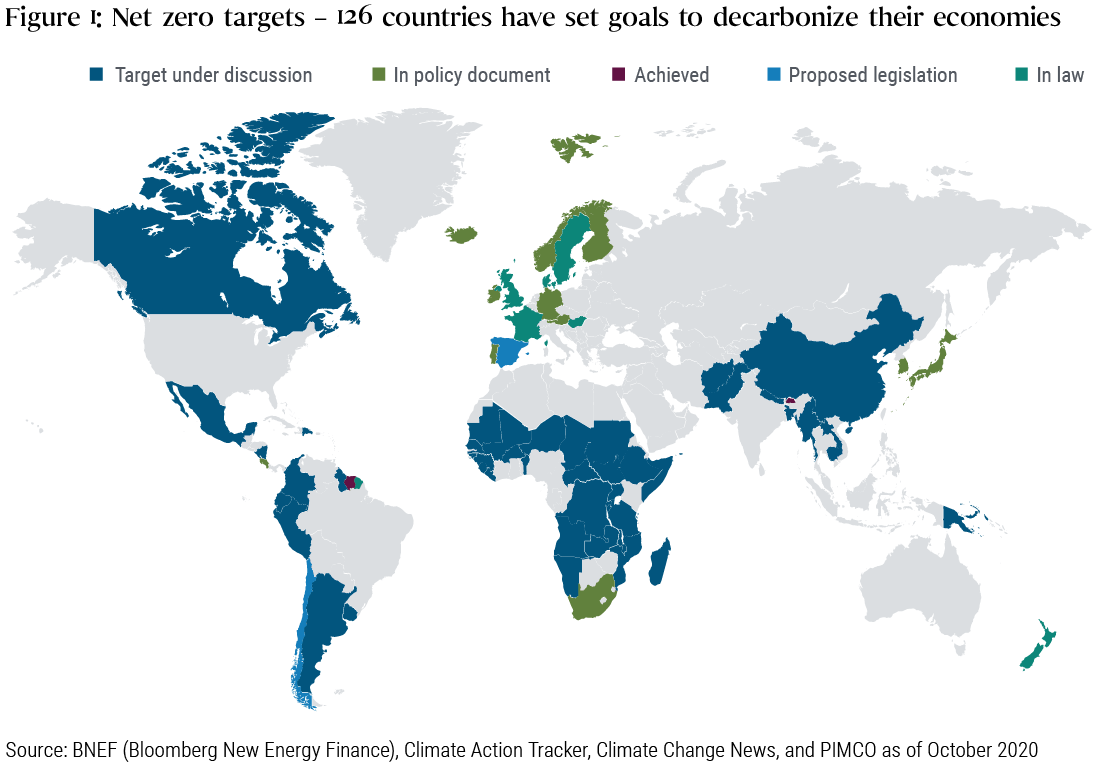
Some of the world’s leading countries have recently announced major sustainability targets. These moves, aimed at making economic recovery faster and more sustainable, will create investment opportunities as well.
Key Points
A COVID-19 vaccine could start being administered globally this week.
The planned rollout is good news that has lifted the stock markets around the world. But the reality of the rollout faces risks that could extend the time frame for mass immunizations.
We expect markets to be volatile in coming months while the threat of new lockdowns weighs against the hope of recovery, although we believe we may be on the verge of a period of international stock market outperformance.
We see five independent areas providing evidence of a commodity bull market. They are, commodities themselves, the economy, and the bond, stock and currency markets. Let’s consider them in turn to see if this time commodities can fulfill their promise.
Franklin Small Cap Value Fund Assistant Portfolio Manager and Research Analyst Nick Karzon gives five reasons why we continue to see attractive long-term opportunities for select small-capitalization (small-cap) P&C insurers.
GMO’s new quarterly letter to clients examines the worst 12-month performance for value stocks in history and explores how investors can profit from a period reminiscent of previous bubbles in global markets.
Some changes unfold over time and it’s possible to see them coming. There are demographic changes coming in the next decade that will change the direction of the U.S., since the Silent generation and the Baby Boomers hold a different view of government than Gen Z’s and Millennials.
Whether you’re looking to dust off your CRM software and learn to better use its features, or you’re looking to make a CRM investment for the first time, here’s what you need to know.
Let's look at some of the assumptions that lead people to believe they have a fear of success, along with some questions to ponder.
The story of U.S. inflation in 2021 could very well amount to this: It’s all a mirage.
The year 2020 will be remembered for any number of things, including how wrong so many were about so much. From the pandemic to the election, and from the economy to financial markets, prognosticators did a horrible job.
Investors may choose a passive fund because they don’t believe they can distinguish between luck and skill among active fund managers. But new research shows that the issue of luck and skill plays an important role in passive fund returns too.