As the Q1 2026 earnings season enters its most frantic stretch, the market stands at a critical crossroads between resilient corporate fundamentals and macro-driven anxiety. While the high percentage of early beats suggests that American business remains surprisingly nimble, the coming days will determine if that momentum can withstand the Mag 7’s massive spending requirements.
Like many of you, I am inundated with information. Most of it is not useful or repetitive. Today, were going to do something different. Rather than one theme, let’s look at various bits of data that I found interesting this week.
Back-and-forth developments over the weekend around the Strait of Hormuz have added near-term volatility to energy markets. That uncertainty is feeding into oil prices and reinforcing questions about how persistent energy-driven inflation pressures could become, particularly if disruption risks continue to ebb and flow.
Last week’s economic data was defined by conflicting signals from the consumer. While retail figures suggest resilience, sentiment levels have plummeted to record lows. Meanwhile, the S&P 500 continued its historic rally as markets prepare for the upcoming Fed decision.
There’s no shortage these days of stories, posts and videos warning of the robot armies readying to vacuum up white-collar jobs in technology, finance, marketing, you name it. And there’s no doubt that artificial intelligence is rapidly changing how we live and work. Amid all this, though, a relative calm has descended on the labor market and should persist for the rest of this year, at least.
The index is on the verge of doubling for the first time in this bull market – currently up ~99% – a move that would take just under 3.5 years, slightly faster than the historical average of 3.9 years. While all sectors are in positive territory over this period, leadership has been narrow with only three – technology, communication services and industrials – posting gains above 100%.
Global bond markets are heading for their worst week in a month as investors grow increasingly uneasy about a stalemate between the US and Iran.
The spring edition of our Investment Directions takes on a new look. As the weather heats up, our “summer body” of work embraces a slimmed down word count, Q&A format, and visualfirst approach – better for consuming on the go, or preferably, outdoors.
Kevin Warsh's bid to become the next chair of the Federal Open Market Committee (FOMC) unfolded amid sharp political tension, legal uncertainty, and pointed questions about his independence from President Trunp. During a combative Senate confirmation hearing, Warsh sought to reassure lawmakers that he would not allow political pressure to dictate monetary policy, even as unresolved Justice Department investigation into current Chair Jerome Powell threatens to delay his confirmation and underscores broader concerns about the politicization of the central bank.
Markets are being pulled in multiple directions. Geopolitical tensions, questions around Federal Reserve policy and the rapid rise of artificial intelligence are all competing for investor attention.
Markets have long struggled to price geopolitical risk. Part of the issue is that each flare-up tends to be viewed as a one-off volatility jolt to be weathered and then faded once there is resolution.
During and after World War II, Allied forces established airbases across remote Pacific Islands, bringing with them food, medicine, tools, and machinery that the indigenous people had never encountered before.
Higher oil prices have both positive and negative effects on the municipal bond market. Investors may want to evaluate their concentration risk.
At this point, investors of all ages are well aware just how much inflation can cut into one’s spending power, whether it be for everyday expenses or big-time purchases.
Stocks have been on a bit of a rollercoaster over the past two months. If your nature is to tune out the noise and check in occasionally, you might have missed it. After a 9 percent sell-off earlier in the year, markets quickly rebounded and have recently traded at all-time highs.
Concerns about the sustainability of U.S. fiscal policy have moved back into the investment spotlight. Over the past week, both multilateral institutions and prominent policymakers have raised warnings about the potential implications of America’s expanding debt burden for Treasury markets.
New Federal Reserve (Fed) chairs don’t come along often. Since 1980, only five individuals have led the Fed: Jerome Powell is currently in his second term, Janet Yellen served one term and Alan Greenspan famously held the role for more than 18 years.
Each spring, the International Monetary Fund (IMF) releases its World Economic Outlook (WEO), a review of global growth, and the key challenges confronting the world economy. This year’s edition followed the Fund’s usual structure, but the circumstances underneath it had shifted. ]
It’s a busy macro stretch as company earnings reports come in fast and furious. A focus on real data and earnings may be a welcome development for investors wary of geopolitical headlines. The team at Wall Street Horizon will keep you up to speed with the latest trends, and you can access our industry-leading forward-looking corporate event data to stay ahead of markets.
Fixed-income market sentiment was dominated by geopolitical headlines, particularly the conflict in the Middle East following disruptions to the Strait of Hormuz and rising oil prices, which contributed to renewed inflation concerns.
Since the Federal Reserve announced the resumption of quantitative easing (QE) in December, the central bank has expanded its balance sheet by over $200 billion.
The U.S. market story this year has been a tug-of-war between sticky inflation, slower growth, and resilient risk appetite. For fixed-income investors, that mix has produced more narrative movement than the 10-year Treasury itself.
While we are currently in a particularly grueling climb (including the war in Iran – a situation in which we will provide an update at the end of this piece), we cannot lose our long-term perspective. We want to take this piece as a summit in the middle of our hike; one where we can see a path through the trees and hills and clearly see four potential paths from here.
Vanguard is boosting its holdings of Treasuries, taking advantage of higher yields following the Middle East conflict to lock in rates and hedge against the risks of a potential growth slowdown.
Stocks are trading near a record high, signaling Wall Street is learning to cope with lingering geopolitical risks. Main Street is struggling to catch up.
LPL Research examines the fixed income space as global bonds broaden yields and reduce U.S. concentration, offering diversified income and resilience via non‑U.S. developed and emerging markets.
The stock market selloff between February 28 and April 14 produced one of the more instructive market lessons in recent memory. It isn’t because of what the market did, but because of what investors did in response.
As always, I hope you’re having a good 2026 and that all is well with you, my readers, and your family and friends. Here’s my latest.
While Russ acknowledges that the ongoing conflict in the Middle East has contributed near-term volatility, he also notes that these rising tensions are occurring against the backdrop of a solid U.S. economy.
The long-term care confidence gap is the difference between understanding the importance of a risk and consistently addressing it with clients. Advisors know, but they do not always say. The gap isn’t about intelligence or professionalism; it’s about the difference between technical knowledge and conversational leadership.
Yes, much of the blame lies with energy prices, which surged due to the war in Iran. Still, the March reading of the Consumer Price Index (CPI) serves as a reminder of the work to be done to damp inflation.
The federal government is still on an unsustainable fiscal path with the national debt reaching $39 trillion in March and set to move higher in the years ahead as we keep running budget deficits. However, beneath the headlines both revenue and spending trends have shifted in a positive direction. It’s possible that investors are recognizing this and this may be helping buoy stock markets.
The history of the U.S. airline industry is really a history of consolidation driven by crisis. The pattern has been remarkably consistent. Historically, when an external shock has hit—a recession, a war, an energy spike—the weakest carriers have folded or been acquired, while the strongest have emerged leaner and more profitable.
Over the past few weeks, a rising tide of optimism has been gathering in the equity markets. This positive momentum reached a crescendo last week when Iranian Foreign Minister Abbas Araghchi announced that, in line with the ceasefire in Lebanon, the Strait of Hormuz would reopen for commercial vessels after being closed for approximately seven weeks beginning in late February.
Clearly the path to peace is not as easy as it looked last Friday when the easing in Middle East tensions, the reopening of the Strait of Hormuz to commodity flows, and the sharp retreat in oil prices calmed fears on the most immediate macro threat to equities.
The Q1 2026 earnings season has officially started, and the early results suggest a market that is largely defying the geopolitical fog we’ve discussed.
Get ready each week with high-conviction insights that go beyond media headlines.
Oil shocks hitting economies with weak demand and strained balance sheets are especially damaging. Firms cannot fully pass on rising costs, so margins shrink, layoffs increase, and investment falls. Tightening monetary and credit conditions would cause inflation to fade faster but job losses, failures, and fragile household finances to be much worse.
Choosing when to invest is one of the most important factors influencing your retirement security. The best time to start building retirement savings is after your first paycheck. Starting that early allows you to maximize how much time you have to save and how much time those dollars have to grow, thanks to compounding interest.
Developers including D.R. Horton Inc., Lennar Corp. and KB Home all missed expectations last quarter and estimates suggest both sales and earnings have fallen further as conflict in the Middle East unsettled buyers and raised costs.
Today we're going to look at the underlying data and find that while the world is not ending anytime soon, there are actually good reasons for the disparity in forecasts. So, it’s okay if you’re confused. The stock market just hit an all-time high, energy is volatile and will be a negative on global growth, to say the least.
April 15th was Tax Day. It’s a source of misery for many of us as we write a big check to the IRS. But did you know the IRS isn’t the source of your biggest tax bill? In fact, you don’t even get a bill. You just pay the tax every time you buy something.
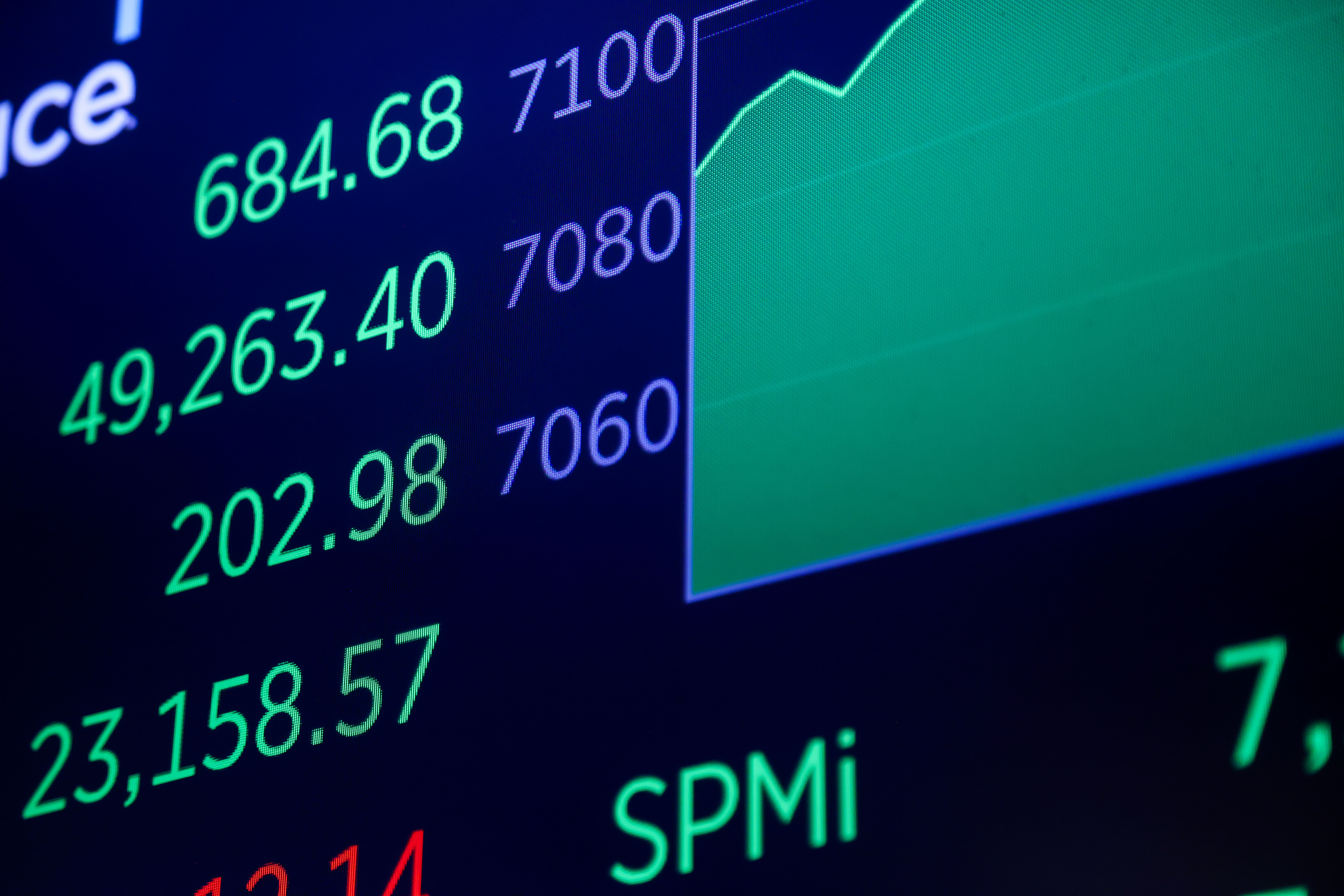
The S&P 500 closed Wednesday at a fresh all-time high of 7,022.95, surpassing the late-January peak and capping a remarkable round trip from the spring selloff.
Iran war-related headlines continue to cause volatility in the markets and oil prices to rise, but our experts remind readers that uncertain times might also present opportunities.
After a 9.1% drawdown, the S&P 500 surged 11% over the last 12 trading days to a new record high, breaking above the 7,000 level for the first time.
EQT AB, Europe’s biggest private equity firm, says the path to exiting investments in clean-energy developers and operators faces a growing number of hurdles.
Late last week, investors were hit with news of the worst inflation spike in nearly two years. But a closer look “under the hood” reveals that price pressures aren’t nearly as bad as some headlines suggest.
As transition activity increases, what was once seen as a step between portfolios is becoming part of the outcome itself. Execution is now more closely tied to how portfolios are reshaped, particularly as restructures grow larger, more frequent, and more complex.
Headline economic indicators remain resilient as gross domestic product (GDP) continues to expand, the unemployment rate remains low and wage growth has held up better than expected. However, these figures reflect averages, not the lived experience of households.
Much of the conversation around private credit versus public high yield focuses on yield levels, default expectations and headline volatility. But we think what matters most is how each market lets investors measure, manage and reprice risk as conditions change.