The private equity industry has rediscovered its mojo. The latest updates from the publicly traded firms specializing in the asset class satisfied investors’ appetite for bullish vibes from the leadership teams. As shares in alternative investment managers build on an already strong recovery, the risks of disappointment can only mount.
This article identifies 10 real-world considerations in tax efficient distribution planning from the perspectives of an academic (Wade Pfau, PhD), a practitioner (Joe Elsasser, CFP), and a CPA (Steven Jarvis).
Six years after a famous blowup in the volatility market shattered a lengthy calm in US stocks, the latest Bloomberg Markets Live Pulse survey reveals growing Wall Street concern over a new boom in trades that bet against equity turbulence.
High yield did well across multiple sectors in the U.S., according to the BondBloxx Fixed Income Monthly Update for January.
Closed-end funds (CEFs) are relatively under the radar compared to peers like exchange-traded funds (ETFs) and mutual funds. Closed-end funds are generally desirable for two reasons: 1) high income; and 2) premium/discount mechanism.
A data-dependent Federal Reserve is keen to hold interest rates until it gets additional confirmation inflation is cooling. This could keep the window open for prospective bonds investors seeking value opportunities.
Mortgage rates in the US inched higher amid signals that the Federal Reserve is likely to keep its policy steady for some time.
Franklin Fixed Income CIO Sonal Desai discusses why the recent acceleration in productivity growth might prove durable, leading to higher potential returns on real investment and a higher equilibrium interest rate.
Over long horizons, dividends’ growth and reinvestment of those payouts serve as vital factors in portfolio growth. However, dividends aren’t guaranteed and with bond yields still high, some skittish investors may be inclined to embrace fixed income over equity income.
One of the more fascinating and mysterious parts of watching the Federal Reserve is the ongoing dialogue between Fed leaders and Wall Street. We imagine private meetings held in great secrecy. Those may in fact occur, but I’m not sure they are even necessary.
Tomorrow marks the start of China’s Lunar New Year, meaning it’s out with the Rabbit and in with the Dragon… but all eyes remain on the Bear. And no, I’m not talking about the hit Hulu series, but Russia.
One of the primary hurdles to broader adoption of environmental, social and governance (ESG) investing principles and the related funds has been long-lacking clarity and regulatory framework covering ESG ratings and regulations.
Alongside great content, we’re also bringing some of the most prominent voices in finance to the stage. J.P. Morgan Asset Management’s chief global strategist Dr. David Kelly recently shared what he’s thinking about and watching in markets ahead of Exchange.
Mega-cap Tech names have been strong outperformers year-to-date. In fact, a composite of the biggest names, or MAGMAN (MSFT, APPL, GOOGL, META, AMZN, NVDA) is up 12%, while the rest of the S&P 500 is up just 2%.
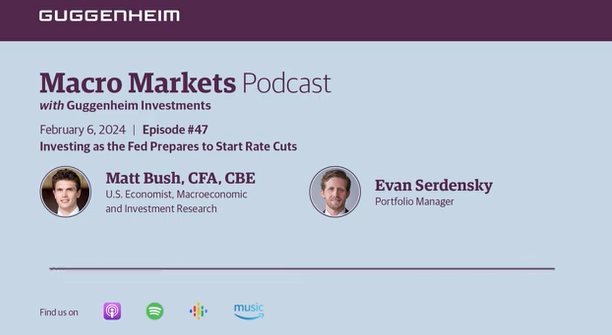
Matt Bush and Evan Serdensky share their updated outlook following the latest FOMC meeting and the January jobs report.
Hedge funds are paid big bucks for making smart market bets. Yet these days, a simple feature of the financial plumbing — largely overlooked on Wall Street during the low interest-rate era — is helping juice industry returns.
The US government sold $25 billion of 30-year bonds at a lower-than-anticipated yield, soothing investor nerves about demand for longer-dated debt.
With a laser focus on the future, David Mann, our Head of Global Exchange-Traded Funds (ETFs) Product and Capital Markets, shares his 2024 outlook for the ETF industry and the key trends he sees taking shape.
With eight seconds left on the play clock, Harrison Butker of the Kansas City Chiefs kicked a chip shot field goal that put the nail in the coffin for the Philadelphia Eagles.
A new ETF playoff champion has been crowned. Artificial Intelligence routed spot Bitcoin ETFs to claim the first-ever ETF championship.
U.S. Stocks were positive in January as more Goldilocks economic data fueled investor optimism. U.S. gross domestic product (GDP) came at a +3.3% for Q4 2023, much stronger than the expected 2% gain.
Doom spending is “spending money despite concerns about the economy and foreign affairs to cope with stress,” says the credit-tracking company, and about 27% of Americans say they’re doing it.
The US government sold a record $42 billion of 10-year notes Wednesday at a lower-than-anticipated yield, soothing investor nerves after a recent rout and indicating confidence that the Federal Reserve will eventually cut interest rates.
Whether you have a family member turning 18, or someone in your life looking to build wealth from the bottom up, this primer provides a solid overview of the basic types of securities, investing strategies, and valuable lessons to help pave the path toward financial confidence.
In less than 2 weeks, advisors will flock to sunny Miami for the annual Exchange Conference. Content sessions this year offer advisors insight into growing their business models in unexpected ways, the macro and market environment of 2024, navigating the AI revolution, and more.
Janus Henderson Investors Portfolio Managers Greg Wilensky and Jeremiah Buckley discuss what they consider the three essential elements of an effective balanced strategy in the current environment.
At its core, inflation is too much money chasing too few goods. That was the case in 2020 through 2022. This is not the case anymore.
While the ability of humans to demonstrate empathy is invaluable, few appreciate the impact of “artificial empathy,” which is incorporated into AI and is likely to become more sophisticated.
It is certainly a confusing economic environment. Jobs growth is strong yet there are constant reports of high-profile company layoffs. The yield curve is inverted suggesting a recession yet the stock market is at a record high.
I received an email this past week concerning George Soros’ “Theory Of Reflexivity.” It’s an interesting question, and I have previously written about the “Theory of Reflexivity.” Notably, this theory begins to resurface whenever markets become exuberant.
Instead of pivoting directly toward an easing bias, the Federal Open Market Committee opted for a wait-and-watch approach in January. Franklin Fixed Income Economist Nikhil Mohan expects rate cuts to come, but not quite as soon as or as many as markets have been anticipating.
The can has been kicked down the road several times but it feels like the end of the road is in sight.
VettaFi’s Roxanna Islam offers perspective on the “Magnificent Seven” and their growing concentration in market cap-weighted indices. BondBloxx’s Joanna Gallegos highlights the firm’s unique lineup of precision fixed income ETFs. Goldman Sachs’ Greg Tuorto discusses the Goldman Sachs Small Cap Core Equity ETF (GSC) and the potential opportunity in small cap stocks overall.
Here are some of my favorite digital tools that can help make running a growing financial advisory business easier.
It’s up to advisors to deploy technology without losing sight of what clients want. Consider these examples.
As I observed last month, the strongest stock market returns in the coming decade, perhaps longer, are likely to emerge during advances in the S&P 500 that attempt to catch up with the cumulative return of risk-free Treasury bills.
While focus remains on when the Fed will start cutting rates, history suggests other factors must be looked at when assessing forward stock market performance.
Treasuries are headed for their biggest two-day loss in months as strong economic data reinforced the message of Federal Reserve officials including Chair Jerome Powell that interest-rate cuts are unlikely to begin before May.
Markets have made themselves clear for a while: they want more rate cuts than what Federal Reserve (Fed) members seem to be willing to accept at this time.
There is no shortage of hope – and hype – about what artificial intelligence could do for productivity and economic growth in the future. But we must bear in mind that our politics have proven too dysfunctional, and our policies too misguided, to manage even the most obvious threats to our future.
I'm going to predict the future. Not the coming year. Not the markets. But the trends that will emerge in 2024 and will shape the future, which advisory firms can prepare for now so that the strong, gusty winds of change will howl at their backs instead of in their faces.
Brian Kelly is The Points Guy, a pioneer in the cottage industry that helps credit card users get the most out of airmiles and other rewards. He got into it when young out of a determination to always fly business class. His motivation? “I’m six-foot-seven!” he says.
State taxes are not just a footnote in the financial statements of NBA players; they are a central element in the negotiation process.
Saving rates rose immensely across economies during the pandemic period. Government support programs, many designed to stimulate demand, elevated household incomes.
American shoppers won’t be deterred by mounting credit-card bills or the recent ripple of layoffs, according to the latest Bloomberg Markets Live Pulse survey.
The US economy is testing bond traders’ faith that the Federal Reserve will deliver a series of interest-rate cuts this year.
A period of market volatility and consolidation is likely as markets have already priced in much of the economy's good news.
The start of 2024 has been marked by record issuance in bonds both in the public and private sectors. But as fresh supply hits the bond market, prices have been dipping as of late.
While interest rates were left unchanged at the January Fed meeting as expected, there were some interesting hints about future monetary policy. Stephen Dover, Head of Franklin Templeton Institute, opines.
Modern economies, even small ones, are unfathomably complex. The number of variables is far more than any human can comprehend or any model can track. It’s really no wonder so many forecasts are wrong.