The stock market is buckling under the weight of a simple equation: cash earns more than equities.
The Fed sent a strong signal that interest rates will remain higher for longer, as our Franklin Templeton Fixed Income CIO Sonal Desai has long predicted. The Fed also started to acknowledge that the natural real rate of interest is higher than it thought.
Private infrastructure offers unique investment characteristics and potential diversification benefits for portfolio construction.
The Federal Reserve forecasts only a modest uptick in U.S. unemployment next year as inflation cools, but history and current labor market trends make us less certain.
Investors that missed out on this year’s dizzying rally in Nvidia Corp. have an attractive entry point this month.
The aim of this series is to move beyond the simplistic example of goals that exist at a single point in the future to consider retirement, the most common purpose for long-term investing for an individual.
To judge by recent history, a US government shutdown won’t be a huge event for the bond market. If anything, it could even provide a little short-term relief, since Treasuries usually rally when investors need somewhere to hide.
It might be hard to believe after the crypto winter of 2022, but monetary tightening by global central banks could be supportive of Bitcoin upside.
In many ways, 2023 continues to be the mirror image of 2022, with the most volatile assets being some of the best performers for much of the year.
Today, in a shock decision, the Bank of England (BoE) left its policy rate at 5.25% by the tightest possible majority vote of 5-4. All but one of 65 economists polled by Reuters had predicted that the BoE would raise the rate to 5.5%.
Wednesday’s Federal Reserve (Fed) decision to keep the federal funds rate unchanged wasn’t a surprise at all. Markets, as we argued last week, had predicted that the Fed was going to stay put and that is what it did.
The Northern Trust Economics team shares its outlook for major markets in the months ahead.
A balanced portfolio needs assets with strong return potential and those that may provide downside mitigation. We believe direct lending can deliver both—a potentially valuable feature, particularly in today’s uncertain market.
Energy and Gold Produces Face Increasing Pressures, Crimping Supply.
A string of CPI readings heading in the right direction. A labor market and consumer that are still intact. All of the sudden, the recession consensus has given way to a soft landing. Learn what may be in store for the equity market.
The hit TV series “That 70s Show” aired from 1998 to 2006 and focused on six teenage friends living in Wisconsin in the late 70s.
Some seven weeks ago, hedge fund investor Bill Ackman laid out his rationale for shorting long-term US bonds, and I took exception.
Bond investors face the crucial decision of just how much risk to take in Treasuries with 10-year yields at the highest in more than a decade and the Federal Reserve signaling it’s almost done raising rates.
Consumer stocks, one of the brightest corners of the market this year, are about to lose their shine as risks build for the sector, according to Morgan Stanley’s Michael Wilson.
Investment-grade credit is currently offering impressive yields, with relatively less risk than other fixed income sectors, according to Josh Lohmeier of Franklin Templeton Fixed Income. He makes a case for investing in the space today.
I, however, like all Kens, have always had a firm grip on the remote for 100% of the time but I decided to let her have her way just once.
Federal Reserve Governor Lisa Cook said the use of artificial intelligence in the economy presents many unanswered questions for policymakers though there is some evidence that it could improve labor productivity.
Fund managers have been avoiding emerging markets (EM), especially when it comes to China. However, that doesn’t mean there aren’t opportunities that exist.
The Federal Reserve weighs the data while investors wonder: Is the rate-hike cycle over?
Call it another case of bad timing for Wall Street strategists. The group, historically known to have a bullish bent, spent most of this year saying US stocks would end lower in 2023. Instead, the S&P 500 Index rallied 16% in the first half.
For the second time in four months, the central bank decided to not increase interest rates but indicated another hike in 2023 is likely.
While some stocks may seem expensive, there are areas of opportunity that feature attractive valuations and growth catalysts, according to the Franklin Templeton Investment Solutions team.
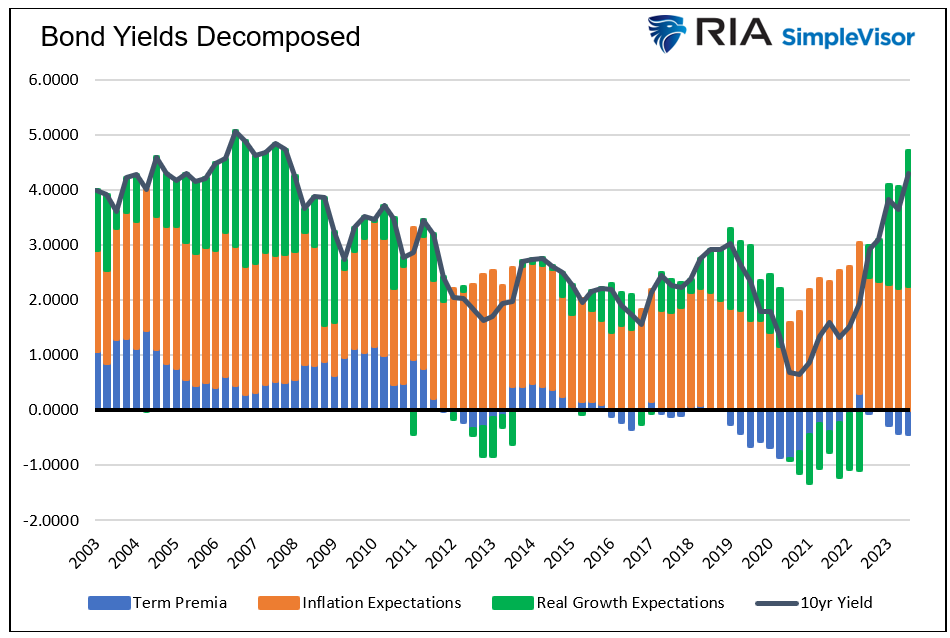
Treasury 10-year yields rose above 4.5% for the first time since 2007 as a more hawkish Federal Reserve adds to concern the bonds face a toxic mix of large US fiscal deficits and persistent inflation.
Investment bankers were finally starting to believe in the green shoots of capital-markets activity this month, but the Federal Reserve might now have crushed them under hawkish boots.
While the Fed kept rates unchanged at today’s meeting, between the press conference and forecast updates, Powell and Co. gave plenty of ammo to keep the financial press busy speculating about what may come at the next FOMC meeting this Fall.
The September Federal Reserve meeting provided few surprises, but ongoing uncertainty about the Fed's next move may mean more volatility ahead.
GMO has published a new 7-Year Asset Class Forecast.
The biggest growth companies continue to increase their concentration in major equity indexes this year. It’s not surprising that investors are starting to rethink their exposure to large-caps, given concentration risk and ongoing market uncertainty.
Labor strikes aren’t cheap. Equipment sits idle. Supply chains get gummed up. Workers lose wages, shareholders lose profits, governments lose tax revenue. All these effects can have an adverse impact on economic growth, employment and inflation.
The Federal Reserve’s internal debate about the “neutral” real rate of interest is heating up.
Bond traders are bracing for Treasury yields to keep pushing higher after the Federal Reserve signaled it’s likely to hold interest rates at lofty levels well into next year.
Can the economy grow 2.0% to 2.5% faster per year over the next 10 years than the last 30 years? I don't think so.
The European Central Bank is likely at or very near its peak policy rate, but we don’t expect rate cuts in the near term.
Inverted curves (when the gold line goes below the red line meaning that short maturity yields are higher compared to longer maturity yields) have preceded recessions.
The Franklin Templeton Fixed Income team believe that issuers that think critically about the environment in which they operate could outperform throughout the full market cycle compared with those who are slower to adapt.
Whatever stories Americans are told about the strength of the economy under President Joe Biden, they are not going to be persuaded to look past the issue of their own living standards. For most Americans, these have declined somewhat as price increases have outpaced wage growth.
Banks have reemerged as a potential pain point for the investment community, as rating agencies recently embarked on a downgrade cycle in the sector.
Industrial securities are unloved by financial advisors. However, it is the backbone of a relatively popular sector ETF and two relatively new thematic ETFs positioned to benefit from transformational changes. Perhaps they want to dive deeper into the fundamentals with us during the VettaFi Equity Symposium on September 21.
Consumers might still be benefiting from inflation pressures abating, but the same is no longer true for corporations.
US five- and 10-year yields rose to the highest levels since 2007 after hotter-than-anticipated inflation data in Canada and rising oil prices added to global concerns about resurgent price pressures.
Investors have had a lot thrown at them this year: more Federal Reserve tightening, a regional banking crisis, and geopolitical turmoil. And yet US stock indexes are on track for a stellar year.
For new investors, the world of finance can appear daunting. But among the sea of investment options, Treasury bonds (often just called “Treasuries”) are a pillar of stability and reliability.
A return to the Great Moderation Era looks unlikely, which might lead to an increasingly volatile—and somewhat unfamiliar—inflationary, economic, and geopolitical landscape.
Celebrating an exciting milestone: Franklin Income Fund turns 75. Learn more about this flagship strategy and read some fun facts from back in 1948.
The term “Bond Vigilantes” is a nostalgic twist on an old-west theme. In the nineteenth century, the American West formed self-appointed groups, or committees, to seize the duties of law enforcement and judicial authority in situations when citizens found law enforcement lacking or inadequate.