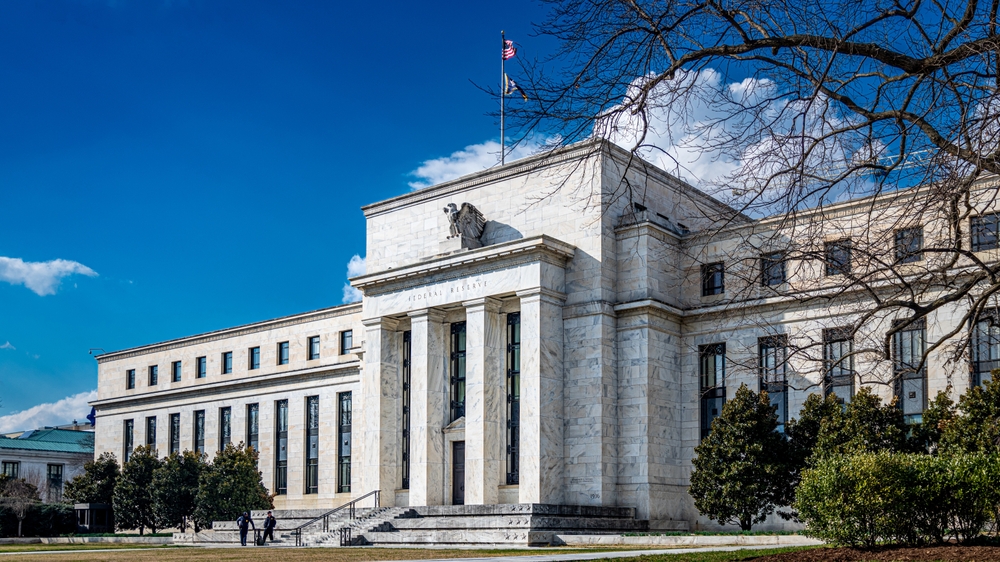
The Federal Reserve is being challenged with one of our most important tenets: levels versus momentum.
Buoyed by the Magnificent Seven, the first half of the year saw strong results for investors. But there are headwinds on the horizon — Fed policy changes, geopolitical tensions, and other factors that could impact market results.
Join the experts at State Street Global Advisors, Astoria Portfolio Advisors, and Clark Capital Management Group as they explore three takeaways from State Street Global Advisor's Midyear ETF Market Outlook: diversifying away from the Magnificent Seven, optimizing income through short-term core and credit, and positioning for macro volatility through real assets.
State Street’s George Milling-Stanley goes in-depth on the current gold market, physical gold ETFs, and crypto. VettaFi’s Roxanna Islam explores the world of defined outcome ETFs.
A major rally in the $27 trillion Treasury market is laying bare anxiety that the US economy is sliding into recession and the Federal Reserve will need to start aggressively cutting interest rates.
The softening trends in both inflation and labor data are sending a message that monetary policy is too restrictive.
Warren Buffett has been selling a lot of stock, and that revelation is inducing his many admirers to follow suit. His Omaha, Nebraska-based conglomerate, Berkshire Hathaway Inc., reported Saturday that it reduced several positions and slashed its stake in top-holding Apple Inc., a sign to some in markets that the “Oracle of Omaha” was bracing for deep stock-market declines.
Recent macroeconomic and geopolitical developments, along with shifting AI sentiment, have raised concerns over whether strong headline returns, low volatility, and persistent mega cap tech leadership can continue as we look ahead.
The relative weakness in July’s nonfarm payroll employment number and the increase in the rate of unemployment from 4.1% in June to 4.3% in July, triggering the Sahm Rule is a reminder of the difficult tasks ahead for the Federal Reserve.
Roth conversions, when executed with precision and strategic foresight, can significantly enhance a client’s financial plan.
A recent mid-year strategist pulse check from Natixis revealed where strategists believe the top opportunities exist across markets.
De Leus and Gijsels, both originating in the world of institutional brokerage identify the five principal trends affecting investments in the near future. The two take turns writing chapters so that the book is a straight man/funnyman show, with the straight man providing mostly sound, conventional analysis and the funnyman interviewing dead economists and Fed chairmen not yet born.
Global bonds rallied as traders bet the Federal Reserve and fellow central banks will turn more aggressive in cutting interest rates amid mounting concern that economic growth is faltering at a faster pace than expected just weeks ago.
With stock markets plunging around the world, traders are talking up the prospect of an emergency interest-rate cut from the Federal Reserve after the US central bank passed up the opportunity to ease policy last week. Not only is this highly unlikely, it would be counterproductive.
The Federal Reserve is between the Rock of Gibraltar and the Rocky Mountains. The data they use to explain their policy choices is in apparent transition. A self-aware analyst, seeing the conflicting data, knows that the right policy choice will only be understood in hindsight.
Treasury yields plunged below 4% this week for the first time since January on recession fears as global manufacturing activity contracted and hiring in the U.S. slowed dramatically in July.
On July 31, the U.S. Treasury released its most recent Quarterly Refunding Announcement which revealed its financing strategy, presenting both positive and restrictive elements for global liquidity.
The secrets for a blueprint for young investors are: Start young. Be disciplined, do it regularly. Focus on what your needs are and what your goals are.
Once again, the Fed kept rates unchanged at the July FOMC meeting. As a result, the Fed Funds trading range remains in the 5.25%–5.50% band that was introduced exactly a year ago and still resides at a more than 20-year high watermark.
Advisors and investors that want to try to outperform can still gain some diversification benefits using concentrated ETFs.
Jeff Bezos’ wealth slumped by more than $21 billion after Amazon.com Inc. said it planned to continue spending big on artificial intelligence even at the expense of short-term profits.
Municipal bonds extended their rally on Friday after a lackluster jobs number cemented expectations that the Federal Reserve will start cutting interest rates by the end of its next meeting in September.
Global investors are gobbling up bonds that can be turned into stocks, feeling good about the prospects and return potentials of smaller companies.
Amazon.com Inc., Microsoft Corp. and Alphabet Inc. had one job heading into this earnings season: show that the billions of dollars they’ve each sunk into the infrastructure propelling the artificial intelligence boom is translating into real sales.
The bond-market rally escalated Friday after a report showed that job growth slowed sharply last month, further stoking speculation that the Federal Reserve will start aggressively cutting interest rates to keep the economy from stalling.
ETFs had a big July, with some leading strategies lifting their YTD inflow totals behind strong July numbers.
Like you, we have read countless comparisons between today’s enthusiasm for all things AI and the top of the TMT bubble in 2000, with the implication being that stocks are on thin ice.
Coming into this earnings season, one of the most intriguing questions was how well the consumer-facing companies would be able to maintain their pricing power. The new algorithm for success is a bit more complicated than “raise prices by x.”
Economists Stephen Miran and Nouriel Roubini are making waves by suggesting in a paper published last week that the Treasury Department has actively engineered easier financial conditions by increasing the issuance of short-term bills and, consequently, reducing the share of longer-term notes and bonds, thereby keeping yields lower than they would otherwise be.
The Federal Reserve kept its policy rate unchanged at the July meeting, but left the door open to rate cuts later this year.
Today’s passive index investing requires active choices, as customization and innovations in index funds have resulted in new considerations for investors and the potential for greater control.
Nvidia Corp.’s wild ride this week is headed for the record books.
In mid-July, VettaFi's webcast asked what advisors were concerned about. “Market valuation” topped the list of choices with 56%.
Demand growth is cooling, but evidence suggests that overall fundamentals are still sound.
Reasonable Treasury debt ratios and more than enough buyers put Treasuries in a much better light than is commonly heard.
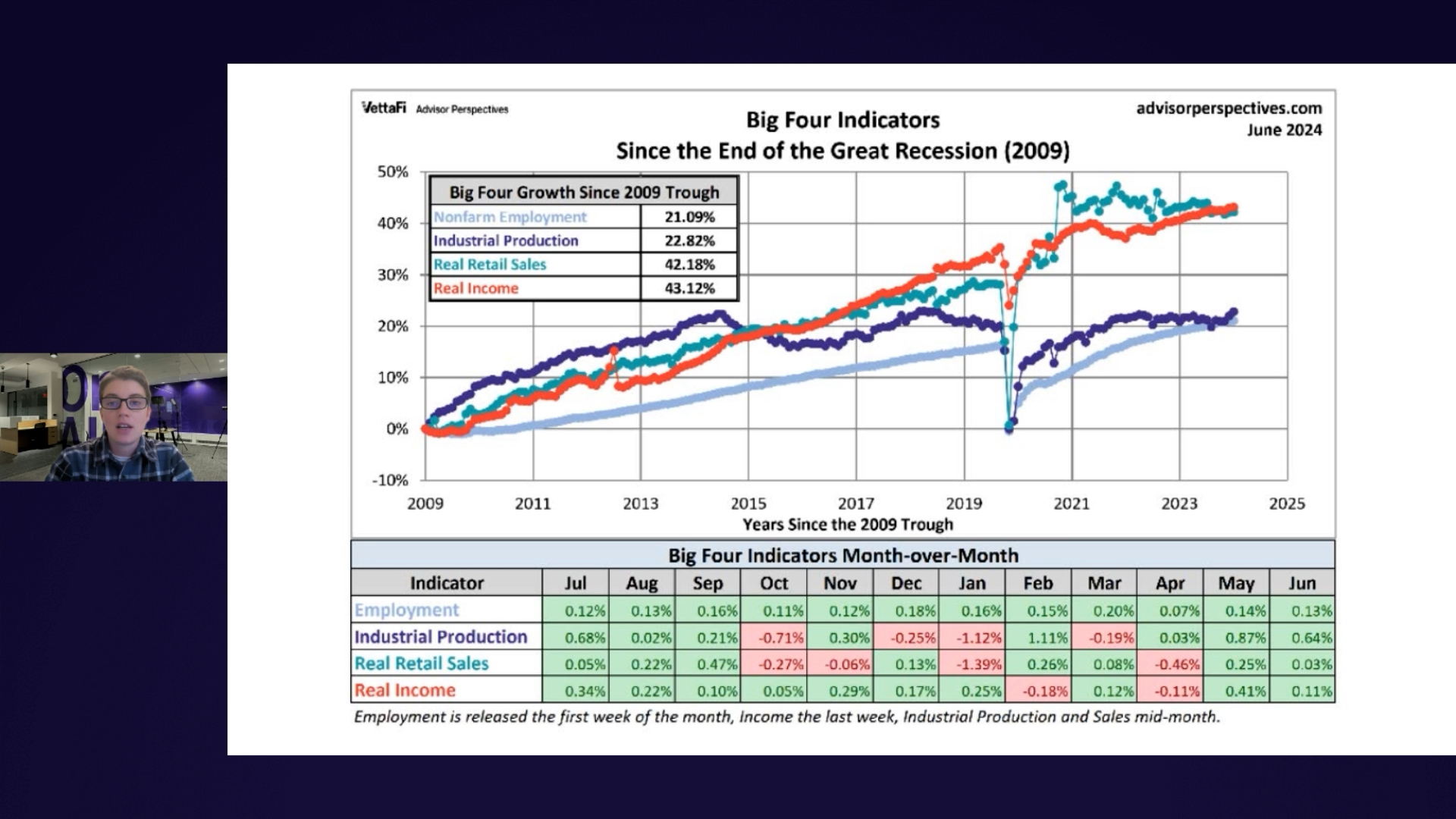
Official recession calls are the responsibility of the NBER Business Cycle Dating Committee, which is understandably vague about the specific indicators on which they base their decisions. This committee statement is about as close as they get to identifying their method.
When dealing with millennials and often with more seasoned investors, it’s important to understand their barriers to acceptance of a boring approach to investing.
Options strategies remain a popular choice with advisors and investors for the benefits they bring to portfolios.
US companies added the fewest number of workers since the start of the year and wage growth slowed, consistent with signs of a softer labor demand.
We are approaching a turning point in policy decisions as the FOMC attempts to walk the fine line of hitting their inflation targets while maintaining a healthy labor market.
Overly optimistic investor expectations of market returns may be a problem.
Potential for another trade war fueled by a rise in global protectionist policies has investors revisiting the potential impact on stocks, inflation, and economic growth.
The US Department of Labor (DOL) offers eight tips for advisors to use to review target-date funds. Our Mike Dullaghan illustrates how to use the DOL tips in preparation for plan review season.
Our outlook on the 11 S&P 500 equity sectors.
Macro drivers mixed with market narratives last week to sustain the volatility cocktail being served in July
Unfortunately, investors have little else to work with given the table scraps of useful data being offered by the tech giants. None of the top companies have yet adequately spelled out the financial performance of AI adoption on their income statements.
You don’t need a fortune to channel your giving through a DAF. These funds are designed for everyday people who want to make charitable donations in a way that offers tax efficiency, flexibility, and choices.
The Federal Reserve (Fed) doesn’t like to spook markets, that is the reason why it has crafted its communication on monetary policy to give indications way in advance and nothing has been pointing to a change of heart that could lead to a surprise move next week.
Improving inflation and growth scenarios should enhance the equities and bond dynamic for multi-asset investors.
Listen to enough politicians and it won’t take long to hear about the lack of “affordable” healthcare, drugs, daycare, and housing. This was going on long before inflation returned after COVID. Everyone wants affordable things.
On this episode of the “ETF of the Week” podcast, VettaFi’s Head of Research Todd Rosenbluth discussed the Grayscale Ethereum Mini Trust (ETH) with Chuck Jaffe of “Money Life.” The pair talked about several topics regarding the fund to give investors a deeper understanding of the ETF overall.