Stop ignoring client annuities, and consider not only how they can improve performance in your client’s portfolios, but also how you can leverage them to expand your capabilities and grow your business.
I don’t question Elon Musk’s good intentions, but I respectfully disagree with the underlying insinuation that crypto miners in particular are a threat to the climate. It’s just not true, for reasons I explain below.
With commodity prices soaring, money supply growth exploding, and government spending surging, there is a palpable fear of a return to 1970s-style inflation.
Andrew Milliner, Global Bonds Portfolio Manager at Janus Henderson Investors, has put together the below comments in reaction to current U.S. inflation figures and what it means for the economy and markets moving forward. Please let me know if you have any questions or wish to further discuss with Andrew.
Municipal bonds have held up well this year, despite rising interest rates and inflation. Munis’ long-term outlook is strong too. What accounts for their outperformance in today’s environment?
ETF traders are increasingly wary of the corporate bond market as inflation anxiety boils over.
The switch on the U.S. economy is readying to come fully “on,” more than a year after the global pandemic forced abrupt closures around the world and across industries.
Widespread lockdowns have resulted in record output declines and soaring debt across the euro area. But the political response to the COVID-19 crisis may be positive for the European integration project—and for euro-area bond markets.
The once red-hot SPAC market has gone cold.
Global indicators continue to signal a sharp business recovery from last year’s COVID-19 pandemic lows. While inflation expectations are increasing as a result, business improvements offer multi-asset investors good reasons to remain tilted to equities for the next stage of the recovery.
Tracy Nolte talks AAM’s Outlook for Inflation, Fixed Income Market’s Outlook for Inflation, and Managing the Current Rate Environment.
Today, we find ourselves with particularly high confidence in the likelihood of three scenarios to which we believe all investors should be paying close attention. First, we anticipate the current market euphoria will likely last through the summer.
The strong economic recovery will not be interrupted by inflation or a credit crunch, according to Ed Yardeni, and the S&P 500 will soon reach 4,500.
Today the US employment report for April was released and it took the markets by surprise. Estimates were for net job gains of 1 million. Instead, the US economy added 218K private sector jobs. This compares to 708K private sector jobs in March.
I am going to more dig into buffer-and-floor strategies, with a particular focus on the underlying options-pricing dynamics.
I've developed this kind of duality. It's hard to think of the next 20 years or indeed the last 20 years without being very optimistic about the future of humanity.
After a strong rally for value stocks in recent months, some investors are wondering if the rebound will continue.
The highest-flying tech names are getting no help from one of the sector’s usual lifelines amid a fierce selloff that’s showing few signs of slowing.
While gold is valued for a variety of reasons, the uncertainty and economic fallout tied to the COVID-19 pandemic saw investment drive the price of the yellow metal to record highs in 2020.
Inflation is likely to rise in 2021—but will the rise be sustained? That seems to be the million-dollar question lately.
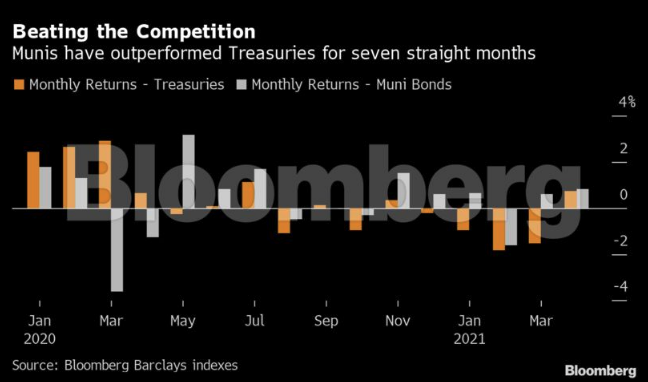
America’s municipal bonds are staging their longest winning streak against Treasuries in seven years.
The Fed is under the misconception that it controls events, according to James Grant. It is overconfident in its belief it can accurately calibrate and attain a 2% inflation target.
There’s an old bit of advice that one shouldn’t count one’s chickens before they’re hatched.
One of the interesting aspects of “bull markets” is the further they go, the lower forward returns fall.
How to structure your portfolio when interest rates are rising.
I will explore three approaches to options-based strategies: DIY, an ETF or a RILA.
As regulators push to transition away from Libor, sales of Treasuries linked to the successor rate could boost the new benchmark’s credibility and expand nascent markets for related debt and derivatives.
There has been much commentary suggesting bonds have gotten overvalued due to historically low rates.
With everything up, where are the value buying opportunities?
The Treasury’s bill auctions Thursday drew the lowest yield in more than a year as an excess of cash in front-end of fixed-income markets kept borrowing costs anchored near zero.
Here’s one way the federal government could help America’s black colleges and universities: expand the market for their tax-exempt bonds.
In less than four months, investors have already poured more cash into ETFs tracking U.S. stocks than they did in all of 2020.
The reflation trade continued in earnest during the first quarter of 2021. Commodities were up another 13.3% from January to March, following a 14.7% move in the fourth quarter of 2020.
10 year Treasury rates peaked at the end of March at 1.74% after having risen from low of just 0.56% back in the summer of 2020. Now, the rate stands at 1.57% even as economic data continues to come in smoking hot and policy remains incredibly accommodative.
A powerful economic restart is underway in the U.S. – with Europe and emerging markets (EMs) set to follow.
Nuclear decommissioning trusts (NDTs), the pools of money accumulated over decades used to dismantle nuclear power plants and safely dispose of radioactive materials, allocate about 40% of their assets to fixed income securities.
Although we remain constructive about the economic outlook, the recent increase in speculative activity gives us some pause. We continue to favor a cautious approach in the near-to-medium term.
Since the disruptions that roiled financial markets in March 2020, investors have turned more to cash and other short-term instruments typically associated with risk aversion and preservation of capital and liquidity.
Investors aggressively sold off Treasuries in the first quarter in favor of risk assets. We think this is likely to continue as the economy strengthens and inflationary pressures build, and we are maintaining a defensive duration profile to protect against rising rates.
The Federal Reserve is expected to announce it will begin trimming its $120 billion in monthly asset purchases before the end of the year as the U.S. economy recovers strongly from Covid-19, according to economists surveyed by Bloomberg.
Given the increase in interest of registered index-linked annuities (RILAs) and consistent growth in sales, advisors should understand the basics of the product and how it works.
There will be a large drawdown and an extended low/negative return period to balance out the above average return of the last 12 years.
More than 60 central banks right now are believed to be exploring the idea of digital currencies, including retail tokens that would be used by citizens as well as wholesale applications for financial institutions.
Many US technology companies use stock compensation to help align workers’ performance with shareholder interests.
Review the latest portfolio strategy commentary from Mike Gibbs, managing director of Equity Portfolio & Technical Strategy.
While a global recovery has now become the base case for financial markets, differences between countries and regions on the path toward normalcy are significant and seem set to widen.
Factor timing is the ability to add value to an investment strategy by altering the exposure to various factors through time.
It often happens that associations which end up leaving an indelible mark on our collective memory of certain market events are the result of sheer happenstance
This is our Q1 2021 slide presentation of our quarterly strategy report.
Although it’s early in the first quarter earnings reporting season, it’s worth a look at the progress so far and the implications for the rest of the season, as well as valuations.