Precious metals markets are extending their losing streak as the U.S. dollar pushes higher.
What’s going on with the markets and the economy? Long-term Treasury yields are up substantially since last Fall while the stock market, after a big rally, has stumbled so far this month. Meanwhile, the real economy appears to continue to chug along – even accelerating!
When it comes to large- and mega-cap stocks benefiting from the artificial intelligence (AI) craze, Alphabet (NASDAQ: GOOG), Microsoft (NASDAQ: MSFT), and Nvidia (NASDAQ: NVDA) are among the obvious choices.
Better productivity is easing employers' burden of higher wages.
With the path of least resistance for stocks seemingly lower for now, key to watch will be a stabilization in interest rate volatility and clarity on the path of monetary policy.
Nick Goetze discusses fixed income market conditions and offers insight for bond investors.
With the Fed’s tightening on monetary policy and the constant threat of a recession looming, policymakers and advisors are closely monitoring economic indicators because the data can ultimately impact business decisions and financial markets.
ETFs have become a popular investment vehicle among many investors and continue to grow in adoption, and so what we’re seeing is that more and more investors are incorporating ETFs into their own portfolios in some way or another.
The role of the human psychological cycle in driving stock and bond prices is well understood and pre-dates behavioural economics. There are elements that suggest we may be going through another period of ‘irrational exuberance’ as several long-term investors seem stuck in the mindset that ‘There Is No Alternative’ (TINA) to US equities.
Interest rates are at 20-yr highs, yet unemployment is at 50-yr lows, core-PCE is near 30-yr highs, and Wall Street (and Fed) economic forecasts continue improving. What explains the disconnect between these unexpected outcomes and those expected by mainstream economic textbooks?
We have heard lots of commentary on the student loan repayment issues facing almost 44.5 million Americans. Some of these commentaries are correct but there are others that miss the mark.
U.S. companies broadly notched better-than-expected results in the second quarter, even as overall earnings growth for the S&P 500 saw a decline. Equity investor Carrie King sees more interesting developments beyond the numbers and posits one area that may be getting tired as another readies for a reawakening.
Whereas the U.S. is investing in new airport infrastructure and modernizing facilities to meet ambitious climate goals, European airports are choosing to combat emissions by restricting the number of flights.
Thanks to NVIDIA stock, the ETF is now up over 50% YTD — and it could keep climbing, as investor interest in AI continues to heat up.
The Northern Trust Economics team shares its outlook for U.S. growth, employment, interest rates and inflation.
Over the past 12-24 months of rate hikes, short-term and ultra-short-term bond ETFs have served income-seeking investors well. But as interest rates continue to rise, exposures farther out on the curve have begun to offer attractive yields, too.
Recent data and policy developments have fallen firmly in the soft-landing camp, and market performance has reflected this shift. Notwithstanding recent stronger-than-expected economic activity, we continue to believe a downturn is in the pipeline.
ETFs are investments that can hold: bonds, stocks, gold bullion and cryptocurrencies. Canadian ETFs track a wide range of different asset classes via indexes. Most ETFs are tied to index products, including both equity or fixed income funds.
In this video, Chuck Carnevale, Co-Founder of FAST Graphs, a.k.a. Mr. Valuation, will be analyzing cell tower real estate investment trusts (REITs) and helping you determine if they are a good investment.
Investors should take a closer look at companies that help create a more energy-efficient ecosystem for AI.
While economic growth drives corporate earnings, remember that the S&P 500 is not a replica of the U.S. economy.
Government bonds or stocks? If you were picking an asset class to outperform over the next 18-24 months, which would you choose?
Approval of a spot bitcoin exchange traded fund in the U.S. is one of the most widely anticipated and delayed events in the roughly three-decade history of the ETF industry.
My last three letters reviewed Neil Howe’s new book about the Fourth Turning. Today we’ll look at another set of patterns observed by my friend George Friedman in the geopolitical realm. George’s view of how patterns shape countries is different but not inconsistent with Neil’s generational cycles.
We are now a few years past the onset of the COVID pandemic, and we've had a chance to think about some of its changes in the wealth management business. Even if we wish certain things hadn't changed, we must acknowledge that they have – and adapt accordingly.
This weekly update tracks some of the largest cryptocurrencies by market share: bitcoin and ether. We’ve also included XRP, as it was one of the largest cryptocurrencies when this article began.
Progress toward a sustainable world would be hamstrung without the backing of global banks and their sponsorship of green and sustainable bonds.
While some economists may argue that secular stagnation is to blame for China’s economic slowdown, concerns about sustained slower growth are overblown. If the country falls into a recession, it would constitute the next turn of the debt supercycle that began in the US in 2008 and moved to Europe in 2010.
We expect inflation and rates to remain higher than the last decade. We favor tech within growth and cyclicals within value.
You put on a trade. You are short bonds, or something like that. It may be tempting to see the people on the other trade as the “bad guys,” while you are the “good guys.”
Todd Rosenbluth appeared on TD Ameritrade to discuss artificial intelligence in advance of VettaFi’s upcoming August 30th AI Symposium.
This year has been the year of innovation, with artificial intelligence (AI) all the rage. Yet, many advisors are focusing on other investment styles to round out client portfolios.
The advisor of the future needs to embrace a new value proposition, according to John Kutz, Head of Workplace Retirement Distribution at Franklin Templeton. This means moving beyond the “three F’s” and taking a more holistic approach to changing client needs.
Today was a disaster for Chinese economic data. In the table below, we can see that every single data point missed consensus expectations in the wrong direction. Activity undershot expectations across the board.
In this video, Chuck Carnevale, Co-founder of FAST Graphs provides an update on Medifast (MED). Since October 1st, 2021, Medifast has dropped over 52%, resulting in a 28% annualized loss.
Return to office mandates are growing, but workers are hesitant to give up flexibility.
Monetary and fiscal policy are typically thought of as independent tools that central banks and governments use to manage the economy.
With so much uncertainty remaining around the Fed’s rate cycle and the potential for recession, many investors are beginning to look toward international equity markets for the means to build income. Yields continue to look attractive for international dividend ETFs, in particular.
With so many moving pieces, and under such unconventional conditions, navigating today’s global economic landscape would be challenging for anyone. But even if we cannot anticipate every contingency, we can understand quite a lot by assessing the US Federal Reserve’s prospects for engineering a soft economic landing in the near term.
In 2023, it’s fair to say that artificial intelligence (AI) is one of this year’s most captivating investment themes. Add to that, from the perspectives of adoption, applications, and investing, AI is still in its infancy. This indicates market participants will be hearing about it for years to come.
As the 2023 earnings per share (EPS) recession narrative grows louder into the second half of the year, we expect the market to shift to discounting an EPS rebound. The best opportunities look to be in more economically sensitive and value sectors, which have been hit particularly hard this year.
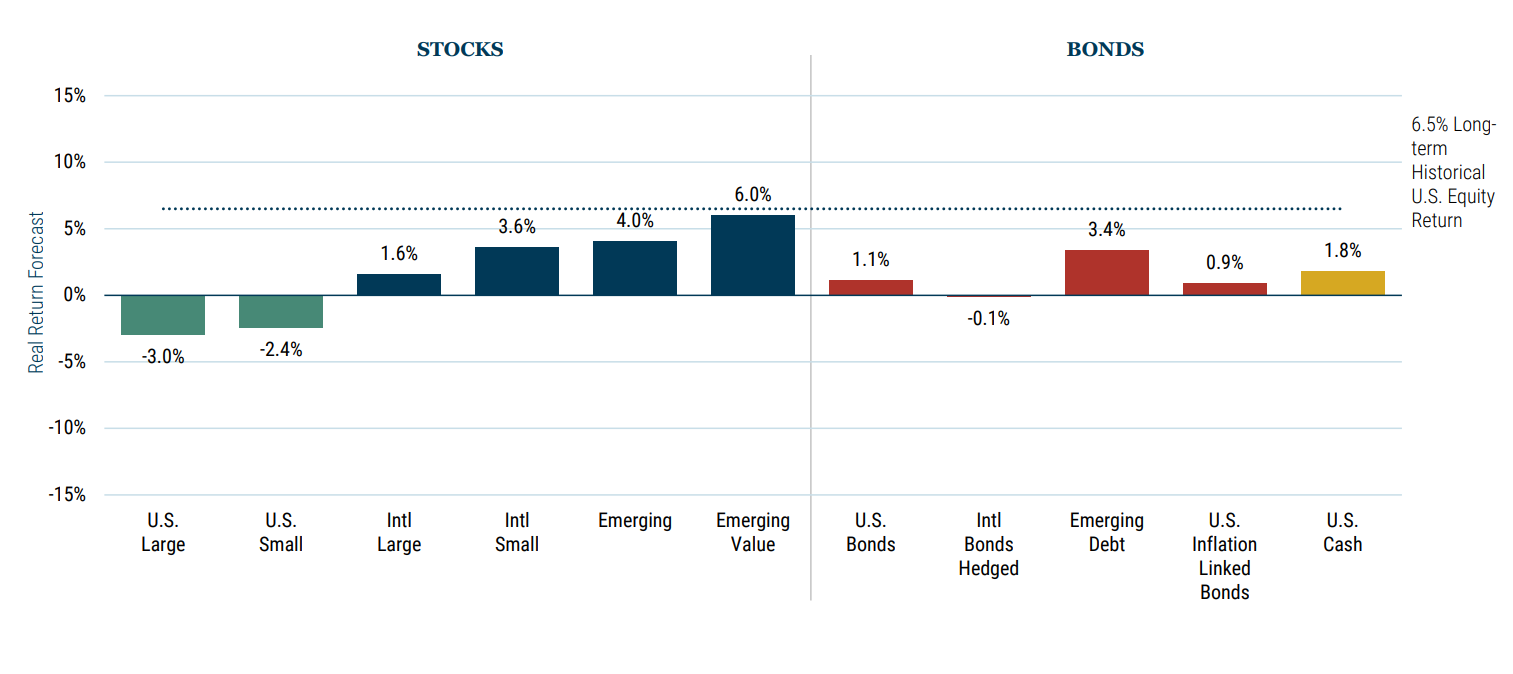
GMO 7-Year Asset Class Forecast: July 2023
AI development is racing ahead. A thoughtful framework to making decisions and leveraging tools can help investors stay on course.
Artificial intelligence is one of the most controversial topics across many fields. Though many see AI has a critical tool for improving productivity and increasing efficiency, there are also concerns. Artists and other creatives have raised questions about how AI could be stealing their work.
For this edition of Bull vs. Bear, Elle Caruso and Karrie Gordon discuss the likelihood of continued strong returns for semiconductor ETFs.
Christian Correa, Chief Investment Officer of Franklin Mutual Series, discusses his team’s top three themes for the back half of 2023: a less-gloomy US macroeconomic outlook, real asset investment and Japan’s rising sun.
Foreign stocks are again competitive with their domestic counterparts. Here are four ways to gain exposure.
U.S. corporate earnings have stagnated for a year, but Q2 beat a low bar. Expectations of improving margins look rosy. We stay selective in equities.
There aren’t many bullion investors who haven’t thought about using their stash to buy groceries one day.
Tax receipts are falling, which has historically preceded economic recessions.