A couple of weeks ago, we wrote about how the deficit had come back into focus for the U.S. financial markets.
The $1.8 trillion federal budget deficit in the fiscal year that ended in September was the third biggest ever in dollar terms, trailing only the pandemic deficits of the 2020 and 2021 fiscal years. As a share of gross domestic product, a better gauge for historical comparisons, it was, at 6.4%, the biggest ever outside of a large war or global crisis.
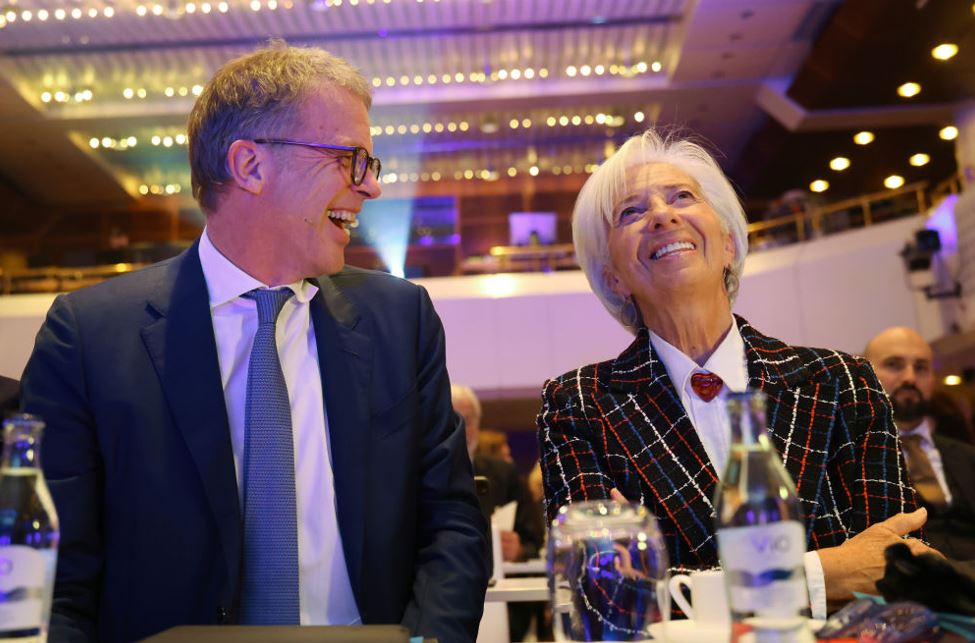
Next week’s European Central Bank meeting is more important than it might first appear.
Donald Trump’s tariff barrage may trigger a response from the Federal Reserve that the new president won’t like.
Bond traders are positioning for the US Treasuries market to extend its recent advance, showing confidence that yields will continue to pull back from the peaks hit after Donald Trump’s election victory.
The S&P 500 earnings growth rate will likely come in just below the 6% mark for the third quarter.
In their 2025 outlook, Head of Americas Equities Marc Pinto and Head of EMEA and Asia Pacific Equities Lucas Klein say a changing macroeconomic backdrop could create new pockets of leadership in global equity markets.
While politics garner headlines, fundamentals drive the market over the long term.
The Fed could be ‘slower to lower,' while the Trend continues to rise, with an overly optimistic Crowd due to seasonality and post-election trends.
The WisdomTree BioRevolution Fund (WDNA) is showing signs of recovery, reflecting renewed investor confidence in biotechnology innovation.
Armada’s Phil Bak discusses wrapping private assets in ETFs and fields rapid-fire questions on some of the industry’s hottest topics. VettaFi’s Kirsten Chang explains “ETFs going Hollywood”, with a growing list of prominent individuals now launching products.
Dollar bulls emboldened by Donald Trump’s win are entering a month that has historically punished the greenback.
It’s the anniversary of the first-ever controlled nuclear fission chain reaction. And it’s the day that Enron filed for Chapter 11 bankruptcy in 2001.
Next year, the US Federal Reserve will undertake an exercise with global implications: the periodic monetary policy framework review, at which it rethinks its approach to managing the world’s largest economy.
International markets are expected to clear the hurdles of uncertain trade policy, tighter fiscal policy and slower than average economic growth to support solid overall returns.
It’s hard to keep track of all the theories about inflation. Remember policymakers and analysts blaming the surge in inflation in 2021-22 on supply-chain disruptions, too much government spending, and Putin invading Ukraine? Now some are saying that tariffs and deportations are going to cause a second surge in inflation.
Astoria rounds up its 10 ETFs for 2025, providing unique thought leadership and actionable investment ideas.
As a result of the election and rate cuts, the stock market indices surged to new highs in anticipation of lower taxes & looser regulations.
Short-term rates are going down because the Treasury is issuing related debt at lower rates. Meanwhile, long-term rates are going up because the Fed is not intervening.. The Fed is trapped in a vicious cycle. Can you see a way out?
Expectations for solid corporate earnings drove our U.S. and Japanese equity overweights this year. They have delivered, showing that fundamentals are key. Earnings strength could matter more to equity investors in 2025 over valuations.
US Treasuries fell on Monday as traders awaited a hefty week of economic data and speeches from Federal Reserve officials that will likely determine expectations for the central bank’s policy decision later this month.
The world’s biggest hedge funds made the most of trading opportunities sparked by Donald Trump’s reelection last month, keeping the industry on track to post its strongest returns in at least four years.
The question on “everyone’s” mind, whether the back or the front, is where will the stock market be in two, three, six years?
Trump's election win spurred market optimism, driving rallies in equities, crypto, and cyclical sector.
Policy changes could reshape return potential for companies across the US market. Here’s how investors can start thinking about the challenges ahead.
2024 is set to enter Wall Street’s hall of fame of bull years.
The U.S. economy faces growing risks, from a surging Federal deficit to geopolitical uncertainty. Investors must assess how these factors could ignite market instability and take proactive steps to safeguard their portfolios.
VettaFi spoke recently with Nate Williams, a vice president and ETF specialist with Franklin Templeton, about the growth of its ETF business.
Treasury Secretary Janet Yellen came under fire this year from economists such as Nouriel “Dr. Doom” Roubini for stepping up the issuance of short-term Treasury bills.
President-elect Donald Trump’s pick for the top trade position sees China as a “generational challenge” to the US and has advocated for a strategic decoupling from the country.
The dominance of US equities over the rest of the world is unlikely to abate unless geopolitical and trade policy risks fade, according to JPMorgan Chase & Co. strategists.
The US economy expanded at a solid pace in the third quarter, largely powered by a broad-based advance in consumer spending as inflation continued to cool.
Not everyone is ready to give thanks for moderating food prices.
On whole, EM growth has been resilient, while inflation has fallen closer to normal levels.
Following President Trump’s re-election, the S&P 500 has seen an impressive surge, climbing past 6,000 and sparking significant optimism in the financial markets. Unsurprisingly, the rush by perma-bulls to make long-term predictions is remarkable.
In the weeks surrounding the US election, US bond yields climbed sharply, reflecting speculation that President-elect Trump’s policies could lead to higher inflation and a widening federal deficit.
he Tax Cut and Jobs Act (TCJA) was passed in 2017, otherwise known as the Trump Tax Cuts.
As we look through our financial lens and reflect upon everything that has transpired in 2024, we have compiled a list of the top ten economic and market-oriented things that we are most grateful for this year.
This week’s data and market momentum solidified the case for a resilient U.S. economy, defying concerns of an imminent slowdown. Initial jobless claims dropped to a five-month low, reinforcing the strength of the labor market, while GDP growth projections hover around an impressive 2.5%.
There has been a lot of talk about (in)efficiencies in government spending, both before and since the election. Much of the conversation has been driven by Elon Musk, who will co-head the Department of Government Efficiency (DOGE, not an actual government agency). Musk has boasted he could find $2 trillion to cut from the federal budget.
New ideas are never as easy as they sound in campaigns.
On the latest edition of Market Week in Review, Investment Strategist BeiChen Lin reviewed the latest inflation numbers from Canada.
Some retirees say they could have planned better for lifetime income—helpful insight for current participants.
What are the key drivers of the gold market? Let’s delve into it.
The headlines regarding Trump's proposed tariffs and their inflationary consequences are undoubtedly worrying, but will they prove correct?
With the re-election of President Donald Trump, the worries about tariffs and pro-business policies sparked concerns of “Trumpflation.” Inflation has been a top concern for policymakers, businesses, and everyday consumers, especially following the sharp price increases experienced over the past few years.
Politicians and think-tank wonks of all stripes love to condemn government “waste, fraud, and abuse.” But saying it isn’t hard. Who is the opposition? No one says we need more waste, fraud, and abuse. We’re all 100% agreed all three are bad.
This week, at the North American Blockchain Summit in Dallas, Texas, I had the distinct privilege of moderating a fireside chat with former Canadian Prime Minister Stephen Harper.
The US bond market is finally showing signs of steadying after a two-month selloff, with investors starting to swoop in whenever yields test new peaks.
The dollar fell and US government bonds rallied after Donald Trump picked Scott Bessent to run the Treasury, a Wall Street veteran who investors expect will take the sting out of the administration’s more aggressive trade and economic policy proposals.