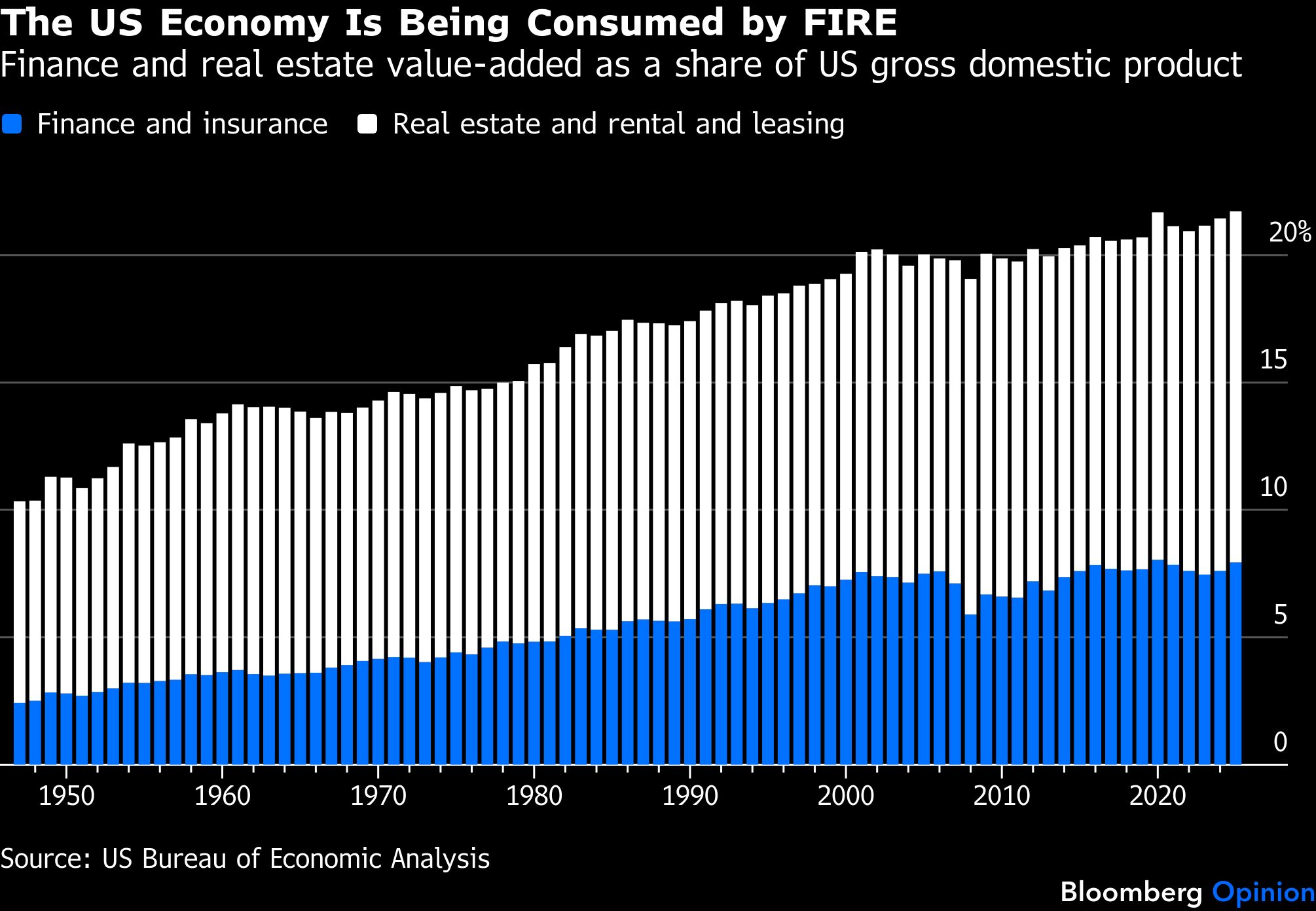
During and immediately after the financial crisis of 2008, there was much talk and academic research about the rapid growth of the US financial sector over the preceding decades and whether that was good or bad.
The backlash against globalization, the slow death of the Washington Consensus, and the rapid rise of AI are fueling volatility that, if left unchecked, will lead to lower growth, higher inflation, and greater inequality. To move the economy onto a better path requires, first and foremost, abandoning our faith in outdated ideas.
For many, the statistics surrounding autism aren’t just numbers on a page — they are lived experiences. I am one of those people; I have an extended family member on the spectrum, and I’ve seen how people have slowly begun to better understand and support the neurodivergent community.
Late last year, the Federal Reserve ended its latest quantitative tightening (QT) program: the process by which it shrinks its balance sheet by selling securities or letting them mature without reinvestment.
Over the past year, LPL Research’s Strategic and Tactical Asset Allocation Committee (STAAC) has emphasized that tactical investing does not require constant activity. Instead, it requires preparation, patience, and the discipline to act only when the expected benefit of a change clearly outweighs the risks.
Focusing on tax planning year-round can significantly improve your financial situation. By reviewing your recently filed 1040 form, you can uncover valuable opportunities to optimize investments, maximize deductions and strategically plan for retirement, ensuring long-term financial health and tax efficiency.
Asia and emerging markets experienced extreme volatility in the first quarter of 2026 as markets surged in the first two months, supported by strong demand for artificial intelligence (AI) and an easing of the global monetary environment.
For the first time, stablecoins have surpassed the Automated Clearing House (ACH) payments network in monthly transaction volume. According to blockchain analytics platform Artemis, stablecoins processed $7.2 trillion in February, topping the ACH’s $6.8 trillion.
The artificial intelligence theme is entering a more granular phase, with investors increasingly looking beyond foundational large language models (LLMs) toward the physical infrastructure required for scale.
The Middle East war has replaced tariff-driven inflation concerns with fears of rising energy prices feeding through the economy. On Friday, the Bureau of Labor Statistics (BLS) released its March CPI report, when markets received their first ‘official’ glimpse of how the surge in energy prices has begun to impact the U.S. inflation setting.
“Diversification” has been the driving principle of investing and risk management for generations. But what does it mean to be “diversified?”
As private credit managers mount a spirited defense of their industry to discourage investors from fleeing, they’ve found at least one persuasive argument for why much of the cash they lent to software firms at the start of the decade shouldn’t be at risk.
Rising oil prices and the historically inflationary aspects of war have changed expectations for Federal Reserve interest rate policy and have pulled Treasury yields higher.
The Iran war has created a reshuffle in investing. High-flying tech companies are out while unloved old economy names are getting a second look.
In an investment world marked by ongoing macro uncertainty, more investors are seeking alternative strategies to navigate murky markets. One of the funds capturing this shift is the Fidelity Managed Futures ETF (FFUT). That fund secured the award for Best New Alternatives ETF in the 2026 ETF.com Awards.
Join the experts at SS&C ALPS Advisors for a product due diligence session exploring the electrification of everything—and the infrastructure powering the AI era.
When Paul Atkins took the helm of Wall Street’s top regulator, he came with a long to-do list: craft rules for the cryptocurrency industry, make initial public offerings “great again” and ease financial reporting for public companies.
A dramatic shift is underway in US equity markets. Stocks hit an all-time high Wednesday as Middle East peace hopes tamped down geopolitical anxiety, and derivatives traders who had pulled back from bullish bets are now racing to position for further gains in technology shares.
Hedge funds are increasingly downbeat on the dollar as the prospect of a two-week ceasefire extension between the US and Iran sap the currency’s war-driven strength.
In what should be a surprise to no one, energy has been one of the better performing sectors since the joint U.S.-Israel airstrikes on military targets in Iran on February 27, although it has given up some ground since a two-week cease fire was announced last week.
Mythos, a new artificial intelligence model that Anthropic PBC has teased as too dangerous to release, looked at first like a problem for banks.
Technology is transforming bond investing, across research, trading and—through optimizers—portfolio construction. We believe optimizers based on advanced digital investment platforms have a major advantage—and can create new levels of insight for portfolio managers that have them.
Despite a confluence of economic shocks in the first quarter, markets have held up remarkably well, but cracks appear to be forming beneath the surface.
The US dollar's obituary has been written many times—with increasing frequency over the past year. Each time we get a fresh round of analyses declaring that de-dollarization is accelerating, the world is reorganizing its financial architecture around alternatives and the greenback's reign is drawing to a close.
I came across a statistic the other day that goes against the intuition of practically everyone in the US who has a job: Americans are working less than they did in the 1950s and ’60s. How is this possible, when we all feel chained to our desks or our phones?
There's a fight over war funding looming in Congress after a return from the Easter break, and uncertainty around the timing of the Fed chair confirmation hearing remains.
The escalating conflict in the Middle East — especially the closure of the Strait of the Hormuz — had an adverse effect on many investment strategies in March, and gold was no exception. The spot gold price closed out March at $4,668.06.
The first quarter was defined by overlapping macro shocks and a violent shift in market leadership, punctuated by the war in Iran and the closure of the Strait of Hormuz. As capital surged into physical assets such as energy, materials, and defense, software and other digital businesses faced a historic repricing.
With Q1 earnings season well underway, it was Johnson & Johnson (JNJ) giving investors a peek at how the broader healthcare sector might perform
The war in the Middle East has brought about an elevated uncertainty quotient when examining the U.S. macro backdrop. The resultant rise in energy prices is being looked at as both a potential ‘tax on the economy’ as well as a catalyst for a near-term elevation in inflation.
Active management is gaining traction as investors navigate a market paradox where high valuations meet geopolitical uncertainty, according to Chris Davis, chairman and portfolio manager at Davis Advisors.
Bitcoin trended toward the high end of its more than two-month trading range as risk assets rallied on optimism that the US can strike a deal with Iran to end their conflict.
With the US-Iran war demonstrating not just how captive the world economy remains to fossil fuels, but also how easily energy can be weaponized, whether to drill at home is becoming an even more pressing question for some countries.
Most business owners spend decades building their business. For many, it represents 70–80% of their net worth. As your client’s trusted advisor, your role isn’t to become a transaction expert. It's to recognize where risks lie, ask the right questions, and spot red flags.
The S&P 500 Index is on track to close at its first record since January, as traders bid up stocks amid optimism over the ceasefire between the US and Iran and robust corporate fundamentals.
Wall Street has gotten repeatedly burned calling a bottom in software stocks, which have been hit hard by fears that artificial intelligence will make the companies obsolete. But this week’s bounce is bringing some bottom-fishing investors back to the group on hopes that the worst may finally be over.
Pacific Investment Management Co. bought all $400 million of bonds issued Monday by a Blue Owl Capital Inc. private credit fund, according to people with knowledge of the matter.
Bank of America Corp. disclosed it has about $20 billion in private-credit exposure, as the bank and its Wall Street peers seek to calm concerns about the industry’s exposure to the asset class.
Morgan Stanley’s traders got a boost from President Donald Trump’s deregulation agenda. In the first three months of the year, Morgan Stanley plowed capital that was freed up after US regulators relaxed a key rule into its prime brokerage division and its macro trading desks, according to Chief Financial Officer Sharon Yeshaya.
When I teach my graduate classes in leadership, we talk about the essence of motivation. Even the best leaders cannot motivate other people to do something. They can create an environment within which the person becomes self-motivated. But motivation is intrinsic.
Compliance officers hold qualifications that take years to earn, develop an understanding of regulatory frameworks most people in financial services never fully acquire, and build institutional knowledge that no keyword-match system can replace.
Over the past several years, those patterns have been changing. The evolving flows of both tourists and emigrees will have important economic effects.
Outside of energy commodities, capital markets posted a downbeat March as cross-asset volatility spiked in response to the outbreak of hostilities in the Mideast, and kicked off April in similar, choppy fashion before posting a swift bounce following last Wednesday’s two-week ceasefire agreement.
Rapid development of AI technology poses a direct threat to the SaaS sector, but the risks are not necessarily terminal or universal and vary based on time horizon.
While infrastructure companies are not immune to a potential economic slowdown, they may provide a longer-term investment opportunity amid an uncertain macroeconomic backdrop.
In a rare plot twist, Goldman Sachs front-run the banking pack today, marking the first time the firm has kicked off the earnings season ahead of JPMorgan Chase since 2018. The storied investment bank delivered notable results, comfortably surpassing analyst’s estimates on both the top and bottom-line.
Behavioral finance is the study of how emotions, cognitive biases, and human behavior may influence financial decisions, often in ways that can conflict with logic, data, and long-term goals.
Diversification is finally paying off. After more than a decade of U.S. dominance, international equity ETFs are enjoying monster inflows, outpacing their domestic counterparts for the first time since early 2023.
Rapid technological shifts and shifting interest rate expectations continue to define the current market environment. Amid the uncertainty, investors are looking for a reliable North Star to guide their growth allocations. They can start with the Fidelity Blue Chip Growth ETF (FBCG).
Yield curves exist for many products and can be interrelated, yet they also carry distinctive characteristics. Normally, long-term rates are higher than short-term rates because investors demand a higher return for lending money over longer periods. This arrangement would create an upward-sloping curve much like the Treasury curves displayed to the right.