Dan Ariely is one of the most famous behavioral economists in the world. And in his latest act, he's attempted to apply his research to investing.
In 2021, municipal (“muni”) bonds have been a tough asset class to manage due to overwhelming demand and limited supply in the market.
Second quarter is likely the peak growth rate for both the economy and corporate earnings; with positive economic surprises waning.
Funds with a socially responsible or environmental, social and governance (ESG) mandate may allow clients to feel good about their investments. But new research shows that they should not expect excess returns.
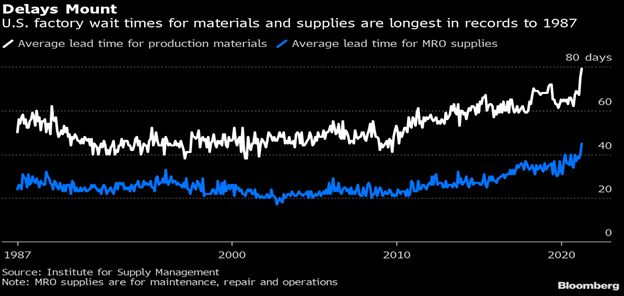
From base effects to bottlenecks, wages to pricing power, inflation questions abound.
Wondering where the dollar’s headed as the U.S. deficit keeps growing? Wall Street’s also trying to figure it out.
Our Chief Market Strategist Stephen Dover speaks with portfolio managers Matt Moberg from Franklin Equity Group and Aram Green from ClearBridge Investments on how they factor inflation and valuations into stock-picking decisions.
On the latest edition of Market Week in Review, Director of Investment Strategies Shailesh Kshatriya and Head of Portfolio & Business Consulting Sophie Antal Gilbert discussed the meeting minutes from the U.S. Federal Reserve (the Fed), the latest inflation data and the recent volatility in cryptocurrency markets.
Factor models are extremely popular for their objectivity. However, such models fail to properly incorporate Valuation and Wealth Creation. When properly defined - Valuation, Wealth Creation, and Leverage make the popular factors used in most quantitative models statistically insignificant.
This talk examines problems with traditional factors, accounting data, and popular valuation approaches. We present an empirically superior alternative approach to portfolio construction regardless of size or style.
A quant pioneer with $112 billion in fixed income assets is defying doom-mongers like Ray Dalio as it places a bullish wager on interest-rate risk.
In good news for high-yield bonds, recovery rates on defaults are also improving from the concerningly low levels of recent months, as energy-sector defaults have worked through the system. However, recovery rates are still well below their historical level, which indicates weak bond covenants.
There was the usual mish-mash of financial news last week, some good and some bad.
It’s dawning on many investors that our post-Covid financial problems may not be as easily solved as Washington claims.
Traditional succession plans have two main downfalls.
Over the long term, confusing market crashes and bear markets can be detrimental to investor outcomes.
China was the first nation to enter recovery, and high U.S. import demand has helped it.
Advocates of ESG investing may be disappointed to learn of a new research study showing that greenhouse gas emissions have had no measurable effect on corporate profitability or equity performance.
We believe the municipal bond market is on the brink of major changes. The Biden administration has proposed legislation that, if passed, could meaningfully increase both taxable and tax-exempt supply in the municipal bond market. While this potential shift could cause some short-term disruption, we believe it could result in more balanced supply and demand over the medium term.
A just-released survey shows that advisors are not quite ready to attend in-person conferences following the 16-month pandemic hiatus. When they do, smaller conferences that offer networking opportunities will gain share relative to the custodian-sponsored national mega-events. And advisors are tired of hearing from high-priced political speakers.
The pandemic forced us all to communicate via Zoom.
We have had multiple conversations with our advisors about asking for more referrals. But our clients are older – in their 70s.
Harvard urged the Supreme Court to reject an effort to bar colleges from using race as a factor in admissions, saying the appeal seeks to upend four decades of legal precedent.
Have market disruptions changed the types of companies you seek to invest in?
A boom in spending has stirred fears of economic overheating, which has coincided with a surge in commodity prices and a lift in traditional inflation metrics.
The CPI rose more than expected in April, adding to inflation worries.
Equity markets are not a bubble, according to Howard Marks. He expects six to nine months of very good economic news, followed by “decent” growth for several years.
With commodity prices soaring, money supply growth exploding, and government spending surging, there is a palpable fear of a return to 1970s-style inflation.
While much of Wall Street is ringing alarms about out-of-control inflation, Federal Reserve Chair Jerome Powell and his colleagues are expressing confidence in a more benign outlook.
The US Centers For Disease Control and Prevention reported last week that the US birth rate plunged for its sixth consecutive year in 2020. The US fertility rate also hit a new record low. Demographers are puzzled at this potentially troubling trend...
Special purpose acquisition companies (SPACs)—also known as blank-check companies—have gained immense popularity among investors since the beginning of 2020, despite being around for decades.
To say that we were surprised by some of the discussion at the Berkshire Hathaway Annual Meeting would be an understatement. The conversation Warren Buffett and Charlie Munger leaned into on inflation was possibly the most interesting. Warren and Charlie gave large credit to Larry Summers for his willingness to stand alone on the effects of today’s fiscal and monetary policy on prices. We thought this was an ideal time review Buffett and Munger’s discussion and see what conclusions we could draw.
The performance of a market-cap-weighted index is driven by a handful of stocks with the largest capitalizations, but these stocks do not remain at the top for long. A smart beta multi-factor strategy is a good solution for investors concerned about the concentration risk of a passive market-cap tracker.
Today, we find ourselves with particularly high confidence in the likelihood of three scenarios to which we believe all investors should be paying close attention. First, we anticipate the current market euphoria will likely last through the summer.
It is a particularly good time to invest in the commodities markets.
A host of impediments stand in the way of allocating funds to annuities. Some issues relate to brokers or advisors, and others involve their clients. Some are valid, but others are questionable and reflect irrational behavioral biases.
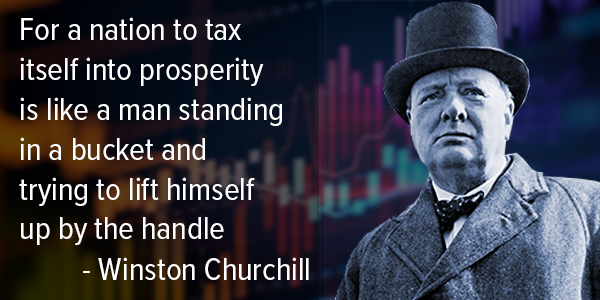
One of my all-time favorite quotes comes from Winston Churchill, who was just as witty as he was a great leader: “We contend that for a nation to try to tax itself into prosperity is like a man standing in a bucket and trying to lift himself up by the handle.”
While gold is valued for a variety of reasons, the uncertainty and economic fallout tied to the COVID-19 pandemic saw investment drive the price of the yellow metal to record highs in 2020.
Inflation is likely to rise in 2021—but will the rise be sustained? That seems to be the million-dollar question lately.
As the US economy continues to reopen, economic growth is accelerating in line with our above-consensus forecasts.
Addressing within-country inequality may be the political imperative of the moment.
Corporate executives often bemoan the cost of high regulation, but new research show that greater federal regulatory scrutiny has historically correlated with better stock performance.
We believe Asia is the core of growth and innovation within emerging markets, and companies domiciled in Asia comprise over 75% of the benchmark universe.
The post-pandemic economy could well be defined by the return of robust aggregate productivity growth after 15 years of relative sclerosis.
Nobody expected the Fed would lift interest rates today
In December of 2018, I was invited to dinner with some of the world’s largest Bitcoin holders at the Guggenheim museum in New York.
Much has changed since the oil-market collapse in the early pandemic days of 2020, when prices actually turned negative. Franklin Templeton Fixed Income Research Analyst/Portfolio Manager Bryant Dieffenbacher looks back at industry developments since then, and outlines opportunities he sees in the high-yield energy bond market today.
10 year Treasury rates peaked at the end of March at 1.74% after having risen from low of just 0.56% back in the summer of 2020. Now, the rate stands at 1.57% even as economic data continues to come in smoking hot and policy remains incredibly accommodative.
Here’s what financial advisors need to know about creating video content versus a podcast.
Nuclear decommissioning trusts (NDTs), the pools of money accumulated over decades used to dismantle nuclear power plants and safely dispose of radioactive materials, allocate about 40% of their assets to fixed income securities.
The exchange-traded fund revolution sweeping through U.S. money management is eliciting little more than a shrug from a European cohort arguably next in line for disruption.