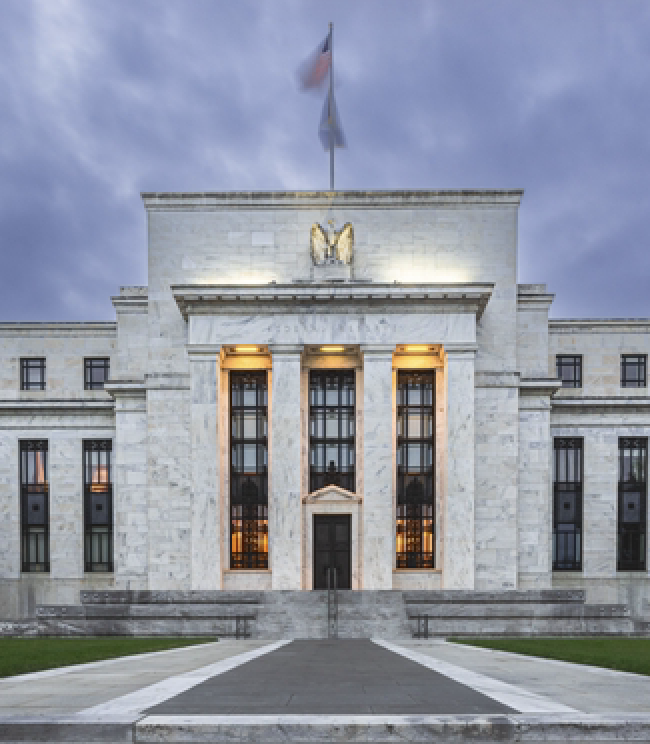
Shifting geopolitics are causing policymakers in Europe and Japan to step up fiscal spending to gain self-sufficiency and generate growth.
A Retirement Ready Dividend Portfolio for Young Investors In Part B of this series, Chuck Carnevale, co-founder of FAST Graphs and “Mr. Valuation,” continues building a dividend growth portfolio designed for younger investors who still have decades before retirement.
Owners of Invesco Ltd.’s famed tech fund QQQ voted to convert the product into an open-ended structure, a move that could unlock hundreds of millions in annual revenue for the asset manager.
The era of "easy" yield in money market funds is ending as the Federal Reserve begins its long-awaited series of rate cuts. To stay ahead of shifting borrowing costs, investors are increasingly looking toward the flexibility and proprietary research of actively managed fixed income ETFs.
In the current installment of The Roundup, Oaktree experts explore the need for renewed vigilance in the direct lending market, discuss the future of private credit in Europe, identify the evolution of the high yield bond market, and reflect on the backdrop for emerging markets equities.
Franklin Equity Group’s Grant Bowers suggests the US economy may be approaching a Goldilocks equilibrium in 2026, supported by stable growth, anchored inflation and policy tailwinds.
Understand how a recession is defined and how to avoid common investment mistakes during recession-driven stock market downturns.
Investors navigating the 2026 landscape must balance a fragmented "K-shaped" consumer market against the tailwinds of falling interest rates and the "One Big Beautiful Bill Act" (OBBBA). Despite a cautious Federal Reserve and potential government shutdowns, the prevailing view is that structural transformation and fiscal support will foster economic resilience.
In statistical terms, the coming year will offer a multi-modal distribution of possibilities: a plausible path of robust, AI-led growth sits in the middle, flanked by a productivity miracle on one side and a risk-laden, bond-market-led downside on the other. Investors and policymakers must prepare for all of these outcomes.
What were the key takeaways from last month’s numbers? Our corporate bond specialists look back at the market’s performance and provide incisive commentary to help you make sense of what drove the market—and what may be on the horizon for fixed income investors.
Many beneficiaries who inherited retirement accounts after 2019 must begin taking required minimum distributions in 2025 under the SECURE Act's 10-year rule. Our Bill Cass notes that heirs should plan distribution strategies based on their individual tax situations.
As widely expected, a divided Federal Reserve cut its benchmark interest rate by a quarter of a percentage point, marking the third consecutive meeting with a rate reduction. One voting member dissented in favor of a larger half-point cut, while two members voted to leave rates unchanged. T
LPL Research examines why the bull market appears ready to continue its run in 2026, powered by AI enthusiasm and further easing of monetary policy from the Fed.
Doug Drabik discusses fixed income market conditions and offers insight for bond investors.
Elevated yields, steeper yield curves, and ongoing volatility make core bonds a compelling choice for total return, income, diversification, and downside risk mitigation in today’s markets. Active management is key: Historically, it has helped core bond portfolios outperform passive strategies through a rigorous, diversified approach.
Investors should treat bitcoin as the volatile, high-risk asset it is. A look at the data, along with comparisons to the Magnificent 7 stocks, indicates a small (1% to 2%) portfolio allocation for most investors would be the safest.
The Federal Reserve wrapped up its final meeting of 2025, delivering – as expected – its third consecutive rate cut. Policymakers lowered the fed funds rate to a target range of 3.5% to 3.75%, signaling continued support for the economy.
In this video, Chuck Carnevale, co-founder of FAST Graphs and “Mr. Valuation”, continues his series on portfolio construction by shifting the focus from retirees to younger, pre-retirement investors building wealth for the future-how young investors can build a future retirement with dividend growth.
Innovation is no longer confined to tech—it’s transforming every sector of the economy, from transportation and health care to energy and retail. Learn more from Franklin Equity Group’s Matt Moberg.
We’ll call it a steady year for the box office in 2025. A handful of big-time flicks are on deck for the holidays, while studios hope for an improved macro backdrop to drive bigger numbers next year.
Preparing for the new year? It helps to look back on the big stories in fund management that can inform plans for 2026.
Looking to add exposure to the Nasdaq? The key market index, with its heavy focus on the information technology sector, can help investors lean more into some key growth-oriented firms in the U.S. and global economy.
One of the most important roles of a financial advisor is to help retired clients determine how much they can afford to spend each year. It might be a good idea for advisors to ascertain whether their client’s spending goals are actually consistent with a retirement paychecks approach.
Dividends offer a powerful dual benefit: they provide an immediate, consistent stream of passive income, while also being an incredible tool for long-term wealth building through the magic of compounding when reinvested. The yield is the essential metric that measures this horsepower, allowing investors to effectively compare and manage their income-generating investments.
ClearBridge Investments expects a broadening of market participation that should benefit more diversified portfolios in 2026.
A generation ago, a single income could support a family, buy a house and pay for a vehicle or two in the driveway. Today, even two high earners are struggling to purchase a new home.
Investors are gravitating to dollar bonds to ride the rally in emerging-markets, and have poured the most money in two years into a fund tracking the asset class.
Researching lesser-known economic indicators on the thinkorswim® platform is a low-effort way to potentially elevate an investor's game.
Despite rapid growth, including significant trading volume increases, the company faces major challenges from competitors like Robinhood and Interactive Brokers, an ongoing association with gambling, and regulatory pushback regarding its classification as a financial-derivatives exchange.
Our year ahead explores what could challenge the consensus outlook, how rate-cut expectations shape market behavior, and why quality, dividends, and broader opportunities may matter more than investors realize.
Today we’ll look at government debt as a global problem because that’s what it is. Some governments are somewhat less profligate, but very few have clean hands on this. All of us are in the mud.
We expect the US economy to remain resilient in 2026, providing a constructive backdrop for risk assets, as well as corporate and municipal credit. But the mix of macro uncertainty, policy division and elevated deficits could widen the range of potential outcomes and increase rate volatility—especially as the Federal Reserve approaches the neutral rate.
Each December, those of us in the investment business lay out our expectations for the coming year. We do so with the knowledge that no one has a clear crystal ball (it’s one of the reasons I like Oprah’s quote).
Pioneered by Harry Markowitz's Modern Portfolio Theory, the classic 60/40 portfolio allocates 60% to stocks for growth and 40% to bonds for income and risk mitigation. This strategy is predicated on the idea that these two asset classes, when combined, should have a less-than-perfect correlation to optimize risk-adjusted returns.
Once considered a tactical niche product for nervous investors, buffer ETFs are reshaping how financial advisors approach risk management.
Investors are navigating not just uncertainty, but an unstable environment influenced by tariffs and inflation, among other factors. While volatility may increase, there is likely room for another solid year in 2026, especially for fixed income and international stocks
Around this time, most mutual fund and exchange-traded fund (ETF) providers release estimates of their upcoming distributions. We track and aggregate these early numbers to help you better prepare for what to expect.
The Federal Reserve lowered its policy interest rate by 25 basis points, as widely expected. However, Fed Chairman Powell hinted at a pause ahead, and there were several dissents.
In their latest SPIVA report, S&P discussed the underperformance of active funds relative to index blends across various assets.
Value seems to be having a moment — over the last six weeks value style and value factor indexes (a subtle but real nuance, as we will show) are outperforming representative broad market and a representative growth style index.
International stocks could be poised for another strong year in 2026 due to accelerating global growth, attractive valuations and the potential for dollar weakness.
Signed into law in 2022, SECURE 2.0 legislation pursued many of the key themes of the original SECURE Act from 2019, including expanding access to retirement accounts and promoting plan participation.
U.S. equities edged higher last week, approaching all-time highs, fueled by steady consumer spending reflected in strong Black Friday retail sales, though data indicated consumers are increasingly prioritizing value.
Despite the concern post-2024 election about rising U.S. deficits and a potential return of "bond vigilantes," the supply side of the Treasury market has remained stable, with deficits settling near the $1.8 trillion baseline.
The U.S. economy depends on consumers buying stuff. Persistent price inflation forced Americans to blow through their savings and then turn to credit cards to make ends meet.
With a third consecutive rate cut bringing the Fed Funds range to 3.50%–3.75%, the Fed may pause for now as it reassesses the effectiveness of its “risk management” approach amid mixed economic signals.
The dot-com bubble burst in 2000. Now, 25 years later, anxiety abounds about the potential for a similar AI bubble burst and resultant crash.
The year 2025 exemplifies the prevailing regime — markets driven less by fundamentals and traditional business-cycle dynamics and more by fiscal and monetary policy influence. Today, policy decisions have emerged as one of the most impactful forces driving market direction.
After a turbulent start to 2025 defined by US policy shocks, attention shifted to AI optimism and corporate fundamentals, with earnings and capex intentions often eclipsing traditional data releases. Despite these twists, returns were solid across asset classes.
ClearBridge Investments believes emerging market equities have turned a corner, showing strong performance after years of lagging returns.