Benchmarks are broken. That was the premise established in a conversation with Samarth Sanghavi, head of fixed income index product at TMX VettaFi, when the problem was first addressed in a previous article. TMX VettaFi creates innovative index solutions, and with the premise established that benchmarks are indeed broken, here is the fix.
Geopolitics, artificial intelligence, and inflation each took their turn commanding market attention last week. U.S. equities were mixed, as a pullback in technology names masked broadening performance beneath the surface.
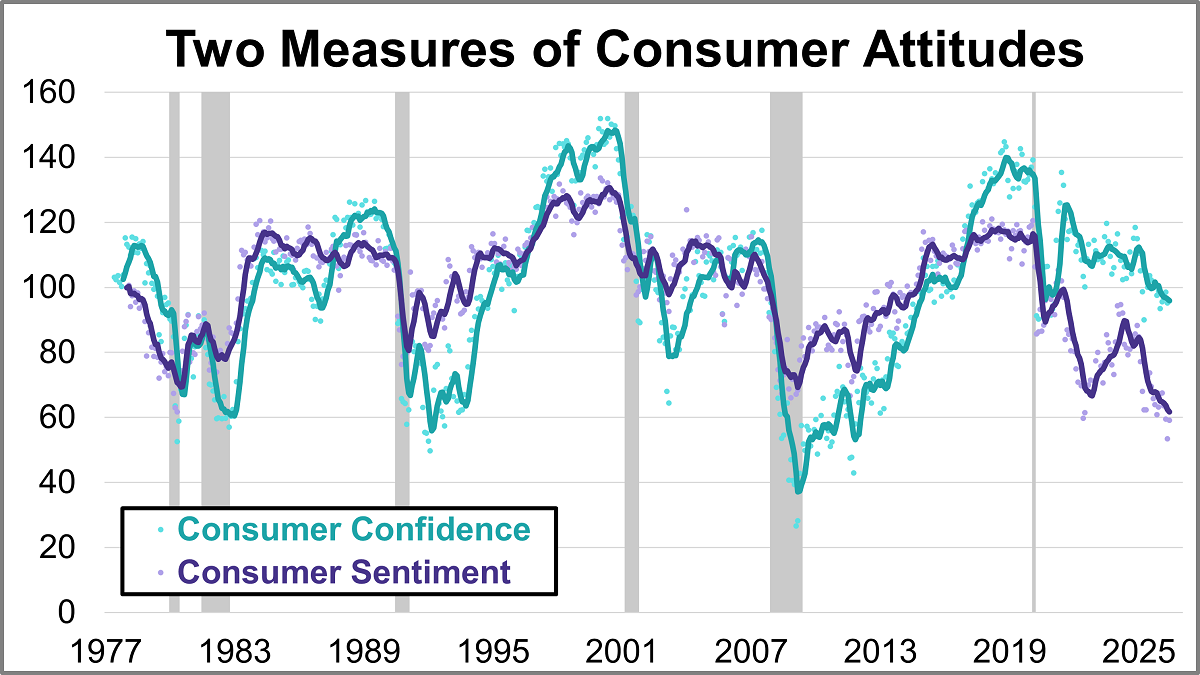
What are consumers thinking about the economy? Their collective mood offers crucial clues for businesses, investors, and policymakers alike. In June, the two leading benchmarks, the University of Michigan’s Consumer Sentiment Index (MCSI) and the Conference Board’s Consumer Confidence Index (CCI), offered similar views with both showing slight improvement despite ongoing inflation concerns.
The OBBBA created something the industry rarely gets: a defined planning window without a hard deadline attached. Exemptions are historically high, the law has no sunset, and there's a real body of existing work that needs revisiting. The advisors who treat this as an opportunity, rather than waiting for a client to ask, will drive much stronger outcomes compared to those who don’t.
Even people whose money beliefs and behaviors align more closely are not necessarily an ideal match. Partners whose predominant money scripts fall into the money vigilance category may both track expenses, openly discuss finances, and hold similar values around saving.
These are dark days for free-market economists when one of the few areas of bipartisan consensus is for a terrible idea: Both Vice President JD Vance and Senator Bernie Sanders want the federal government to take an explicit stake in AI firms.
The money is REAL. The question was never whether it exists. It’s who’s spending it, and what they borrowed to do it. When the wall of cash and the bottom half finally commit to risk at the same moment the Fed turns hawkish, that’s not the start of something. That’s the part of the cycle where the careful investor gets paid to be careful.
Ten years ago this week, the world watched the United Kingdom vote to walk away from the European Union. While the political class was clutching its pearls and every talking head on television was promising Armageddon by Christmas, I told you something different.
Chris Galipeau discusses high-conviction insights that go beyond media headlines.
A widening confidence gap in non-traded investment vehicles is testing private credit valuations, sharpening the case for manager selection and diversification beyond direct lending.
It’s hard to believe we’re nearing the halfway point of 2026 – and what an eventful start it’s been. Markets have pushed through a geopolitically driven energy shock, rising inflation pressures and accelerating disruption from the artificial intelligence boom.
The top 10 active ETFs YTD by fund flows show some intriguing trends and successful names that may pique the interest.
Social Security is now just six years away from insolvency, according to the latest annual assessment. Many in Congress might like to keep on ignoring the problem, as they have for years, but this won’t be an option much longer. Senators elected in November will see the system’s trust fund empty during their terms.
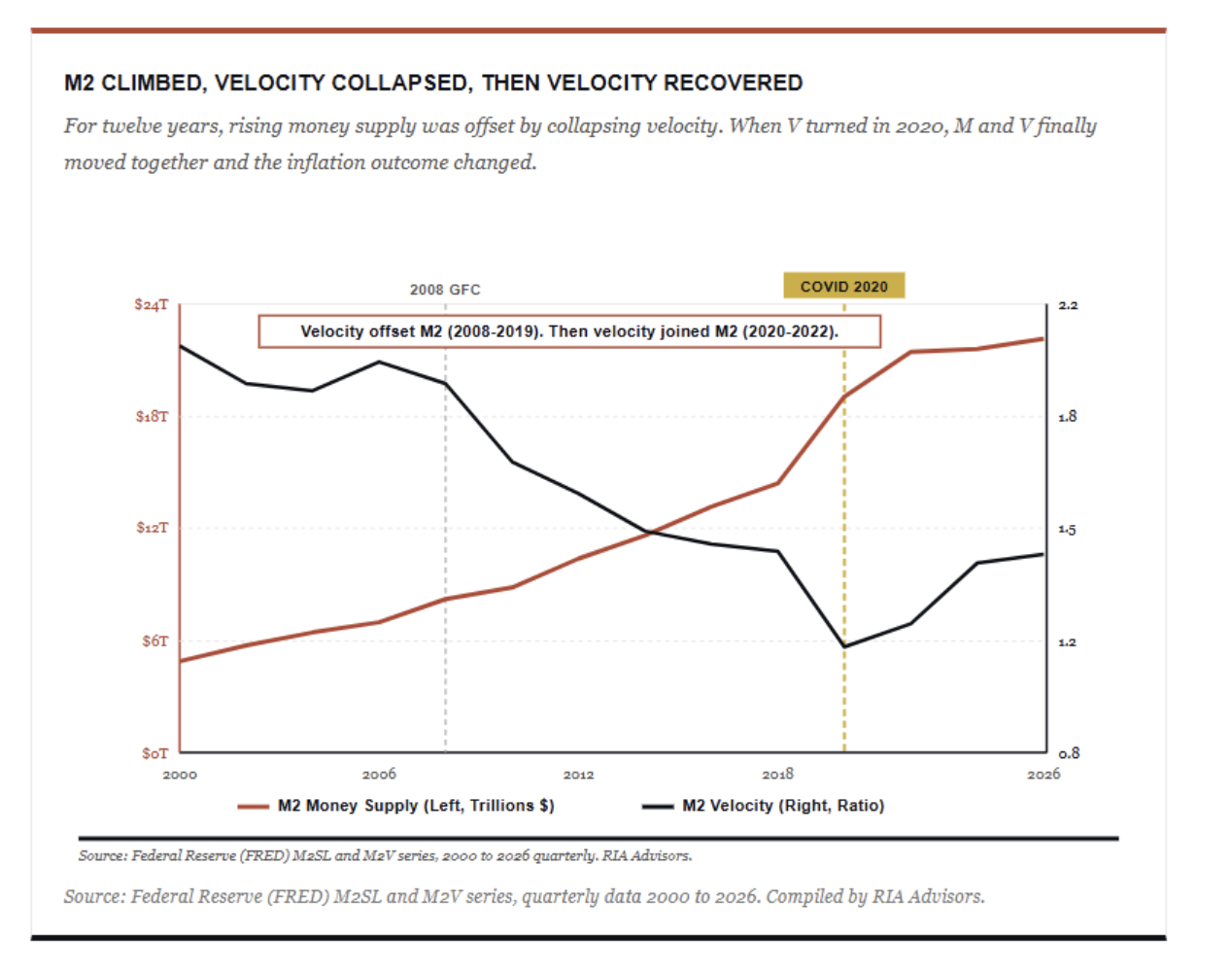
Friedman was reasoning from the equation of exchange, MV = PQ. Money times velocity equals prices times real output. It’s an identity, not a theory. Where it gets interesting is when you ask which variable does the work.
The dominant theme this week was a tug of war between improving macroeconomic conditions and weakness in parts of the technology sector.
Markets have been hyper-focused on AI, crypto and buffer ETFs, but REIT ETFs have quietly staged an impressive comeback. The REIT terrain has shifted rapidly over recent years, and forward-looking investors and advisors have taken notice.
During the past month, the ETF market has seen a wave of excitement surrounding a concentrated group of companies. While investors still want exposure to the tech giants that have dominated the past few years, the successful launch of SpaceX in early June created widespread anticipation for planned IPOs like Anthropic and OpenAI.
Last week’s data reaffirmed that inflation pressures remain the defining narrative across the economic landscape.
I’m hopeful new chair Kevin Warsh will help change the Fed’s inflation-tolerating institutional culture. Early signs look positive. Today we’ll talk about how insidious inflation is and why those who think a little inflation is fine should have their heads examined. It is not fine… for anyone.
The AI boom goes from strength to strength. Big technology companies are pouring hundreds of billions of dollars into chips, data centers and power-hungry infrastructure. One estimate puts annual AI infrastructure investment above $650 billion in 2025 and potentially over $800 billion in 2026..
Model portfolios have helped many advisors solve for scale. The next challenge is more nuanced: how do advisors keep that scale while delivering more personalization, tax awareness and differentiated value to clients?
GraniteShares and VettaFi are coming together for a state-of-the-category briefing: the flow data behind the surge, the structural reasons advisors are making room in income sleeves, how the category has held up across different rate and volatility regimes, and the diligence questions worth asking before adding it to a model.
The dollar is wrapping up one of its best months in a year as a raft of Wall Street banks see a turnaround of fortunes for the US currency.
Private credit is having a moment in the headlines. Higher interest rates and a pullback in certain types of bank lending have pushed more financing activity into private markets. Investors may be left with a simple question: What exactly is private credit?
In a world of high starting yields and rupturing economic alliances, investors who actively diversify across regions, sectors, and currencies can be better positioned to pursue durable returns.
As the market continues to broaden in 2026, a balanced approach matters more than ever.
New Fed Chair Kevin Warsh is already reshaping policy communication by reducing forward guidance, questioning the dot plot’s future and emphasizing real-time data, potentially increasing Treasury market volatility.
The ETF landscape includes plenty of exciting ETFs. Not all, however, can claim to combine high current income and outperformance. The ProShares Russell 2000 High Income ETF (ITWO) has done just that so far this year with its innovative approach to covered calls.
VettaFi currently has index products tied to ETFs issued by American Century, Victory Capital, and ALPS ETFs, but the addition of RAFI products issued by Invesco and PIMCO that are fundamentally weighted is really exciting, according to Rosenbluth.
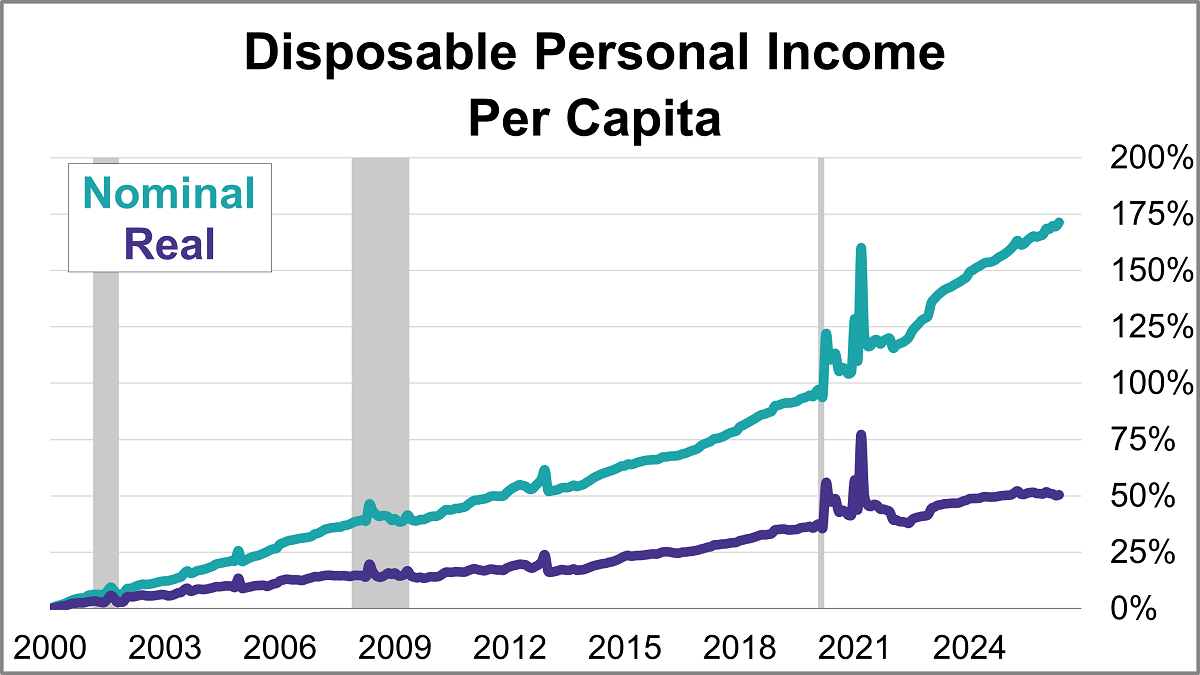
With the release of May's report on personal incomes and outlays, we can now take a closer look at "real" disposable personal income per capita. To two decimal places, disposable income per capita was up up 0.68% month-over-month. But when adjusted for inflation, real disposable income per capita was up 0.23%.
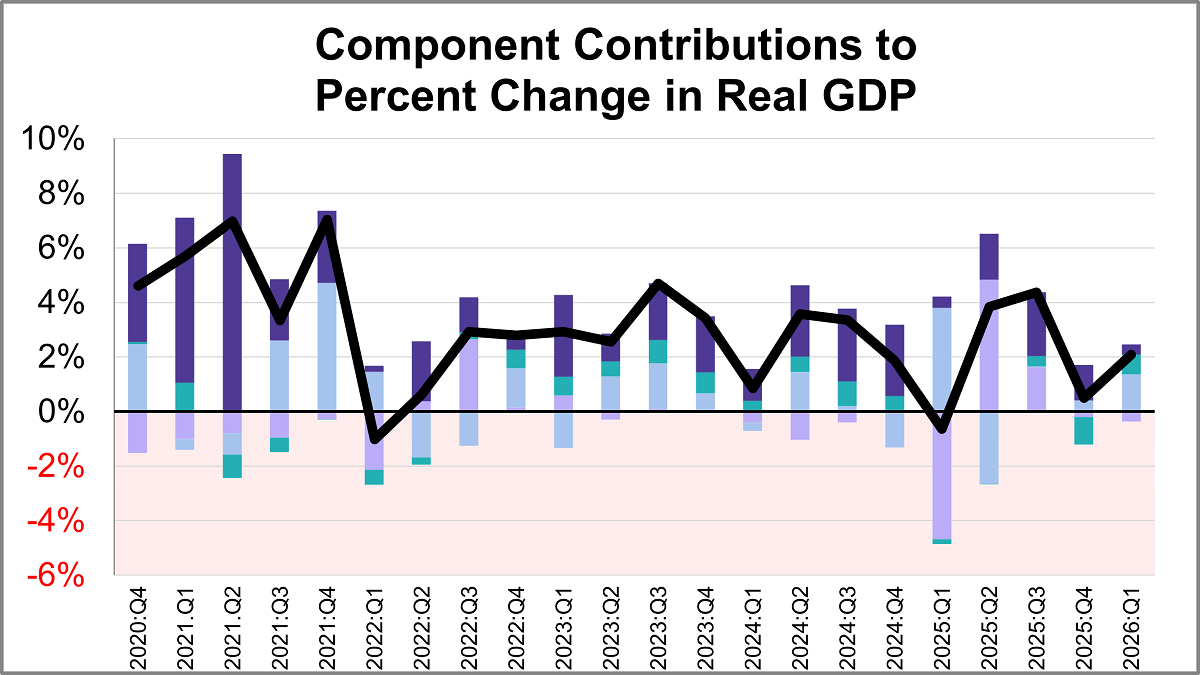
Real gross domestic product (GDP) is comprised of four major subcomponents. In the Q1 2026 GDP third estimate, three of the four components made positive contributions.
Kevin Warsh’s first Federal Reserve meeting as chair mattered less for the rate decision than for what he revealed about how the Fed intends to operate. Warsh signaled a shift toward less guidance and more flexibility.
Municipal bonds often see a seasonal lift during the summer months. This pattern, known as summer technicals, stems from a straightforward supply and demand imbalance that tends to favor bond prices. Over the past ten years, the summer months (May through July) have generally been positive months for the Bloomberg Municipal Bond Index, with monthly returns averaging +0.83%, +0.43%, and +0.82%, respectively.
In broad terms, there appears to be little headline risk facing advisors and income investors mulling municipal bonds. All 50 states carry investment-grade credit ratings, confirming that their credit quality remains solid.
It’s easy to understand why investors are skeptical about value stocks. After nearly two decades of chronic weakness, value’s strong rebound since early 2025 hasn’t offered enough proof that the turnaround has staying power.
US technology stocks rebounded, lifting key indexes, after the latest flareup of concerns about the scale of the artificial-intelligence-fueled rally wiped nearly $1.3 trillion from the market capitalization of Nasdaq 100 companies over the first two days of the week.
THOR builds upon the success of the firm’s Thornburg Investment Income Builder Strategy, bringing that same income generation expertise into a flexible, actively managed ETF.
SpaceX is seeking to raise between $20 billion and $25 billion from a debut bond offering on Tuesday, after attracting about $30 billion of investor orders even before the sales process had formally begun, according to people with knowledge of the matter. At that size, the deal would rank among the biggest of the year, according to Bloomberg-compiled data.
While the market-cap methodology has been the guiding principle for equity index creators, it’s increasingly viewed as a structural error in the world of fixed income. Today, TMX VettaFi is helping to spearhead a growing movement of index innovators who are inclined to challenge the fixed income status quo.
U.S. equities posted a modest advance during the holiday-shortened trading week despite a Wednesday sell-off following a more hawkish than expected Federal Reserve meeting under its new chair, Kevin Warsh.
The rising debt burden of the U.S. government is becoming an increasingly serious economic concern. While it may not be an immediate crisis, it has the characteristics of a slow-moving domestic pandemic.
The corporate world is awash in capex. Leaders in the artificial intelligence (AI) arms race are pouring hundreds of billions of dollars into tech projects, and uncertainty surrounds their profitability. For now, the market rewards this use of cash, but it’s not without pitfalls. Share buybacks, for instance, are seen as a net loser, while the S&P 500® dividend yield has sunk toward all-time lows near 1%.
All of this is a warning to other developed markets with debt levels on the verge of exceeding their gross domestic product. Following the Truss chaos of four years ago, the market has decided to approach the UK through a lens of always assuming the worst, a default that continues to cost British taxpayers in the form of higher interest rates.
The fixed income environment continues to project uncertainty, as higher-for-longer interest rates persist amid sticky inflation. Investors may want to lean on the expertise of active managers when deciding between an active and indexed fund.
Kevin Warsh, the new chairman of the FOMC, has long been critical of forward guidance, which is the Fed’s practice of explicitly signaling the future path of interest rates (e.g., “rates will stay low for an extended period” or publishing a projected path for policy rates). His concern is that the guidance could give the impression that policymakers might have a high degree of confidence about the future path of the economy and rates.
The US-Iran conflict – and its impact on oil prices – has dominated headlines over the past three months. Higher oil prices have pushed inflation to a three‑year high, reshaping the Federal Reserve’s rate outlook.
On Monday, President Donald Trump announced that the U.S. and Iran have reached a peace deal to reopen the Strait of Hormuz, the 21-mile chokepoint through which roughly 20% of the world’s oil supply normally flows.
The most consequential decisions a founder will face, equity gifting before valuations increase, trust structures timed ahead of a sale, QSBS qualification built while eligibility still exists, all must be decided before liquidity. Once the transaction closes, much of what was available earlier is simply gone.
Discover why DoubleLine's Jeffrey Gundlach is urging a structural defensive rotation into emerging markets and international assets.