When it comes to commercial real estate, a lot of attention is obviously paid to offices. But it's not the only sector facing strains.
American consumers are becoming more frugal this holiday season.
The winter holiday season is here, and I wanted to join in the festivities. Recently, advisors have become more comfortable turning to active ETFs to help them and their clients navigate the uncertain market environment. Actively managed ETFs have gained traction in 2023.
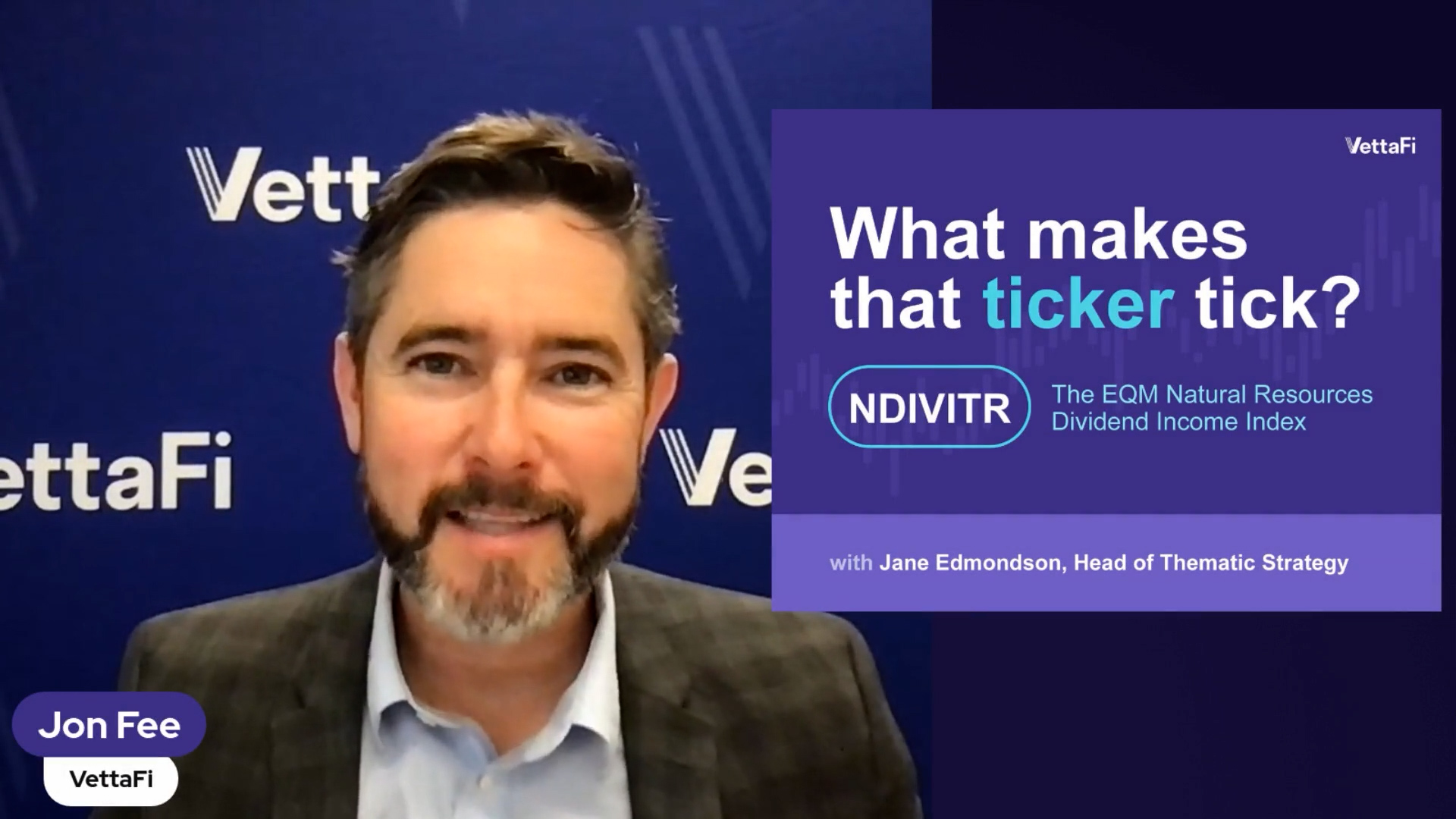
Show host, Jon fee, and Jane Edmondson, Head of Thematic Strategy at VettaFi, discuss the EQM Natural Resources Dividend Income Index (NDIVITR).
Investing in “smart beta” was the rage in the early 2000s, as small-cap-value stocks vaulted over large-cap-growth stocks. But like all supercharged investment strategies, it didn’t last. Factors premiums have not materialized since the financial crisis. For most of the last decade, value has underperformed growth, driving the underperformance of the largest category of smart-beta strategies. We’ll go over the case for and against factors in this interview with long-term investment adviser, Rick Ferri.
Bond traders who powered a ferocious rally in the $26 trillion US Treasury market are about to find out if they’ve gotten ahead of themselves.
History shows that returns are greatest when capital is scarce. But investors need to also realize that risks escalate when there is a glut of capital.
The capital markets are already pricing in rate cuts ahead of 2024, causing yields to fall. One way to continue supplementing income amid a potential drop in yields is to diversify income using a pair of active exchange-traded funds.
Although some volatility may continue, we believe interest rates have peaked. We expect lower Treasury yields and positive returns for investors in 2024.
Our portfolio managers field some tough questions on Matthews Asia Dividend’s performance, its positioning and what they believe are its unique strengths for investors.
Is a stock market correction coming before the Santa Claus rally at the end of the year?
Early last year, critics — and there were many — said the Fed was woefully behind the curve on inflation, and that the only way it could win the battle was to push the economy into a damaging recession by raising interest rates very high, very fast.
The Treasuries market took another leg higher on Wednesday, as a slowdown in private-sector job creation further encouraged traders to bet on US interest-rate cuts ahead of broad labor-market data due Friday.
The notoriously saturated $7.7 trillion ETF industry is this year poised for the second-highest number of closures, as the pandemic-era day trading boom fizzles out.
Both supply and demand of workers will prevent a surge in unemployment rates.
The recent rate pause by the Federal Reserve is bringing optimism to the capital markets that interest rates may finally head lower. In turn, it’s pushing yields down. Conversely, bond prices rallied in November, which should help bring investors back to the market.
Insurance is making national headlines in 2023 as major providers retreat from writing new policies in large parts of the country and renewal premium prices skyrocket.
Markets improved last month across the board as interest rates pulled back on signs of slowing growth. U.S. markets were up by high-single to low-double digits, while international markets were also up by high-single digits.
Student loan interest rates are different depending on whether you have federal student loans or private student loans. The short explanation is that federal student loans are a better deal.
The US Supreme Court heard arguments on Tuesday over a dispute over a $14,279 tax bill — and the slightly more consequential question of what counts as income under the federal tax code, a definition the Biden administration would like to expand.
If Mike Tyson were speaking to a group of investors, what he may have been saying is that everyone has a financial plan until life throws a “punch.”
The message coming from Wall Street is that investor optimism is running dangerously high.
Taiwan’s economic and financial decoupling from China has deepened with the near-collapse of what was once the world’s largest Chinese bond exchange-traded fund market.
Our forecast for the federal funds rate has the Federal Reserve (Fed) starting to cut rates in July 2024, with a second rate cut before the end of 2024.
Valuations for municipal bonds are very attractive right now. And as yields remain strong, so do their fundamentals.
Money markets paid nothing. The dividend yield for the S&P 500 Index was 2%, and the 10-Year Treasury yield was stuck between 2%-3%.
In mid-September, Rockefeller Asset Management, the asset management arm of Rockefeller Capital Management, and KraneShares, a leading global ETF provider specializing in China, climate, and uncorrelated assets, launched the KraneShares Rockefeller Ocean Engagement ETF (ticker: KSEA). The fund invests in public companies with significant impact on oceans and ocean resources, reflecting the meaningful investment opportunities within the blue economy.
KSEA aims to generate competitive returns and improve ocean health through shareholder engagement activity focused on pollution prevention, carbon transition, and ocean conservation. Holdings include companies from diverse sectors such as aquaculture, commercial fishing, waste management, renewable energy, and logistics, among others.
My guest, Casey Clark, will discuss this new ETF.
The $1.6 trillion private credit market is enjoying a “golden moment,” in the words of one Blackstone Inc. executive, as banks retreat from risky lending and investors flock to funds offering double-digit returns on corporate loans.
Our outlook for 2024 is for a gradual U-shaped recovery composed of seemingly chaotic movements in economic data with turning points in policy rates and earnings growth.
Market rents in the US are, depending on which measure you look at, either rising slowly or falling outright. Home purchase prices, after a slight dip last year, are climbing again.
Unlike with a 401(k) plan, you can withdraw as much as you want from your 529 plan at any time. But your 529 plan withdrawal could hit you with severe tax penalties if you use it on nonqualified expenses.
Recency bias is too ingrained within us as human beings to ever go away regardless of the evidence. As advisors, we must learn to manage it.
December’s whipsaw opening shows investors may be concerned November’s epic rallies went too far, too fast in anticipating a near-perfect soft landing for the economy.
Our portfolio managers field some tough questions on Pacific Tiger’s performance, its positioning and what they believe are its unique strengths for investors.
November was kind to fixed income investors as bonds posted their best month of 2023. High yield corporate debt participated in that rally as highlighted by the fact that the largest junk bond exchange traded fund is higher by nearly 4.3% over the past month.
For much of 2023, the market has tried to anticipate a Fed pivot – only to be wrongfooted several times. However, sharply higher interest rates, cooling inflation pressures and moderating wages have the market convinced that the Fed’s current tightening cycle is over.
With more than 3,000 ETFs to cover and many new ones launching each month, it is easy to forget. For many people, S&P 500 Index-based ETFs remain the core of their portfolio. Heading into 2024, these products topped the latest monthly flow leaderboard.
Across Wall Street, analysts and investors had cheered 2023 as the year of emerging markets, only to be burned by a relentless climb in US Treasury yields. Now, as the Federal Reserve looks set to end its most aggressive monetary tightening campaign in a generation, they’re at it again.
A torrid bond market rally shows traders are convinced the Federal Reserve’s rate-rising cycle is over. The debate now turns to when central bankers start cutting, and by how much.
Recent data point to a record shopping season for Shopify (SHOP), which saw Black Friday sales grow 22% y/y. Additional reports from Adobe Analytics show a strong $9.8 billion Black Friday season.
Back in the Great Financial Crisis era, someone quipped that the federal government had become a giant hedge fund with an army attached. That wasn’t far off. Various agencies and entities were absorbing all kinds of risky assets to stabilize an overleveraged system.
In a turnaround from last year, there is renewed interest in the fixed income asset class as yields have risen. Ed Perks, CIO of Franklin Income Investors, shares his analysis of recent macro developments and where he sees opportunities for income.
Tax-loss harvesting creates an opportunity every year for advisors to turn lemons into lemonade. Advisors can realize losses that their clients experienced during the year and use them to offset realized gains in other parts of their portfolio.
Our 2023 Manager ESG Survey shows that transparency around DEI data is increasing among investment managers. The results reveal that equity product managers in particular are more inclined to share DEI data compared to managers in other asset classes.
Many advisors and investors in 2023 have turned to fixed income ETFs with an average duration of less than one year. Taking on very little interest rate risk through duration has been rewarding as well.
Franklin Templeton recently hosted due diligence meetings with financial advisors where Tony Davidow, Senior Alternatives Investment Strategist, led discussions focused on alternative investments.
Money managers including Invesco Ltd. and Loop Capital Asset Management are bullish on regional-bank bonds, wagering that the debt will perform better than the broader market as fears about funding costs settle down.
In the wake of recent underperformance, healthcare is entering the new year with compressed valuations just as innovation picks up and a post-COVID reset winds down. That should make for a positive outlook, says Janus Henderson Portfolio Managers Andy Acker and Dan Lyons.
Economic conditions now are quite different from the 1970’s and still disinflationary.
Risk premiums on US investment-grade corporate bonds have narrowed to the tightest level in nearly two years on expectations that the Federal Reserve has reached the peak of its monetary-tightening cycle.