In this article, we’re going to throw some cold water on the DI love-fest by explaining why most tax-sensitive investors would be better off with a simpler approach to tax loss harvesting.
US Bitcoin exchange-traded funds have posted their longest run of daily net outflows since listing at the start of the year, part of a wider retreat from riskier assets in a challenging period for global markets.
Bond traders who struggled to predict how high the Federal Reserve would raise interest rates are finding the way down just as vexing.
Cloud computing has been one of the first industries to get a demonstrable boost from artificial intelligence. Oracle Corp.’s quarterly results on Monday are likely to extend that trend.
The US stock market has given us plenty of real and perceived calendar anomalies to think about. There’s the observed tendency for stocks to experience a “Santa Claus rally” (during the last five trading days of the year and the first two of the next) and the weekend effect (where stocks have a habit of slumping on Mondays).
Stock buybacks have boomed in recent years. With corporate cash flows remaining high and potential rate cuts from the Fed, the trend appears set to continue.
Since the end of the “Yen Carry Trade” correction in August, bullish positioning has returned with a vengeance, yet two key risks face investors as September begins. While bullish positioning and optimism are ingredients for a rising market, there is more to this story.
Shopping around for an active ETF? This strategy has outperformed SPY recently thanks to its ability to over- or underweight certain stocks.
ETFs saw a record number of inflows in August, including bond-focused funds, which are offering opportunities in corporate debt.
The U.S. economy may be heading into choppy waters, and investors might be wise to buckle up.
The main focus for investors should is no longer if the Fed will cut rates in 2024, but how much and how quickly the Fed will lower interest rates.
Former Treasury Secretary Lawrence Summers said that while the August employment report wasn’t particularly poor, it did make predicting the size of the Federal Reserve’s likely interest-rate cut this month a tougher call.
Amundi SA and First Eagle Investment Management are looking to raise as much as $5 billion for a new private credit strategy that will offer wealthy individuals in Europe, the Middle East and Asia access to private loans made to mid-size US companies.
Nvidia Corp. has wiped out more than $400 billion in value this week, weighing on key equity benchmarks as jitters spread over the health of the US economy and an AI trade that may have gotten ahead of itself.
As market sensitivity to economic data continues, investors would do well to consider active strategies amidst ongoing volatility.
After two days of record sales in the US blue-chip corporate debt market, another 11 companies are looking to sell bonds on Thursday, and demand for the securities is holding strong by key measures.
The concept of portable alpha is over 40 years old. And while it has evolved through various forms over that time, it continues to be a valuable portfolio tool for institutional investors. Arguably, the most popular iteration right now is adding alpha expected from hedge funds on top of synthetic beta exposure.
Gold is typically an asset that doesn’t generate yield, but there are ETFs that deliver yield on a gold position through options.
OPEC+ is like a teabag – it only works in hot water. The late Robert Mabro, one of the savviest oil-market observers, liked to say the cartel only got the job done when it was under prolonged financial pain. To judge by its latest actions, OPEC+ has yet to realize it’s inside a warming kettle.
Most people see “blockchain” and “funds” in the same sentence and immediately think of pools of money betting on cryptocurrencies like Bitcoin and Ether. That isn’t how Singapore sees the utility of distributed ledgers.
US hiring fell short of forecasts in August after downward revisions to the prior two months, a development likely to fuel ongoing debate over how much the Federal Reserve should cut interest rates.
US Treasuries gained and traders ramped up their bets that the Federal Reserve will opt for a supersized interest-rate cut this month after a mixed report on the US labor market.
The world’s biggest asset manager is taking some chips off the table as markets enter a “new phase” of turbulence ahead of a Federal Reserve interest rate cutting cycle and the US presidential election.
In a recent discussion with Adam Taggart via Thoughtful Money, we quickly touched on the similarities between the U.S. and Japanese monetary policies around the 11-minute mark. However, that discussion warrants a deeper dive. As we will review, Japan has much to tell us about the future of the U.S. economically.
We often write about the opportunity for fixed income investors to lock in relatively attractive long-term rates. And we would argue that investment consultants and financial advisors have no more important charge than to convince their clients to take advantage of this while they still can.
High interest rates have had the predictable effect of restraining the performances of dividend stocks and related exchange traded funds.
Private assets are the fastest-growing market in the financial world, but could be the most challenging field for ETF providers to penetrate.
The Federal Reserve is creating the potential for extreme bouts of volatility surrounded economic data releases.
The bold bet from the likes of Citigroup Inc. and JPMorgan Chase & Co. that the Federal Reserve will slash interest rates by a half-percentage-point this month faces its biggest test yet from Friday’s US jobs report.
Labor Day weekend, marking the end of the US summer driving season, is typically the year’s last hurrah for gasoline producers. This year, the high-fives were reserved for drivers (and White House occupants): The average pre-long weekend pump price was down 13% from last year after gasoline refining margins collapsed in August. Pump prices have eased further this week.
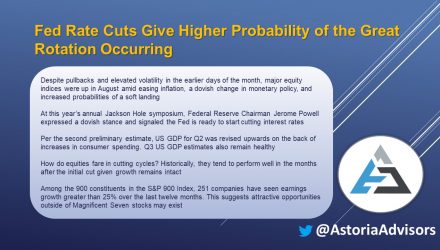
Despite pullbacks and elevated volatility in the earlier days of the month, major equity indices were up in August.
Jane Street Group LLC and Citadel Securities are on a tear. First-half revenue at the two predominantly electronic market makers grew about 80% compared with the first six months of 2023, according to Bloomberg News. That’s enough to make traditional Wall Street executives green with envy — but these upstarts aren’t going to completely devour the old guards’ lunch.
A key segment of the US Treasury yield curve briefly turned positive as weaker-than-anticipated labor-market data bolstered bets on steep interest-rate cuts by the Federal Reserve.
Investors should be careful what they wish for in hoping for an aggressive Fed rate cutting cycle, given stocks tend to do better when cuts are slow and steady.
A bright spot in Chinese investment could spell trouble for its financial institutions.
After a decade of consistent outperformance, Japanese small caps began underperforming their large cap peers in 2018, a trend that has accelerated since 2023.
This week’s data reflects the resilience of the U.S. economy. Currently, the economy is holding steady with jobless claims in the 230,000 range and recent inflation data showing stability. Friday’s inflation report was essentially at expectations and indicates that the Federal Reserve (Fed) will make a rate cut of at least 25 basis points (bps) at the September meeting. Whether the cut is 25 or 50 will depend mostly on this week’s employment report.
The stock market as measured by the S&P 500 is trading at a very high valuation. In this video, Chuck Carnevale, Co-Founder of FAST Graphs, a.k.a. Mr. Valuation is going to share 10 extremely high-quality stocks that are not overvalued, and offer good growth and long term total rates of return.
On this episode of the “ETF of the Week” podcast, VettaFi’s Head of Research Todd Rosenbluth discussed the JPMorgan Ultra-Short Income ETF (JPST) with Chuck Jaffe of “Money Life.” The pair talked about several topics regarding the fund to give investors a deeper understanding of the ETF overall.
Using infographics to illustrate your firm’s financial planning process is a great way to show the value you provide. Whether in your marketing materials, initial consultations, or new client onboarding, these visuals can help set the stage for a successful and growing relationship.
This week I had the chance to run a half-day workshop helping seasoned, successful advisors learn techniques for emerging as strong leaders, so I’ll share some of the information here in this column.
In this edition, Harold Evensky explores the challenges facing sustainable and active funds, the implications of the new DOL Fiduciary Rule, and the value of long-term performance projections. With candid observations and critical analysis--read on to gain perspective on navigating the complex world of investing, the importance of risk management, and the role of fiduciary advisors in securing your financial future.
Equity bulls looking for signs of relief after Tuesday’s stock rout may get a hand from a familiar friend: corporate America.
Bond traders are bracing for wilder market swings in the US than in Europe, as signs the world’s largest economy is faltering fuel bets on a jumbo interest-rate cut from the Federal Reserve.
The sharp selloff that wiped a record $279 billion off Nvidia Corp.’s market value on Tuesday has traders scouring charts for clues as to where the pain might end.
A record number of blue-chip firms swarmed the US corporate bond market on Tuesday, taking advantage of cheaper borrowing costs as they look to issue debt ahead of the US presidential election.
The case for infrastructure investment is rising, but so are its costs.
A soft landing for the U.S. economy still appears to be the most likely outcome.
With his Jackson Hole speech, Federal Reserve Chair Jerome Powell all but promised rate cuts were coming. That’s cool. But it is why that matters.
ERShares Founder Joel Shulman goes in-depth on what’s being called the first ever private-public crossover ETF, the appropriately named Entrepreneur Private-Public Crossover ETF (XOVR). VettaFi’s Todd Rosenbluth discusses Nvidia from an ETF angle, highlighting products with varying exposure to the high-flying stock.