Let’s look at a few approaches to leadership that will be better suited to the current moment than the more traditional styles.
We monitor battery prices, elections and market attention on climate resilience for their impact on transition-related investment opportunities and risks. U.S. stocks were mostly flat last week, while 10-year U.S. Treasury yields fell further. Markets still expect the first Federal Reserve rate cut around mid-2024.
Learn to avoid the most common and damaging errors by considering these five key questions before you hit “enter.”
Super Tuesday was, if I may, super obvious. Former President Donald Trump clinched nearly every delegate that was up for grabs, forcing his Republican challenger, Nikki Haley, out of the race, which all but guarantees his nomination.
There are at least two certainties regarding Indian stocks. First, equities in that country have been the stars among major emerging markets for several years.
The average expected return on asset (EROA) assumption for the largest U.S.-listed pension plan sponsors increased to 6.70% in 2023—the first time a year-over-year increase has been observed in 19 years of records.
I cannot get away from the feeling of guilt that I am sacrificing time with my children to run this business.
Golfers and investors are interested in the same thing: results. But navigating market events, or a tricky par 5, requires balancing risk and reward. Like selecting the proper club, appropriate asset allocation is crucial when seeking success and reaching investors' desired long-term outcomes. That's why often overlooked mid caps present exciting opportunities for investors.
Join the experts at State Street Global Advisors to learn about the opportunity mid-cap ETFs provide and hear golf legend Tony Finau discuss his winning mindset and approach to balancing risk and reward for long-term success.
Investing in sports franchises can be a good portfolio diversifier and generate attractive returns.
There’s been a lot of excitement and reporting about a new ETF: the Alpha Architect 1-3 Month Box ETF (ticker BOXX), designed to give investors the return of short-term US Treasury Bills with the tax character of long-term capital gains.
Nvidia Corp.’s rise is captivating the stock market and driving the S&P 500 Index to new highs. But it also raises cautionary reminders of another investor darling that soared on dreams of a technological transformation, only to tumble back to earth when those hopes turned to disappointment.
The frenzy around AI stocks has blindsided Wall Street forecasters, spurring a race among strategists to keep up with a stock market rally that’s already blowing past their expectations when 2024 began.
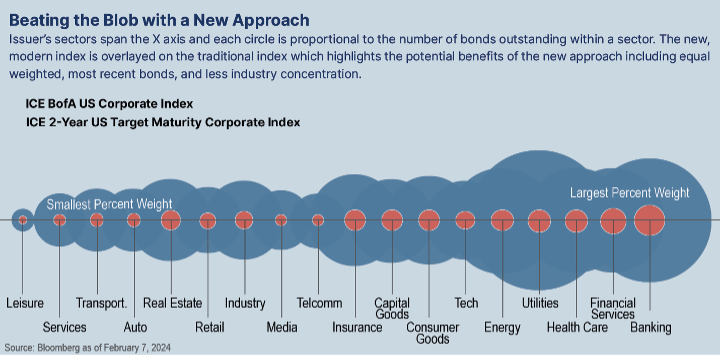
Why the traditional methodology for bond index construction needed a new, investor-focused approach.
Adding real assets to a stock and bond portfolio can help boost returns and smooth volatility when inflation runs above 2%.
Big Tech stocks created, and have so far dominated, the trillion-dollar club in the US. For the first time, there’s a race brewing for an outsider to join their ranks.
Over the past year and counting, money managers have ramped up exposure to a handful of Big Tech companies – swelling market valuations along the way.
There are more than 200 ETF providers in the $8 trillion U.S. ETF market, but I’m intrigued by a recent entrant’s ambitions. In December 2023, Themes ETFs introduced 11 ETFs.
Berkshire Hathaway Inc. shares rose as much as 5.5% in premarket trading on Monday, set to push the market value of Warren Buffett’s conglomerate even closer to $1 trillion.
NVIDIA reported financial results for the fourth quarter and full-year 2023 this week, and I’m still picking my jaw off the floor.
The US and China are discussing new measures to prevent a wave of emerging market sovereign defaults, according to people familiar with the situation, one of the most significant attempts in years at economic cooperation between the rival superpowers.
Immigration is a vital source of economic growth.
After several decades of transformative tech wealth, the AI boom is ushering in another. Not only has Nvidia Corp.’s soaring valuation made co-founder Jensen Huang an extremely wealthy man, but his distant cousin Lisa Su, head of Advanced Micro Devices Inc., is now worth $1.2 billion.
Many investors remain in cash, but we think it’s time to shift exposure to bonds.
It’s been blamed for fueling stock volatility and dismissed as the latest case of market speculation gone too far.
Being bombarded by notifications interferes with your productivity. Here are the alerts you should skip and those notifications you can’t live without.
Secure lifetime income is a top wish-list item for defined contribution plan participants, and it has benefits for plan sponsors too. But there are very different ways to deliver it.
Many midstream companies provide guidance for the year ahead, but a select group also offer EBITDA growth guidance or targets for the next few years. Visibility to future EBITDA growth provides important context for dividend growth.
There is a five-step process to turn someone into a COI.
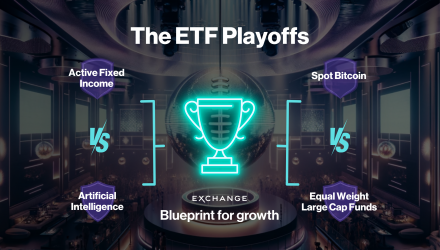
Yesterday, before the Super Bowl kicked off, VettaFi hosted an ETF game show at the Exchange conference in Miami. As part of the ETF Study Hall, we brought together the ETF community to help share information about some equity, fixed income, commodity, and even spot bitcoin ETFs.
There are three pitfalls that I most commonly see income investors fall victim to. I hope illustrating them will help you avoid their damaging effects on your investment portfolio.
Nvidia Corp.’s stock has rallied so much this year that it’s now threatening to overtake Amazon.com Inc. to become the fourth most valuable US company.
I met with seniors from Duquesne University recently, all of them about your age. They are Finance Majors graduating in the spring and were looking for insights into investing, career advice and strategies for building successful careers.
Here are seven ways to be great at sales for those who don’t consider themselves “salesy.”
Here are seven uncommon marketing tactics that were hyper-successful for the firms that used them.
As the market prepares for Apple Inc.’s earnings on Thursday, all I can think is this: Chief Executive Officer Tim Cook has problems. Plenty of them.
The “Magnificent Seven” were at the forefront of 2023’s market rally, but the same leader board has done some shifting to start 2024. After an earnings miss, the stock of Tesla faltered, while peers like Microsoft and Apple continue to see higher heights, reaching the $3 trillion club.
Income investors have an overwhelming number of investment options today. The menu ranges from traditional fixed income to equity investments like REITs to innovative covered call ETFs to more exotic vehicles.
As money market account balances soar, the mainstream media again proclaims, “There is $6 trillion of cash on the sidelines just waiting to come into the market.”
The first round of the ETF Playoffs has concluded! Exchange, a conference for financial services professionals, is happening in Miami, February 11-14. Since Exchange is hosting a party for the big game at Miami’s hottest club, LIV, we’re hosting an ETF championship bracket.
If artificial intelligence is going to live up to the hype, Goldman Sachs analysts said recently, the excitement stage of AI needs to shift drastically this year into a period of meaningful deployment.
Lenders in the world’s two most-populous nations are having very different problems with monetary and fiscal taps. In China, creditors are drowning in cheap central bank cash, but loan demand is muted. In India, banks are in the middle of their fastest expansion in a decade, but they’re parched for liquidity.
The European Central Bank left interest rates unchanged, without conveying any urgency to start cutting rates in the next few months. David Zahn, Franklin Templeton Fixed Income’s Head of European Fixed Income, weighs in on the implications for investors—and why lengthening duration may make sense.
Advisor Perspectives recently asked its community they are recommending the new spot bitcoin ETFs. Many made incorrect statements in their efforts to justify their opposition.
A recent report from the International Monetary Fund (IMF) has projected that AI will affect almost two out of every five jobs done by humans around the world. AI of course will impact work that is already somewhat or totally automated.
Despite several physical gold ETFs on the market seeing strong outflows and spot Bitcoin ETFs stealing market share, gold miner ETFs haven’t necessarily faced the same problem of outflows.
A new report by BMO Capital Markets suggests that the price of gold is no longer being driven by real interest rates. What replaced them? I unveil the answer below.
This week, Microsoft joined the $3 trillion club — which so far has only two members, the other being Apple Inc., which first hit the milestone two years ago.
The markets never fail to keep us guessing, but this year has shown even more evidence that predicting markets is a fool's game. What's in store for 2024? We have some ideas...
January 2024 is likely to be remembered for the strong launch of 10 new spot bitcoin ETFs and the uplisting of the Grayscale Bitcoin ETF (GBTC).
Jim Bianco, President of Bianco Research Advisors, explains the index behind the WisdomTree Bianco Total Return Fund (WTBN) and offers perspective on interest rates and credit risk. VettaFi’s Zeno Mercer discusses the latest around artificial intelligence, including valuations of companies involved in the space and considerations when gaining exposure through ETFs. Academy Asset Management’s Seth Rosenthal spotlights the Academy Veteran Impact ETF (VETZ).