VettaFi’s Todd Rosenbluth and Kirsten Chang discuss year-to-date ETF flows, along with tackling the challenges presented by fixed income right now. etf.com’s Kristin Myers previews their upcoming 2024 industry awards ceremony and highlights several hot ETF topics.
To keep your clients, do more than just your job – you need to keep them engaged. There’s a place for old-school engagement techniques like birthday cards and regular client meetings, but we can do better.
Fixed-income markets are back in a tizzy over inflation, thanks to the combination of rising risks for energy prices and strong retail sales data — both of which come on the heels of a higher-than-expected consumer price index last week.
Growth and inflation have remained remarkably resilient since the start of the year, causing the market to once again rethink the Fed’s rate path. As a result, the odds of a June rate cut have collapsed
Despite expectations for interest rate cuts by the Fed, yields have risen since the start of the year, with the government 10-year bond yield climbing nearly 70 bps this year through April 10. This is a sharp reversal from what occurred in Q4 2023 when the 10-year yield collapsed by 71 bps.
On this episode of the “ETF of the Week” podcast, VettaFi’s Head of Research Todd Rosenbluth discussed the Invesco Senior Loan ETF (BKLN) with Chuck Jaffe of “Money Life.” The pair talked about several topics regarding the fund to give investors a deeper understanding of the ETF overall.
Most US Treasury yields climbed to new year-to-date highs, with the 2-year note’s approaching 5%, after hot retail sales data further eroded investor confidence that the Federal Reserve will start cutting interest rate cuts this year.
A group of US regional banks is ratcheting up lending to oil, gas and coal clients, grabbing market share as bigger European rivals back away.
Don’t bank on an upbeat corporate earnings season to drive equities higher as much of the optimism is already priced in following the record-breaking rally this year, according to JPMorgan Chase & Co. strategists.
The First Eagle Credit Opportunities Fund (FECRX) just reached its three-year anniversary. The fund offers advisors and their clients access to private credit and syndicated loans through an interval fund structure.
There are signs that some previous "rolling recessions" are starting to turn into rolling recoveries.
In the first quarter of 2024, fixed income investors turned to investment-grade corporate bond ETFs.
Artificial intelligence (AI) and Bitcoin were top of mind at Paris Blockchain Week, where I had the privilege of presenting to an enthusiastic crowd. The blockchain and digital assets event, held beneath the world-famous Louvre Museum, attracted close to 10,000 people, an impressive 25% increase over last year, as Bitcoin traded near its all-time high and AI dominated headlines.
Investors wagering on an extension of last year’s global bond gains have been served a harsh reality check.
The first quarter was strong for major U.S. investment banks as the economy grew and M&A and IPO activity accelerated.
Senior Investment Strategist Tracey Manzi notes that with a Federal Reserve easing cycle on the horizon, the fixed income markets are relatively attractive.
Over half of Gen Z and Millennials have a side hustle or some kind of gig work to supplement their income. The numbers show that nearly two-thirds of workers are living paycheck to paycheck.
Fueled in part by expectations that the Federal Reserve will lower interest rates this year — or at the very least, won’t hike anymore — preferred stocks and related ETFs are delivering solid showings for income investors.
The S&P 500 has been touching new highs after a rocky start to the first quarter of 2024, and is doing the same thing again at the start of Q2. While market corrections will happen invariably, it’s a reminder that traders can always take advantage of any short-term weakness.
This week’s discussion is a follow-up to last week’s overview of the elongation of the economic cycle.
A third consecutive month of higher-than-expected inflation data dealt a double-barreled blow to Joe Biden’s political prospects ahead of November’s election, exacerbating concerns voters could punish him over high prices and delaying hopes for Federal Reserve rate cuts the president has predicted.
Signs that inflation has yet to release its grip on markets have simmered for weeks. Now they’re boiling over after Wednesday’s hotter-than-forecast consumer price index sent stocks and bonds reeling.
Given that many people consider gold prices to be a macro barometer, reflecting trends in the economy, inflation, currency, and geopolitics, let’s identify the driving force behind the recent surge in the price of gold.
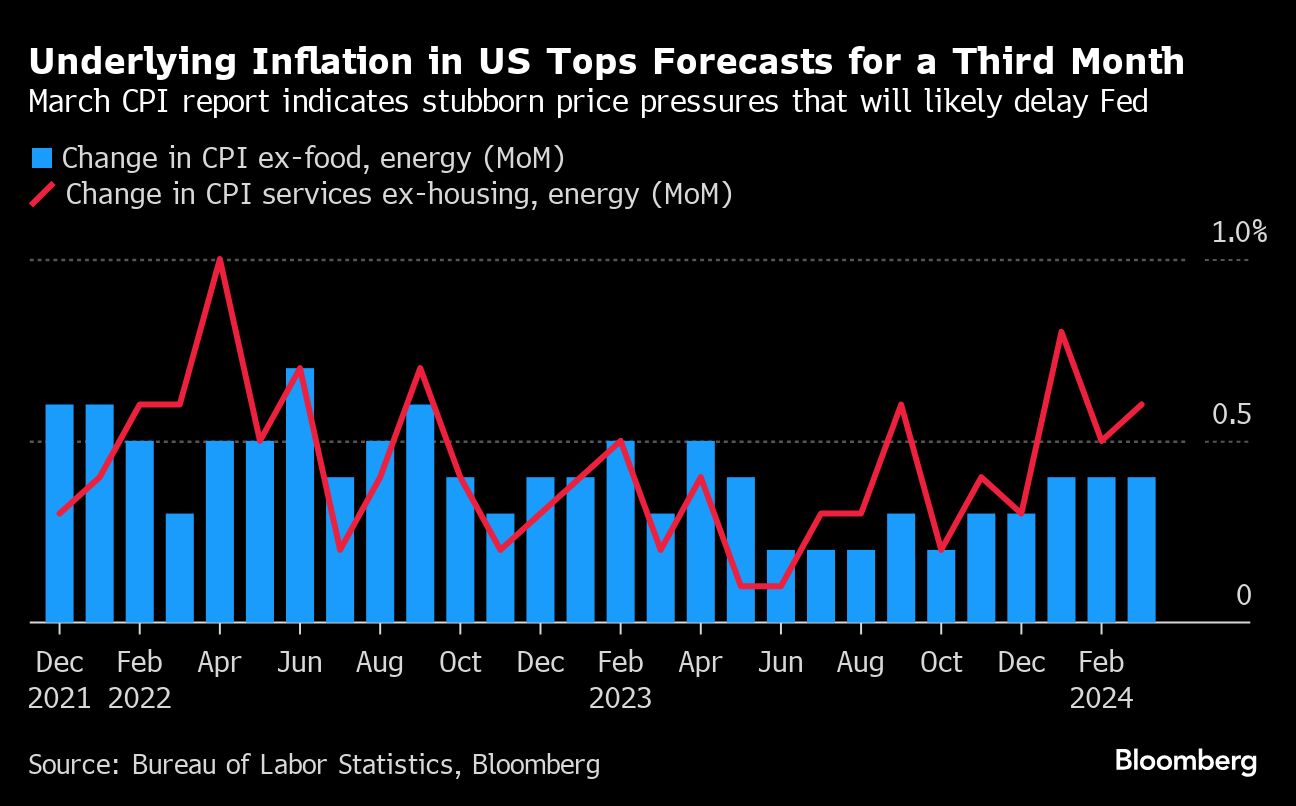
A measure of underlying US inflation topped forecasts for a third straight month, heralding a fresh wave of price pressures that will likely delay any Federal Reserve interest-rate cuts until later in the year.
A block trade in US short-term interest-rate futures Tuesday was the biggest on record and helped drive gains for the Treasury market.
How might investors consider positioning their portfolios amid today's complex and uncertain economic landscape?
A steady march higher in markets was snapped by a stretch of jarring volatility as traders gave hints there’s a limit to their appetite for hot economic data.
Treasury yields reached their highest levels of the year Monday — where they swiftly attracted buyers — as traders decided two Federal Reserve interest-rate cuts are likelier than three this year.
While artificial intelligence and new technologies have captured the market's attention, this quarter we reminisce about the good old days and a key piece of technology that has endlessly entertained us all – classic video games.
More clarity on interest rates means more clarity on the investment outlook and the opportunities across private markets.
Investors have been opting for intermediate-term bonds funds as uncertainty over the Federal Reserve's policy looms.
Market update from BlackRock's municipal bond team.
Copper is trading at a 52-week high, oil is above $90 a barrel and the S&P 500 Energy Index just hit a fresh all-time high.
A rough start to the year for bond traders risks getting worse with the release of key US employment data on Friday. Treasury yields remain near their highest levels of 2024 ahead of the report, which is forecast to show that solid jobs growth moderated in March.
Mohamed El-Erian still expects Federal Reserve officials to cut interest rates twice this year, even as a blockbuster jobs report pushes traders to rethink the timing.
A rough start to the year for bond traders just got worse as data showed a buoyant US labor market with few of the stresses that could prompt the Federal Reserve to lower interest rates.
The global investment landscape is set to be transformed in the months ahead as the trajectories of major economies diverge more noticeably.
A flurry of investor interest is taking place in the corporate bond market as investors scramble for yield before rate cuts.
Emerging-market local-currency bonds have rallied sharply since last October, along with other risky segments of the global bond market. However, navigating the market can be challenging.
Federal Reserve Chair Jerome Powell signaled policymakers will wait for clearer signs of lower inflation before cutting interest rates, even though a recent bump in prices didn’t alter their broader trajectory.
Market rally driven by a broadening of the market and optimism that the Federal Reserve will deliver rate cuts later this year.
Investors have been selling inflation protection in the mistaken belief that it’s no longer needed. They’ve helped create a unique opportunity.
In 1983 Bonnie Tyler's ‘Total Eclipse of the Heart’ rocked the FM airwaves, reaching number 1 on the Billboard chart. My father, who couldn't get enough of the tune and played it over and over.
Bond traders are piling into bearish bets, fueling a selloff in benchmark Treasury securities, as fresh evidence of robust US growth triggers a recalibration of expectations for Federal Reserve interest-rate policy.
For a brief moment last week, the market and the Federal Reserve were on the same page about the pace of monetary easing. It didn’t last long, and Treasuries investors are paying the price.
What next for stocks after a strong start to 2024? While a near-term pullback wouldn’t be surprising, we see fuel for the positive momentum to continue throughout the year ― but with selection growing more important.
Over the past 70 years, rising government debt generally has been accompanied by weaker economic activity. But it's not a simple relationship.
Negative interest rates have more cons than clear pros.
Bond investors who are overly focused on individual data points may lose sight of the bigger opportunity picture.
For lack of a better word, the fixed-income mantra is getting stale. Interest rates have peaked, and they remain at elevated levels, allowing investors to take advantage of higher income and ample cash flow opportunities.