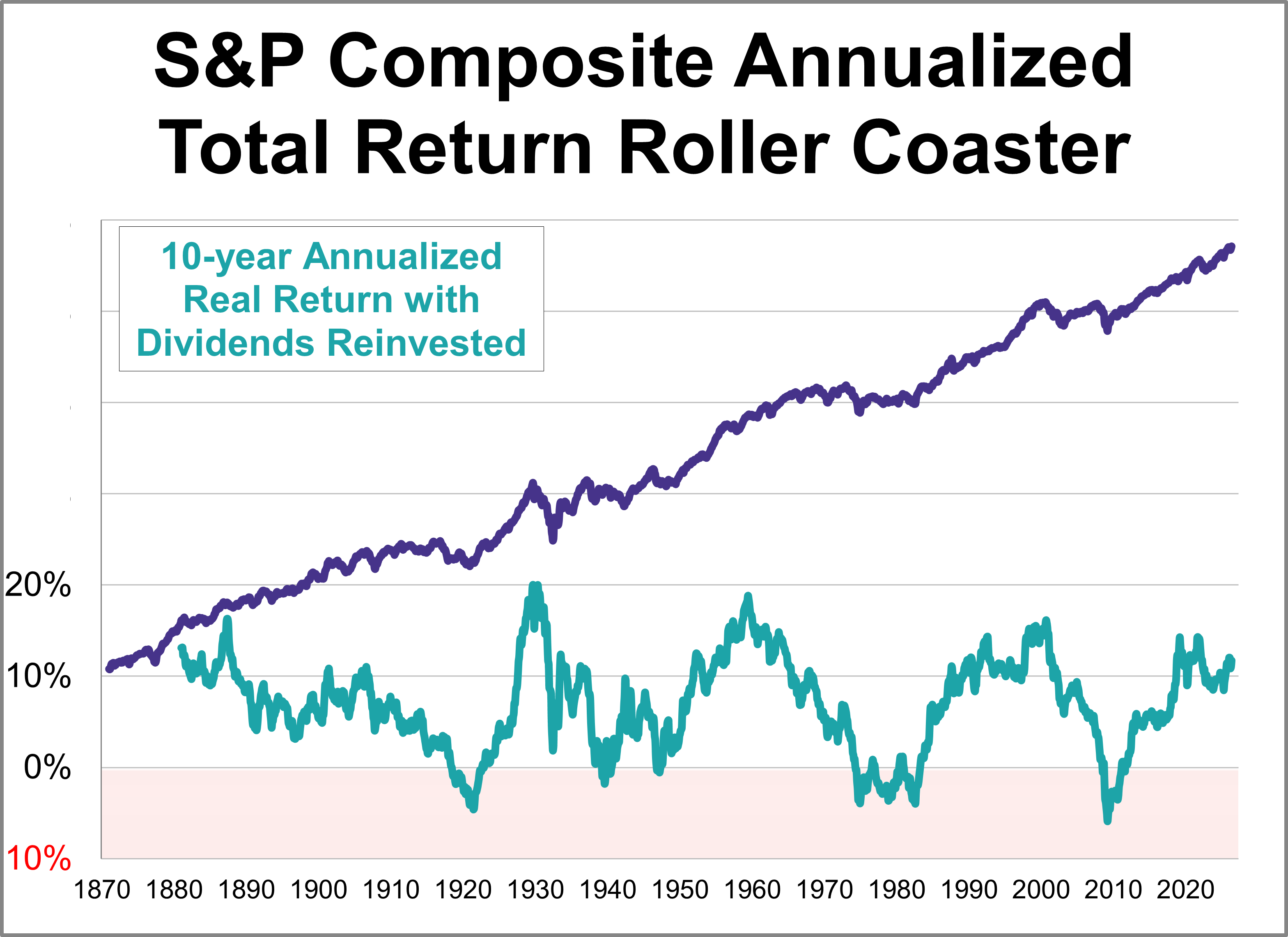
Here's an interesting set of charts that will especially resonate with those of us who follow economic and market cycles. Imagine that five years ago you invested $10,000 in the S&P 500. How much would it be worth today, with dividends reinvested but adjusted for inflation?
On Wednesday, June 3, Wellington Management and The Hartford announced that Wellington will be acquiring Hartford Funds. Once the acquisition is complete, Hartford Funds will operate under Wellington’s brand through the firm’s U.S. Wealth business.
The first phase of the artificial intelligence investment trade was relatively straightforward: if you wanted to capture the AI boom using familiar names, you bought semiconductors.
A seemingly endless appetite for buying US stock dips has propelled Vanguard Group’s S&P 500-tracking ETF past $1 trillion in assets, making it the first fund of its kind to reach a milestone once thought unimaginable for the ETF industry.
The IPO market may be entering one of its largest cycles in years, but the next wave may be defined less by breadth than by scale. Instead of hundreds of companies listing, a smaller group of AI and strategic infrastructure leaders could reset the market on their own.
Foreign investors led by the likes of Stanley Druckenmiller and major Wall Street banks are returning to Argentine stocks this year after some had exited ahead of 2025’s volatile midterm election cycle.
Despite rising global yields and renewed inflation concerns, equities moved higher in May on the back of a strong US earnings season and continued momentum in AI-related stocks. The tech-heavy Nasdaq Composite gained 8.4% for the month, while the S&P 500 rose 5.3% and the Dow Jones Industrial Average was up 2.9%.
Emerging markets offer important exposure to economic growth through rapid industrialization, natural resource endowments, and strong demographic dynamics.
Even if the Middle East war does find a lasting settlement, the specter of inflation appears poised to hang over the markets. Indeed, while employment data had, up until recently, been the primary focus for investors, arguably, inflation reports have now moved into the ‘leaderboard’ position.
A strong business isn’t always a winning stock at every moment, and 2025 was a good reminder of that. Developed market equities finished the year up more than 20%, but quality stocks lagged. That’s why Parametric favors a multifactor approach to capture factor risk premia.
Get ready for a magnificent month, and then some. Mega-cap tech stocks dominate the corporate event calendar in June, already highlighted by NVIDIA (NVDA) CEO Jensen Huang’s keynote address at Computex 2026 in Taiwan earlier this week, one of many major conferences.
Given its focus, the launch presents a milestone for the asset management community. ASD blends a sophisticated index design with structural corporate philanthropy to create an ETF that resonates with those invested financially and emotionally.
Space ETFs have seen strong inflows coupled with standout performance, capturing significant market attention. For investors, the rapid pace of capital deployment into the space economy underscores a compelling investment opportunity. For this edition of Bull vs Bear, writers Zandile Chiwanza and Elle Caruso Fitzgerald debate the use cases for space ETFs in portfolios.
The top ETF launches of the past decade were the focus on this week’s ETF Prime. Host Nate Geraci and Cynthia Murphy, director of research at VettaFi, counted down the 10 most successful debuts by current assets. Murphy noted that the S&P 500’s roughly 13% annualized gain over that span helped shape many of the performance stories on the list.
As billions of dollars leave Bitcoin and Ether funds, money is flowing into a corner of crypto that promises something investors have long struggled to find in digital assets: a clearer path from economic activity to token value.
A private credit fund jointly managed by Future Standard and KKR & Co. sold $900 million of junk bonds on Monday, according to people familiar with the matter, in a rare high-yield offering by a publicly traded credit fund.
Private markets have become integral to modern portfolios, with many investors searching for higher returns and diversification, including from public markets. But recent fund redemptions have reinforced that illiquidity isn’t theoretical, raising questions about the benefits of giving up liquidity. We see several—but investors must understand the trade-offs.
Every family has a money story. It gets passed down quietly, invisibly, in the way families talk around the dinner table or on long walks together.
Join Dan Chung, CFA, CEO at Alger, as he explains how his role as Chief Investment Officer makes him uniquely positioned to see across all of Alger’s product portfolios to identify the “best ideas” for ATFV.
Investors are about to get a read on the durability of the soaring rally in cybersecurity stocks when two of the industry’s major players report earnings in the coming days.
Elon Musk’s SpaceX is negotiating to pay razor-thin fees to Wall Street firms handling its IPO — but banks are still likely to rake in about $500 million from the record-setting market debut.
Caution has become the most expensive position on Wall Street. A hot inflation reading this week — sending the annual gauge to its highest in about three years — landed alongside fresh strikes in the Persian Gulf and enduring expectations that the Federal Reserve may need to keep policy tight.
Investors are pouring money back into municipal bonds as higher yields and the approaching summer reinvestment season draw cash into the tax-exempt market.
Businesses are racing to build the physical infrastructure that makes AI usable at scale – data centers, the graphics processing unit (GPU) hardware stack, power, and cooling.
If you’re not familiar with the name Leopold Aschenbrenner, you should be. A 24-year-old wunderkind, Aschenbrenner was hired by OpenAI in 2023 to work on the company’s “superalignment” team, essentially trying to figure out how to keep AI systems safe once they become smarter than the people building them.
The global defense industry continues to move rapidly from legacy, heavy-hardware platforms to agile, unmanned systems. Today, the Trump Administration announced that it’s pursuing funding deals for drone companies in an effort to increase domestic production in today’s defensive landscape.
Vocabulary is a power builder. Every time I use the word “hegemonic” in a conversation, I see my listeners’ eyebrows go up as if to say, “what does this guy know that I don’t?” Then again maybe they’re just signaling that I’m full of more than baked beans.
The ETF landscape includes a wide variety of innovative, intriguing funds that look to meet investor goals. From equities to fixed income, all kinds of strategies offer intriguing spins on areas like income and dividends.
J.P. Morgan Asset Management has expanded its alternative lineup with the launch of the JPMorgan Managed Futures Plus ETF (JPFP) on the Nasdaq. The actively managed fund combines a core U.S. equity allocation with a systematic managed futures strategy spanning equities, bonds, currencies, and commodities.
Closed-end funds may not be a hot topic right now, but they offer a highly compelling means to solve today's macroeconomic woes.
Are utilities the ultimate hidden growth play? In this video, we break down why the State Street Utilities Select Sector SPDR ETF (XLU) is moving the needle for smart investors. Traditionally known as a boring, defensive sector for dividend income , utilities are experiencing massive new demand driven by the massive energy and electricity needs of Artificial Intelligence (AI) and data centers.
New York City is facing one of the most significant fiscal challenges in recent memory. The NYC Comptroller has projected a $2.2 billion budget shortfall for FY2026, growing to a $10.4 billion gap in FY2027 (Source: New York City Comptroller, January 2026). That is a two-year deficit of roughly $12.6 billion.
For the last eight years, GMO’s Asset Allocation team has held a differentiated view on Japanese equities. Long before Japan re‑entered the global investment narrative, we argued that the country was undergoing slow but durable structural changes aimed at improving corporate governance, growth, and capital efficiency. These reforms were never expected to deliver quick results. Instead, we expected them to compound quietly over time.
The essential feature of a useful alternative asset isn’t that it’s unusual or exotic, but that its returns aren’t tightly linked to the risks that already dominate the portfolio. The value of an alternative asset comes from the way it interacts with the other assets in the portfolio.
Before I recommend what to do, I want to first state what not to do. Don’t invest as if you think you know what long-term inflation will be. Will we return to the double-digit inflation of the late ‘70s and early ‘80s? The answer is: Nobody knows.
The assumption that muni equals tax-free is deeply embedded in how the asset class gets discussed and presented. But for high-net-worth clients in high-tax states, the gap between partially exempt and fully exempt is material enough to be worth a conversation.
Equities extend gains as earnings and semiconductors lead markets higher. Consumer confidence remains subdued despite economic resilience. Inflation is easing gradually but remains above the Fed’s targey.
Recent Federal Reserve communications have turned more hawkish, reflecting concern that persistent supply-driven price pressures could begin to feed into inflation expectations. But unlike in prior cycles, today’s environment is not defined by supply shocks alone.
Ahead of next week’s May employment report, the summer jobs market is coming into focus as teenagers and students finish the school year. According to Challenger, Gray & Christmas, teen hiring from May through July is expected to total just 790,000 jobs this summer, down slightly from 801,000 last summer.
In the 24-hour financial news cycle, there’s much buzz surrounding the buildout of infrastructure for artificial intelligence (AI). What about infrastructure beneficial to humans? There are plenty of ETF opportunities in the sector that’s gone from defensive hedge to dynamic capital appreciation engine.
Last week’s data tracked a shifting economic trajectory over the last several months. While the latest reading on first-quarter GDP confirms the economy started the year with steady growth, subsequent inflation metrics moved higher and ultimately weighed on consumer confidence.
Many debates in defined contribution (DC) circles focus on fees, new asset classes, and ever more complex solutions. But the biggest improvement available to plan participants may come from something far simpler: how their fixed income is managed.
The next IPO wave may create a different kind of portfolio challenge for institutions already holding private stakes in companies like SpaceX and OpenAI.
Massachusetts Mutual Life Insurance Co. agreed to have Nationwide Mutual Insurance Co. reinsure a book of life insurance policies, freeing up about $6 billion of reserves.
The Bloomberg Dollar Spot Index is up 0.7% so far in May, as investors ramped up bets that the Federal Reserve will raise rates by early 2027, boosting the appeal of US assets. The gauge is on track for only its fourth monthly gain since the greenback’s 2025 downtrend began.
Growing excitement around the burgeoning space economy is increasingly favoring companies positioned to benefit not only from Elon Musk’s SpaceX filing for a public offering, but also from rising enthusiasm for space exploration and increased funding.
Large asset managers are rolling out a wave of actively managed emerging-market ETFs, pitching them as alternatives to benchmarks increasingly dominated by AI stocks.
As globalization gives way to reshoring and resurgent resource nationalism, emerging markets may offer fresh alpha opportunities through their ability to supply the raw materials required to fuel the AI boom.
Kevin Warsh was officially sworn in as 17th Federal Reserve chair on May 22. Warsh is likely to build consensus at the Fed rather than push for aggressive action to cut rates.
The U.S. government’s decision to invest $2 billion directly into nine quantum-computing companies through minority equity stakes—not just grants—signals a major shift toward treating quantum as a strategic commercial industry, with potential implications for investors seeking targeted exposure through funds like the WisdomTree Quantum Computing Fund (WQTM).