Online services have long had to contend with bot traffic, and your banking app is no exception. While most of us log on to our apps an average of two times every three days (at least according to Bank of America Corp. data), electronic intermediaries that pull data on behalf of third-party services are a lot more aggressive.
As Donald Trump unleashed his trade war, mused about annexing Canada and generally roiled global sentiment toward the US last spring, worries mounted that foreign buyers would boycott American financial products.
President Donald Trump announced a fresh round of tariffs on pharmaceuticals, heavy trucks and furniture, including a 100% duty on patented drugs unless the producer is building a manufacturing plant in the US.
Treasury Inflation-Protected Securities, or TIPS, can help buffer a portfolio against inflation. However, it's important to understand their unique characteristics and complex nature.
In 2025, the U.S. dollar's image of unassailable strength is being rigorously questioned. The U.S. government budget deficit remains stubbornly elevated, hovering just north of 6% of gross domestic product (GDP), and the debt-to-GDP ratio is tracking beyond 100%.
Business owners who sponsor 401(k) and other defined contribution plans will soon be faced with another decision: whether to offer alternative-investment options among a plan’s investment options.
AI is a potential boon to healthcare companies, but business fundamentals—not the latest science—are the true test of staying power.
Our latest press release announcing that Janus Henderson, Victory Park Capital, and CNO Financial Group have formed a strategic partnership.
Medicare provides health coverage for more than 60 million individuals. Understanding the details about enrollment periods and plan coverage is critical to getting the right plan for retirement. Our Bill Cass shares the highlights of the program.
Taxes can have a major impact on the long-term growth of a portfolio. Find out how continuous, thoughtful tax management can help investors maximize their wealth.
Municipal bonds, commonly referred to as “munis,” are debt securities issued by states, cities, counties, and other state governmental entities to fund public projects.
Many have said that midcap stocks are a “sweet spot” of market capitalization. They deliver both growth potential — typically associated with smaller companies — and profitability — usually seen in larger companies. To quote WisdomTree, in a recent research note, midcaps sit in the “sweet spot between innovation and maturity.”
There are growing pains associated with scaling a financial advisory business, but a way to alleviate these pains is practice management.
Clearer policy and lower rates are favorable for growth.
Active ETFs are in growth mode, but they’re still way behind their passive brethren, and narrow-use vehicles flummox investors.
Join the experts at MassMutual for an educational webcast exploring the tools and ideas available to help your practice get to the next level and scale efficiently and sustainably.
Join us for an exclusive webcast where Holmes discusses how thematic ETFs in the gold royalty and defense/AI sectors may offer advisors ways to manage risk and support portfolio resilience using smart beta 2.0 strategies in today’s volatile market.
This article is part of a series exploring two complementary investment themes. The ROBO Global Artificial Intelligence Index (THNQ) captures the digital AI ecosystem, including AI-semiconductors, cloud infrastructure, cybersecurity, connectivity, and applications.
Figma, Circle, and CoreWeave are just a few names to remind investors that the initial public offering (IPO) market is alive and kicking despite the market challenges in 2025. This opens the door into a room with IPO-focused exchange-traded funds (ETFs) that can provide niche exposure to these up and comers.
Many people are puzzled about the disconnect between how well the US economy is doing and how badly Americans feel about it.
The US economy grew in the second quarter at the fastest pace in nearly two years as the government revised up its previous estimate of consumer spending.
Stock bulls looking for the next hot Wall Street trade are increasingly turning to the busiest corner of the US market this year — initial public offerings.
A pair of senior Goldman Sachs Group Inc. executives are betting that Europe’s long-awaited revival in infrastructure spending and dealmaking will help power regional growth at the Wall Street bank.
Intel Corp. has approached Apple Inc. about securing an investment in the ailing chipmaker, according to people familiar with the matter, part of efforts to bolster a business that’s now partially owned by the US government.
On Sept. 9, Russell Investments hosted a webinar examining the rising demand for overlay solutions, how overlay strategies are evolving and how institutional investors are using these tools today.
The Federal Reserve cut interest rates, but uncertainty is high and the FOMC is deeply divided on where policy should go next.
Healthcare costs will be a chronic pain.
How can investors navigate the diverse, dynamic field of corporate and asset-backed opportunities?
Division by zero is known as a “singularity.” It’s the point where equations break down, values become “indeterminate,” things stop working normally, and variables shoot toward infinity and suddenly collapse on the other side.
Drew O’Neil discusses fixed income market conditions and offers insight for bond investors.
Chinese equities have surged amid investor optimism about AI innovation and certain government initiatives, despite a slowdown in China's economy.
As expected, the Federal Reserve (Fed) cut interest rates last week to take the fed funds rate down to 4.25% (upper bound). Moreover, through the release of the updated dot-plot, the Committee signaled that two more interest rate cuts could be appropriate this year, which would take the fed funds rate down to 3.75% (upper bound).
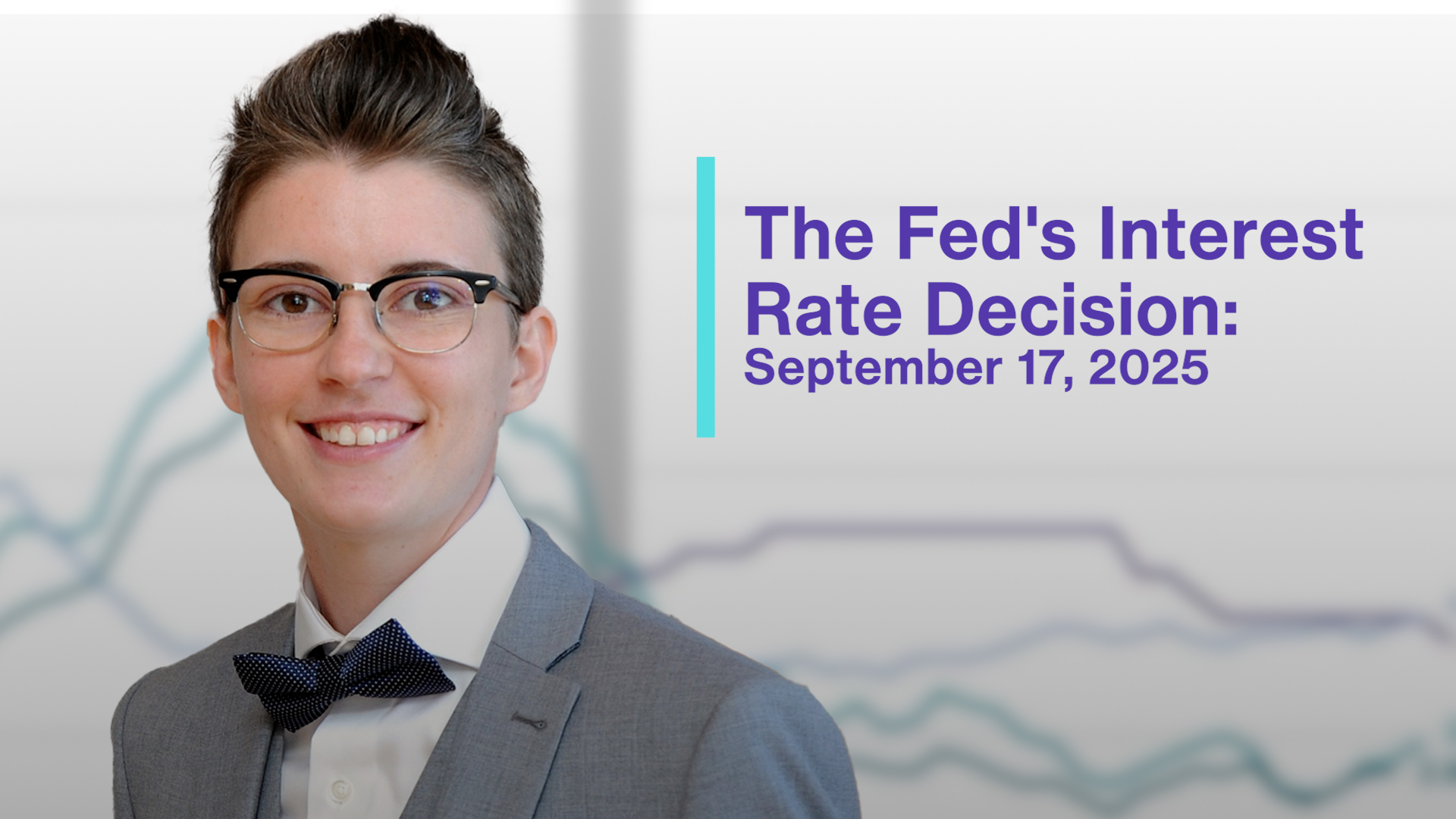
The Federal Funds Rate (FFR) is the interest rate banks charge each other to borrow money overnight. It's set by the FOMC and is one of the Federal Reserve's primary tools to implement monetary policy and is a key driver of economic activity. This video examines the Federal Funds Rate and reviews the Fed's interest rate meeting on September 17, 2025.
Cullen Rogers, Chief Investment Officer at Wedbush Fund Advisers, highlights the Dan Ives Wedbush AI Revolution ETF (IVES) and explores the broader investment thesis fueling interest in artificial intelligence. Craig Ebeling, Head of ETF Strategists at Fidelity Investments, outlines key factors to consider when evaluating income-generating ETF strategies and offers timely guidance on tax-loss harvesting ahead of year-end.
A retrospective look at the data around some of this year’s ETF launches reveals some key trends in the industry.
Studies show that Americans work more hours overall (with a work week that often exceeds 40 hours) and take less vacation time than our counterparts in many other developed nations (for example, a statutory five weeks' paid vacation in France). Increasingly, we work right through our vacations.
AI excels at credibility and reliability but fails miserably at intimacy and authentic advocacy. When clients face family crises, market volatility, or complex succession planning decisions, they need the empathy and moral courage that only human advisors provide.
I grew up in an era, like many people, where we were told not to talk about politics or religion in the workplace. We were often told not to even do it with friends and family, just to avoid bad feelings and difficult conversations! Now, if you don’t have a point of view and share it, there is something wrong with you.
The financial advisory sector is adapting to a fundamental shift in how wealth is defined and managed. While professionals are skilled at handling traditional securities and physical property, a client’s growing digital footprint presents a new and complex variable in estate planning.
Investment giants KKR & Co. and Blackstone Inc. are leading a combined $17 billion investment in the natural gas industry, marking a massive push of private funds into a sector helping to quench artificial intelligence firms’ relentless thirst for energy.
Alibaba Group Holding Ltd.’s shares surged to their highest in nearly four years after revealing plans to ramp up AI spending past an original $50 billion-plus target, joining tech leaders pledging ever-greater sums toward a global race for technological breakthroughs.
The Federal Reserve has long been able to depend on the housing boost from interest rate cuts juicing the US economy. This time looks different.
Bets that the Federal Reserve will continue cutting interest rates have fueled a rally in one of the riskiest corners of the technology sector, raising concerns about a potential painful reversal in the stocks.
OpenAI plans to invest roughly $400 billion to develop five new US data center sites in partnership with Oracle Corp. and SoftBank Group Corp., marking the biggest push yet to fulfill an earlier pledge to spend a half-trillion dollars on artificial intelligence infrastructure in the country.
Get ready each week with high-conviction insights that go beyond media headlines.
France, Britain, and the Fight for Fiscal Credibility
Stocks and bonds staged a roller coaster on Fed day but finished essentially where they began—an apt metaphor for a market digesting a quarter-point cut, a split dot-plot, and a Chair intent on starting an easing cycle without declaring victory.
The VettaFi Q3 Fixed Income Symposium came just less than 24 hours after the Federal Reserve instituted its first rate cut of the year. While this was widely expected by the capital markets, investors may not be well-positioned to maximize their fixed income exposure. It’s an ideal opportunity to take advantage of active management.
Cybersecurity continues to grab consistent media attention as hackers become increasingly emboldened. They’re also more ambitious in terms of targets, many of which are familiar companies behind goods and services consumed by Americans on a daily basis.
The buildout of data centers and the power grid may offer the best opportunity to generate sustained growth. The scale of investment is large enough to matter, the economic multipliers are high, and the timeline aligns with when fiscal pressure will peak.