Despite rapid growth, including significant trading volume increases, the company faces major challenges from competitors like Robinhood and Interactive Brokers, an ongoing association with gambling, and regulatory pushback regarding its classification as a financial-derivatives exchange.
Chief Economist Eugenio J. Alemán discusses current economic conditions.
Our year ahead explores what could challenge the consensus outlook, how rate-cut expectations shape market behavior, and why quality, dividends, and broader opportunities may matter more than investors realize.
The flood of big money into the RIA space is a tribute to what the pioneers created. But it also represents a step backward. The new masters are profit-driven capitalists, not creative, client-focused entrepreneurs.
Clients with large, concentrated stock positions, often from vested Restricted Stock Units (RSUs), face undiversified risk and a huge potential tax bill. This article introduces two new, complex methods that defer capital gains.
Pioneered by Harry Markowitz's Modern Portfolio Theory, the classic 60/40 portfolio allocates 60% to stocks for growth and 40% to bonds for income and risk mitigation. This strategy is predicated on the idea that these two asset classes, when combined, should have a less-than-perfect correlation to optimize risk-adjusted returns.
Once considered a tactical niche product for nervous investors, buffer ETFs are reshaping how financial advisors approach risk management.
The economic narrative last week was shaped by a highly anticipated Federal Reserve rate cut, which came against a backdrop of conflicting signals in the labor market.
Around this time, most mutual fund and exchange-traded fund (ETF) providers release estimates of their upcoming distributions. We track and aggregate these early numbers to help you better prepare for what to expect.
The Federal Reserve lowered its policy interest rate by 25 basis points, as widely expected. However, Fed Chairman Powell hinted at a pause ahead, and there were several dissents.
Oracle's recent earnings report offered little comfort for those concerned about the cost of AI infrastructure, revealing unwelcome surprises like a $10 billion quarterly cash burn and significantly increased capital spending.
With Elon Musk’s SpaceX eyeing an initial public offering that could value the company at over $1 trillion, investors looking for exposure to the space industry can turn to a space ETF that has already delivered outsized returns in 2025.
Silver jumped for a fourth day, as exchange-traded fund inflows, momentum-following and physical market tightness pushed the white metal toward its best year since 1979.
International stocks could be poised for another strong year in 2026 due to accelerating global growth, attractive valuations and the potential for dollar weakness.
The Federal Reserve concluded its last meeting of 2025 with another quarter-point rate cut, while maintaining its outlook for only one cut in 2026.
The U.S. economy depends on consumers buying stuff. Persistent price inflation forced Americans to blow through their savings and then turn to credit cards to make ends meet.
Gold wavered as traders mulled the Federal Reserve’s outlook for interest rates. Bullion gained as much as 0.5% in US trading before paring some gains, while Treasury yields and the dollar declined.
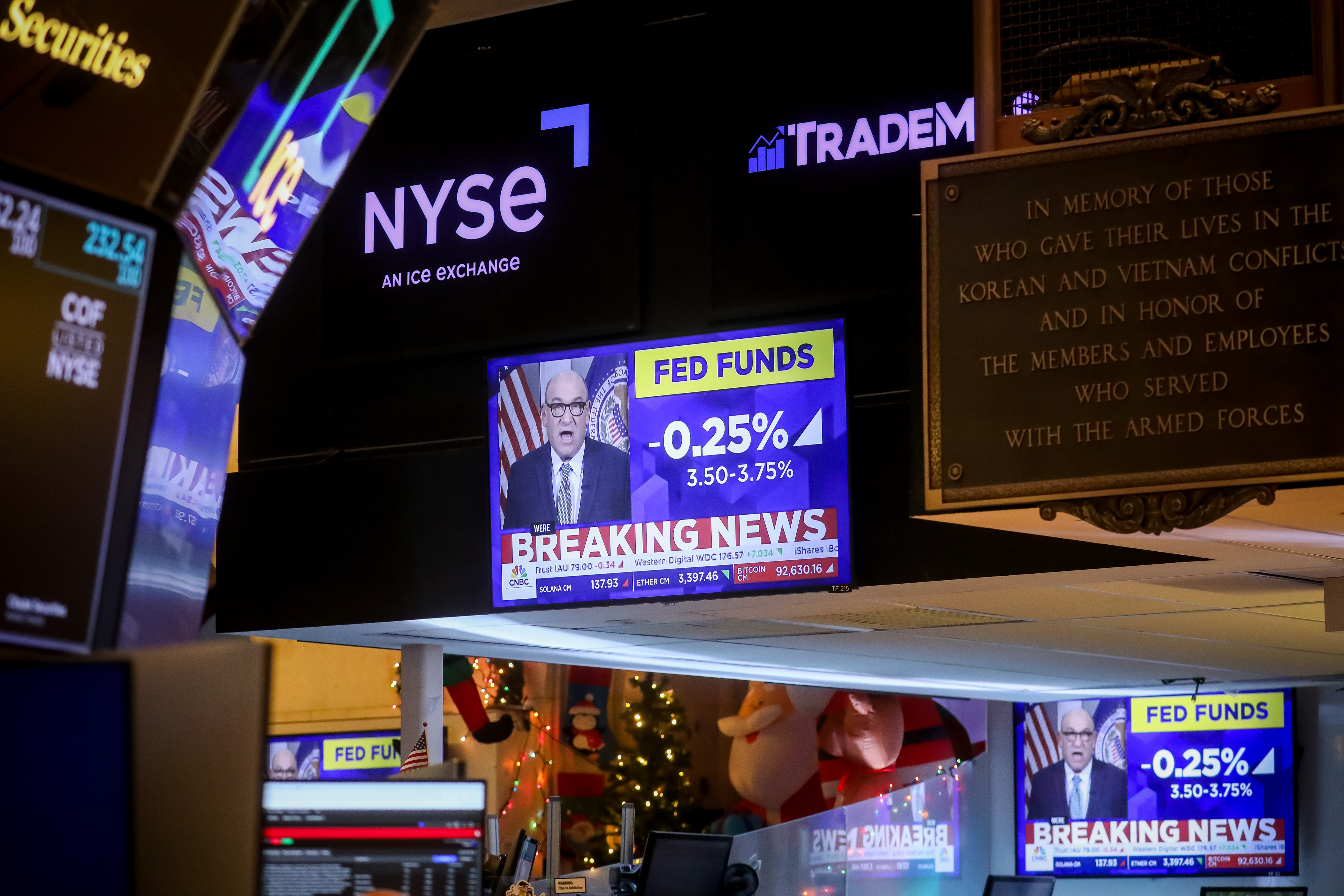
With a third consecutive rate cut bringing the Fed Funds range to 3.50%–3.75%, the Fed may pause for now as it reassesses the effectiveness of its “risk management” approach amid mixed economic signals.
US Treasuries rose after the Federal Reserve lowered interest rates by a quarter-point for a third straight meeting and left the door open to additional policy easing in 2026.
The launch of multi-token crypto products (i.e., crypto index ETFs) signals that many issuers believe the next growth phase in crypto ETFs will be driven by investors who want a rules-based basket approach rather than single asset calls.
The rotation from technology stocks has investors, at long last, scouring one of the least loved corners of the market: energy producers.
The dot-com bubble burst in 2000. Now, 25 years later, anxiety abounds about the potential for a similar AI bubble burst and resultant crash.
Growth, growth, and more growth — that’s been the common refrain in the current market environment. However, peeking from behind the curtains is the quality factor. While it has yet to receive the full spotlight in 2025 relative to growth, it’s due for a breakout performance (potentially in 2026).
ClearBridge Investments believes emerging market equities have turned a corner, showing strong performance after years of lagging returns.
The Federal Funds Rate (FFR) is the interest rate banks charge each other to borrow money overnight. It's set by the FOMC and is one of the Federal Reserve's primary tools to implement monetary policy and is a key driver of economic activity. This video examines the Federal Funds Rate and reviews the Fed's interest rate meeting on December 9-10th, 2025.
Two perspectives emerge when analyzing the state of US consumers. Sentiment surveys paint a picture of economic weakness, yet behavioral data tells a different story — spending remains in line with historical expansion trends.
JPMorgan Asset Management is seeking to convert two municipal-bond mutual funds with over $840 million of assets into ETFs in 2026, underscoring the growing popularity of the products.
Following the disappointment of its open-source Llama 4 model, Meta's AI strategy is undergoing a major shift, with CEO Mark Zuckerberg now personally directing efforts toward monetizable models.
Despite controversial leadership and little to no profits, experts believe public stock investors will be highly eager to embrace these massive listings, potentially breaking the multi-year IPO rut. If SpaceX lists at its massive rumored valuation, it would catalyze a "massive trend of IPO activity," forcing similar giants like Stripe and ByteDance to follow suit.
As 2025 comes to a close, I am using this column to offer high-impact strategies for you and your team to implement before the year ends. While you are likely focused on tax planning, Required Minimum Distributions (RMDs), and the other client necessities, it is equally important to address the operational and strategic health of your practice.
Gold ETFs globally reported net inflows of gold for the sixth straight month, driven by a strong surge in Asian investment.
With macro drivers continuing to reshape markets, Ali Dibadj explores key investment themes for 2026 to help actively position portfolios for resilience and growth. He also explains how asset managers need to evolve to best work together with clients.
Rising margin debt levels signal increasing speculation and leverage in the market, with the cost of carrying this debt nearing historical peaks that have typically preceded significant stock market corrections.
Three years with five reliable recession signals, five recession scares, and no recession. Why? And what comes next. A useful framing of the economy for the last three years and why a recession isn’t imminent now.
Active fixed income ETFs took center stage at VettaFi's recent 2026 Market Outlook Symposium, with two industry leaders sharing thoughts.
I’ve lived through several bubbles and read about others, and they’ve all hewed to this description. One might think the losses experienced when past bubbles popped would discourage the next one from forming. But that hasn’t happened yet, and I’m sure it never will.
On this episode of the “ETF of the Week” podcast, VettaFi’s Head of Research, Todd Rosenbluth, discussed the Goldman Sachs Corporate Bond ETF (GIGL) with Chuck Jaffe of Money Life. The pair discussed several topics related to the fund to give investors a deeper understanding of the ETF.
Roxanna Islam, Head of Sector & Industry Research at VettaFi, shares her perspective on several recent ETF developments, including Vanguard opening brokerage access to spot crypto ETFs, Goldman Sachs’ acquisition of Innovator ETFs, and the SEC’s pushback on filings for 5x leveraged products. Petra Bakosova, CEO of Hull Tactical and Portfolio Manager of the Hull Tactical U.S. ETF (HTUS), explains the firm’s approach to delivering tactical, risk-managed S&P 500 exposure.
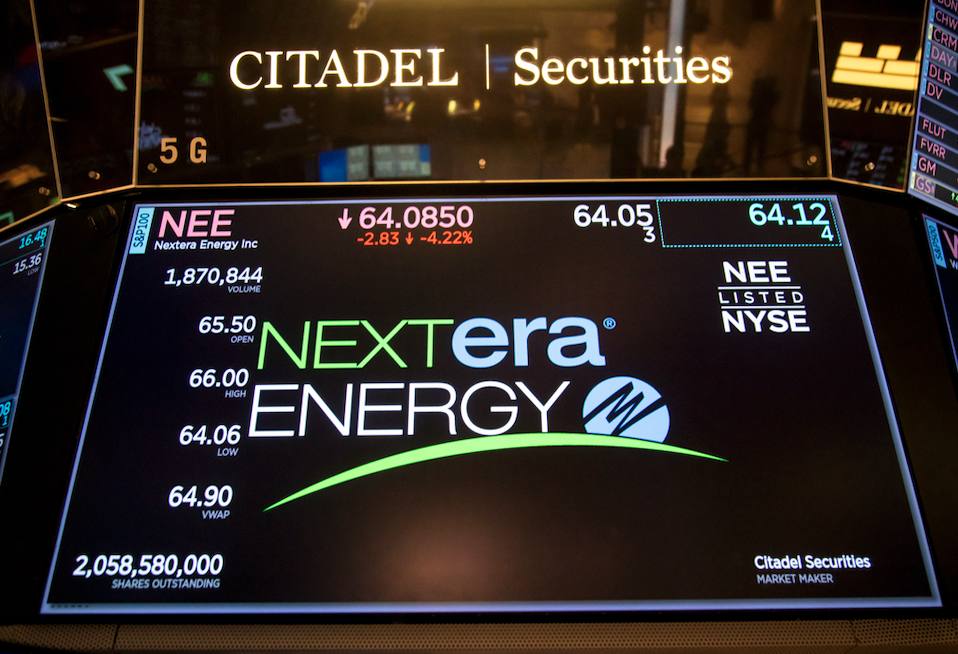
NextEra Energy, once the "tech darling" of the utility sector due to its vast renewables business, is pivoting its strategy to navigate political uncertainty and the booming power demands of Artificial Intelligence (AI).
Shares of Apple Inc. were battered earlier this year as the iPhone maker faced repeated complaints about its lack of an artificial intelligence strategy. But as the AI trade faces increasing scrutiny, that hesitance has gone from a weakness to a strength — and it’s showing up in the stock market.
Recessions are less common today than they were before the 1980s. Some argue that the reason is that we have become better at conducting fiscal and monetary policy to reduce the ebbs and flows of economic cycles.
A conventional data center uses between 5,000 and 15,000 tons of copper. A hyperscale data center, on the other hand—the kind being built to run artificial intelligence (AI)—can require up to 50,000 tons of copper per facility, according to the Copper Development Association.
To understand where we're headed, let's look back at the late 1990s — the height of the dot-com bubble. The internet was going to change the world, and it did. That's a fact. During the bubble, internet stocks soared. Then they crashed.
This focus on payout growth and a relatively higher tech allocation suggests OUSA may be well-positioned for performance in 2026, even as corporations globally favor share buybacks over dividend payments.
The field of quantum computing has shifted its focus from the short-lived concept of "quantum supremacy" to a more measurable goal: quantum advantage, which emphasizes reproducible, domain-specific results that verifiably outperform classical systems.
Advisors should avoid centering long-term investment strategies on predicting the Federal Reserve's next interest rate move, as tactical bets based on the Fed's near-term calls often cause investors to miss out on returns.
Due to the federal government shutdown, official jobs data remains incomplete, forcing the Federal Reserve to rely on alternative private-sector reports to gauge the labor market. These alternative data sources, such as the ADP report and Revelio Labs estimates, indicate a widespread and concerning slowdown in employment, with job creation stalling, openings shrinking, and layoffs rising across many sectors.
I’ve been a retirement economist for my entire adult life, and yet I am continually amazed at how America continues to get retirement saving so wrong. Now, finally, the world’s largest issuer of mutual funds is showing signs that it recognizes a major flaw in the system.
Bitcoin options traders are currently betting that the largest cryptocurrency will remain range-bound in the near term, a sentiment reflected by higher open interest in short-dated contracts due to the selling of volatility.
While some corners of energy markets have looked pretty frothy of late, one segment has Wall Street betting it won’t get trapped in a bubble: grid tech stocks