Morgan Stanley raised its price estimates for liquefied natural gas in 2023 and 2024, seeing Europe’s soaring demand for the fuel intensifying global competition for supplies.
The worst may be behind gold mining stocks. Since hitting a 52-week low on September 26, they’ve risen about 18% and today notched their second straight week of positive gains.
U.S. stocks are trading modestly lower in pre-market action with the markets awaiting tomorrow's key September nonfarm payroll report.
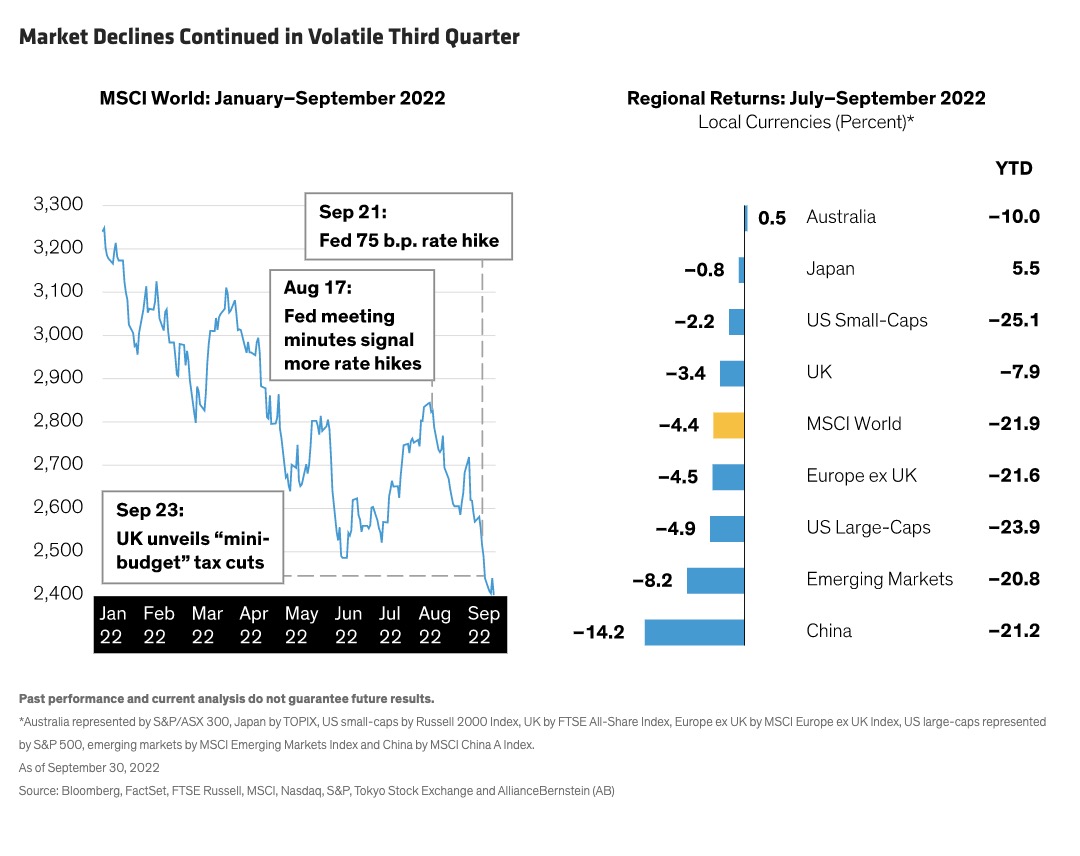
Equity market volatility persisted in the third quarter as investors came to terms with a new reality of high inflation and rising interest rates.
Just 18.5% of homes in Florida counties that were told to evacuate have coverage through the National Flood Insurance Program (NFIP), which is administered by FEMA. Most regular homeowners’ insurance policies don’t cover flood damage, which is why Congress created the NFIP in 1968. But at an average cost of $995 a year, according to Forbes, the insurance may be out of reach to many households.
American companies have had a growing list of reasons to downgrade their ties with China in recent years. Former President Donald Trump’s tariffs. Beijing’s stringent Covid lockdowns. The US-Sino standoff over Taiwan. Political pressure to “friend-shore” supply chains toward nations aligned with Washington. But breaking up, as the adage goes, is hard to do.
It appears to us that global innovation has bottomed and offers attractive value.
U.S. equities are higher in afternoon action following a recent plunge to lows not seen since 2020.
As the U.S. CPI data continues to rise, Charles Hamieh, Portfolio Manager at ClearBridge Investments, dives into the opportunity present for investors looking at the infrastructure space as an inflation hedge moving forward.
The great tech selloff of 2022 is far from over as investors brace for earnings misses that may spur a more than 10% plunge in the Nasdaq 100.
Global financial firms, still smarting from multi-billion dollar losses in Russia, are now reassessing the risks of doing business in Greater China after an escalation of tensions over Taiwan.
The world will be going from an era of zero rates and loose monetary policy to higher rates and likely slower growth, except in certain sectors. Adjusting to this change will be both problematic and also full of potential opportunities.
Portfolio Manager John Paul Lech explains why investors in emerging markets should go upstream in order to leverage the long-term power of the EV sector.
Nations are being forced to go it alone in erecting defenses against the relentless strength of the almighty greenback, with no sign that governments are willing to act in concert.
U.S. stocks are moving higher in pre-market trading, following yesterday's third-straight 75-basis point rate hike from the Fed.
Portfolio Manager Michael Oh, CFA, says attractively valued companies are growing in Asia unfettered by inflationary headwinds.
U.S. stocks are declining in pre-market trading as the markets await the Fed’s highly anticipated monetary policy decision tomorrow.
Economist Nouriel Roubini, who correctly predicted the 2008 financial crisis, sees a “long and ugly” recession in the US and globally occurring at the end of 2022 that could last all of 2023 and a sharp correction in the S&P 500.
Inflation continues to rattle the global economy, forcing monetary authorities to strengthen efforts to extinguish it.
Populations are aging, and the economic consequences will be substantial.
After countless delays, the Ethereum “Merge” finally took place this week, switching the blockchain protocol from proof-of-work (PoW) to proof-of-stake (PoS).
U.S. equities are modestly higher in afternoon action on the heels of yesterday's sharp drop that came as consumer price inflation surprisingly came in hot.
Silver rallied to start the week as all contract months were up four percent or more.
U.S. stocks are starting the week in positive territory, extending last week's advance that snapped a three-week losing streak.
As policy makers vie to claim the mantle of hawk-in-chief, spare a thought for what we like to think of as the recovery.
Around the world, soaring borrowing costs are squeezing homebuyers and property owners alike.
Today, about 1% of our vehicles are electric. What will happen in 2035 when many more EVs need to be charged, potentially during another heatwave?
U.S. stocks are continuing to trade higher in the final session of the week and are on pace to end a three-week losing streak.
High prices and a tight labor market weighed on US economic prospects over the next year, though inflation showed signs of decelerating, the Federal Reserve said.
Major corporations have made a one-way bet on renewable power: more of it, every year.
China’s export growth slowed more than expected in August and imports stagnated, a sign of a darkening global economic picture and weak domestic growth hit by Covid lockdowns and a property slump.
CIO Robert Horrocks, PhD, says in order to reconcile assumptions on inflation with what might actually transpire, investors need to look through a wider lens and be prepared for a future that may not look too different from the past.
September has historically been one of the worst months for stocks. The Fed’s aggressive moves and upcoming midterm elections could make this September particularly interesting.
Emerging markets strategies may offer differentiated exposure for investors concerned about a slowdown in the developed world but it’s crucial that investors look at the underlying exposures of their strategy as investment approaches to emerging markets can differ significantly.
Only a few market events in an investor’s career really matter, and among the most important of all are superbubbles.
BMW AG has started producing fuel-cell systems for its hydrogen-powered iX5 sport utility vehicle, moving forward with a climate-friendly alternative fuel that its German rivals don’t expect to be viable in passenger cars.
Franklin Mutual Series explains how global investing may provide a path to better returns.
U.S. stocks ended the day in the red, continuing last week's sharp drop following comments from Fed Chairman Jerome Powell last Friday that heightened inflationary concerns.
Wall Street says the meme stock is here to stay.
The dog days of summer are firmly over as global investors absorb Federal Reserve Chair Jerome Powell’s stern message that interest rates are going higher for longer in a painful fight against inflation.
If reshoring doesn’t become a significant trend over the next decade, it never will.
When Nick Twidale reaches his desk in Bridge Street each morning, in the heart of Sydney’s financial district, he’s greeted by a seemingly endless slew of dollar buy orders.
A sober warning for Wall Street and beyond: The Federal Reserve is still on a collision course with financial markets.
Indonesia wants Tesla Inc. to make cars — and batteries — locally. That might be the smartest bet Elon Musk can make, and it won’t be so hard.
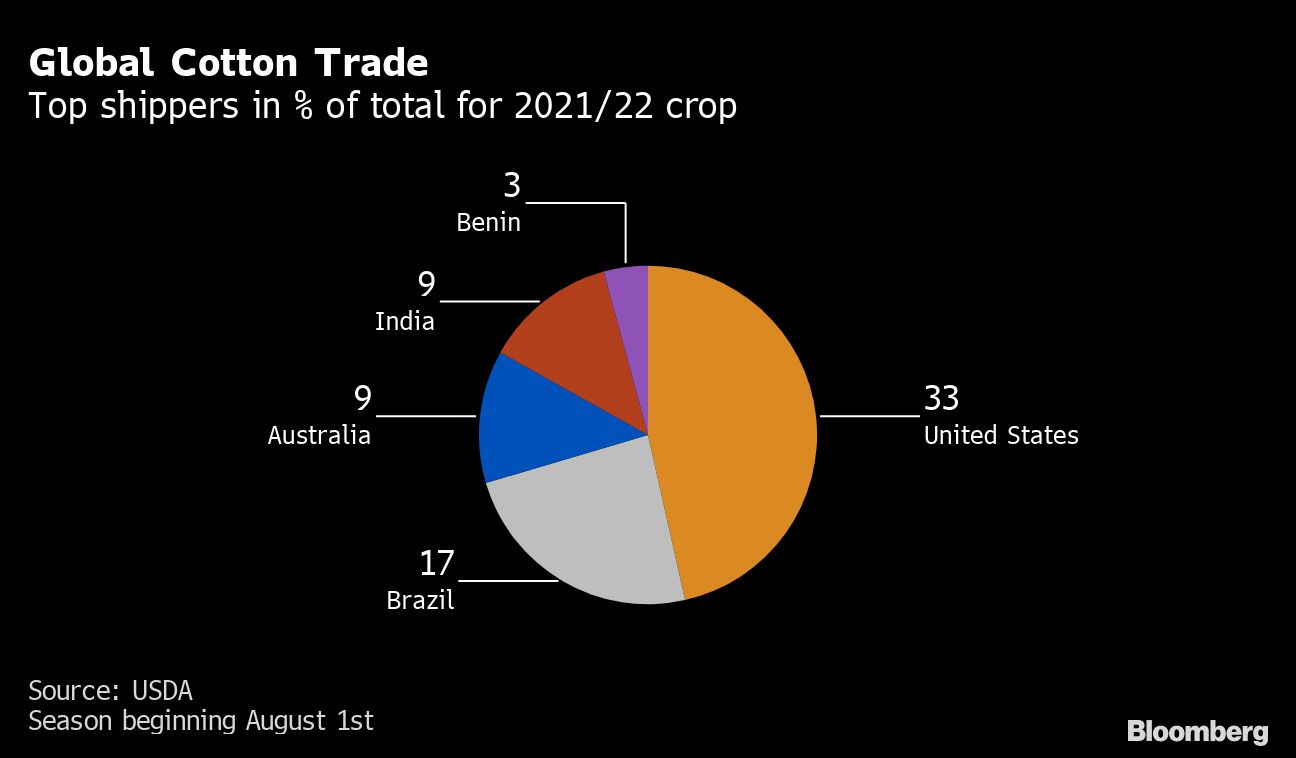
Extreme weather is wreaking havoc upon virtually all of the world’s largest cotton suppliers.
Winter is coming for Europe, and energy prices are soaring as international sanctions on Russia curb the supply of natural gas, on which many European Union (EU) countries have increasingly become dependent.
For those who believe that the surge of interest in warehouse automation and robotics was just a pandemic fling that will fade as the labor market loosens, meet Malcolm Wilson.
“The Godfather” has a quote for everything. Maybe, just maybe, it was Putin all along. Or perhaps its was Nikolai Kondratiev.
U.S. stocks are subdued following yesterday’s release of the minutes from the Fed’s July monetary policy meeting.
The market contraction presents better opportunities than we’ve seen in years to generate income, which we balance against the need for resilience in the face of a potential recession.