Knowledge vs. experience. When it comes to investing, such is what separates long-term success from failure.
Is the retail investor rampage over?
Bond yields are sending an economic warning as this past week 10-year Treasury yields dropped back to 1.3%.
“Warnings From Behind The Curtain” almost sounds like the title of a good “Cold War” fiction novel.
In Part-2 of “Capitalism” does not equal “Corporatism,” we delve into why bailouts support corporatism and how to fix the system.
Wall Street is once again in the midst of a “money heist” from naive investors.
A couple of weeks ago, in “Warning Signs A Correction Is Ahead,” we said quite a few indicators set the stage for a pick-up in volatility.
Bull markets always seem to end the same – slowly at first, then all at once.
Much like “Humpty Dumpty,” despite the Fed’s best efforts, you can’t create permanent inflation from artificial growth.
Over the last couple of months, the Fed started its campaign to prepare markets for a “taper” of its asset purchases.
After a decent rally from the recent lows, there are multiple warning signs a correction approaches.
The media is buzzing with claims of an “Economic Boom” in 2021.
Bear markets matter, and they matter much more than you think.
I can understand the confusion when this past week I discussed the issue of “If everyone sees it, is it still a bubble?”
“The strong economic recovery will not get interrupted by inflation or a credit crunch, and the market will soon reach 4,500.” – Ed Yardeni via Advisor Perspectives
Over the long term, confusing market crashes and bear markets can be detrimental to investor outcomes.
“If everyone sees it, is it still a bubble?” That was a great question I got over the weekend.
The recent NFIB survey suggests we are only in an economic recovery, not an expansion.
One of the interesting aspects of “bull markets” is the further they go, the lower forward returns fall.
There has been much commentary suggesting bonds have gotten overvalued due to historically low rates.
When there is a discussion of low future returns due to valuations, what gets missed is that such requires a bear market.
During a recent CNBC interview, Jeremy Siegel suggested stocks could rise another 30% before the boom ends.
There is no way this bull market doesn’t end very badly.
As markets surge to record highs, analysts are rushing to ratchet up earnings estimates as optimism explodes.
Recently, the March jobs report showed a whopping 916,000 new jobs.
In retail investing, do the “blind lead the blind?” Such was a question I asked recently about young investors who are “Long Confidence And Short Experience.”
President Biden’s stimulus bill “will cut the number of children in poverty by 40%,” according to the Center on Budget and Policy Priorities.
I recently discussed why “Free, Isn’t Really Free” regarding the retail investor. While “free trades” have certainly reduced the transaction costs, the selling of data to the highest bidder has likely cost investors more than they saved.
Since the “Financial Crisis,” the hope was that inflating asset prices would trickle down into economic growth.
The fleecing of retail investors continues as “payment for order flow” expands.
In a “market mania,” retail investors are generally “long confidence” and “short experience” as the bubble inflates. While we often believe each “time” is different, it rarely is. It is only the outcomes that are inevitably the same.
The expected “sugar rush” from more stimulus is why the economy will “run hot” then crash. As every parent knows, giving a child too much “sugar” leads to a “rush” of energy. Then comes the crash, where you find them in some odd place taking a nap.
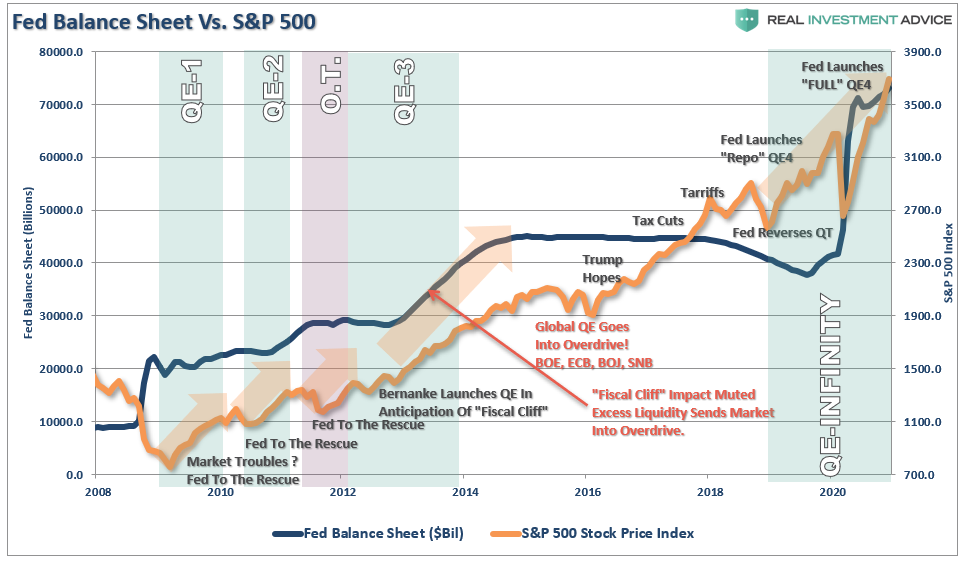
The markets took a tumble to start this week as rising interest rates and inflationary pressures begin to weigh on outlooks. Those worries quickly diminished as Jerome Powell changed the rules to reassure Wall Street that “QE” is here to stay.
More than 90% of investors believe the economy will be more robust in 2021, with a consensus it’s a V-shape recovery. For the first time since January 2020, chief investment officers want to increase capital spending rather than improve balance sheets.
One of my favorite investing legends is Oaktree Management’s Howard Marks. His investing wisdom and in-depth knowledge of investor psychology and market dynamics are unparalleled. Given the “speculative mania” we continue to watch in the market, I thought a review of some of his previous thoughts is appropriate.
As discussed in Friday’s #Macroview, stimulus, mainly when it comes from debt, does not create organic economic growth. In the second part of this analysis, we delve into why Powell is wrong when he says more stimulus will solve the employment problem.
2021 has certainly started off interesting. From Reddit readers chasing the most heavily shorted stocks, to the new Administration discussing more stimulus, investors have had plenty to deal with. A market review seems appropriate as the bulls seem to remain bulletproof even as the mania grows.
The Fed recognizes their ongoing monetary interventions have created financial risks in terms of asset bubbles. They are also aware that most policy tools are likely ineffective at mitigating financial risks in the future. Such leaves them being dependent on expanding their balance sheet as their primary weapon.
The illusion of surging savings rates or the decline in the debt-to-income ratios obfuscates the real economic problems and fosters the belief that monetary policies are working. They aren’t.
We can’t predict the future. If we could, fortune tellers would all win the lottery. They don’t, we can’t, and we aren’t going to try. However, this doesn’t stop the annual parade of Wall Street analysts from putting out forecasts on the S&P 500.
In September 2019, I wrote “NFIB Survey Trips Economic Alarms,” Of course, it was just a few short months later the U.S. economy fell into the deepest recession since the “Great Depression.” The latest NFIB survey is sending a strong warning to investors piling into small-cap stocks.
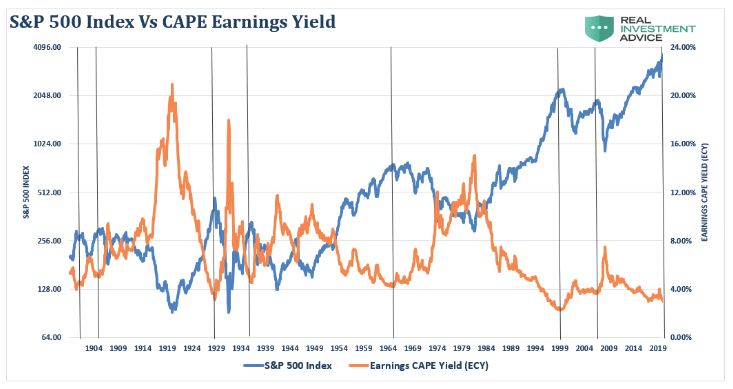
As we enter 2021, there are two myths told to investors to support the bull market narrative. The first, as we debunked recently, is that low-interest rates justify high valuations. The second is that since valuations are not as high as the “dot.com” crisis, there is no “stock market bubble.”
In the current bull market advance, few people are willing to sell, so buyers must keep bidding up prices to attract a seller to make a transaction. As long as this remains the case, and exuberance exceeds logic, buyers will continue to pay higher prices to get into the positions they want to own.
In October, I discuss how the “2nd Derivative Effect” would mute the impact of future stimulus programs. With the passage of the $900 billion stimulus package, we can update the estimates for the economic impact heading into 2021.
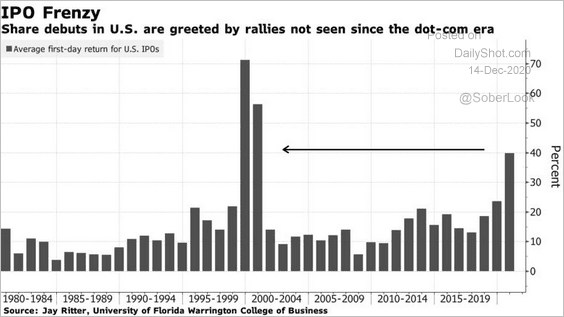
“Maybe this time is different. Those words, supposedly the most dangerous to utter in the investing realm, came to mind amid the frenzied pops in the highly anticipated initial public offerings recently.” That quote was from Randall Forsyth discussing why the current market mania reminds him of the “Shades of 1999.”
Recently, President-Elect Joe Biden named Janet Yellen to be his administration’s Treasury Secretary. Yellen quickly proclaimed the reason “I became an economist was because I was concerned about the toll of unemployment on people, families, and communities.” Such provides excellent commentary, but her track record as Federal Reserve Chairman shows she is more for the top 10% of the economy than the bottom. In reality, and what the markets already suspect, her appointment is an “arranged marriage” to the Fed.
In 2019, we wrote about how corporate share repurchases, or “stock buybacks,” had accounted for nearly all buying in the market. A year later, that significant support for asset prices has reversed.
There is much to debate about the current level of interest rates and future stock market returns. However, what is clear is the 40-year decline in rates did not mitigate two extremely nasty bear markets since 1998, just as falling rates did not mitigate the crash in 1929 and the subsequent depression.
It’s that time of year when Wall Street analysts started trotting out the predictions for earnings growth and stock market targets for the coming year. Unfortunately, each year these overly optimistic estimates are ground down as the year progresses. Next year will be no different as earnings growth will disappoint in 2021.
The rally in energy companies is likely premature. To understand why such may be the case, we have to review a bit of history.