Key takeaways
-
There is little evidence of the “Sell America” trade. More than a year after “Liberation Day,” signs of a structural foreign retreat from U.S. assets – driven by fiscal, political, or dollar concerns – remain scarce.
-
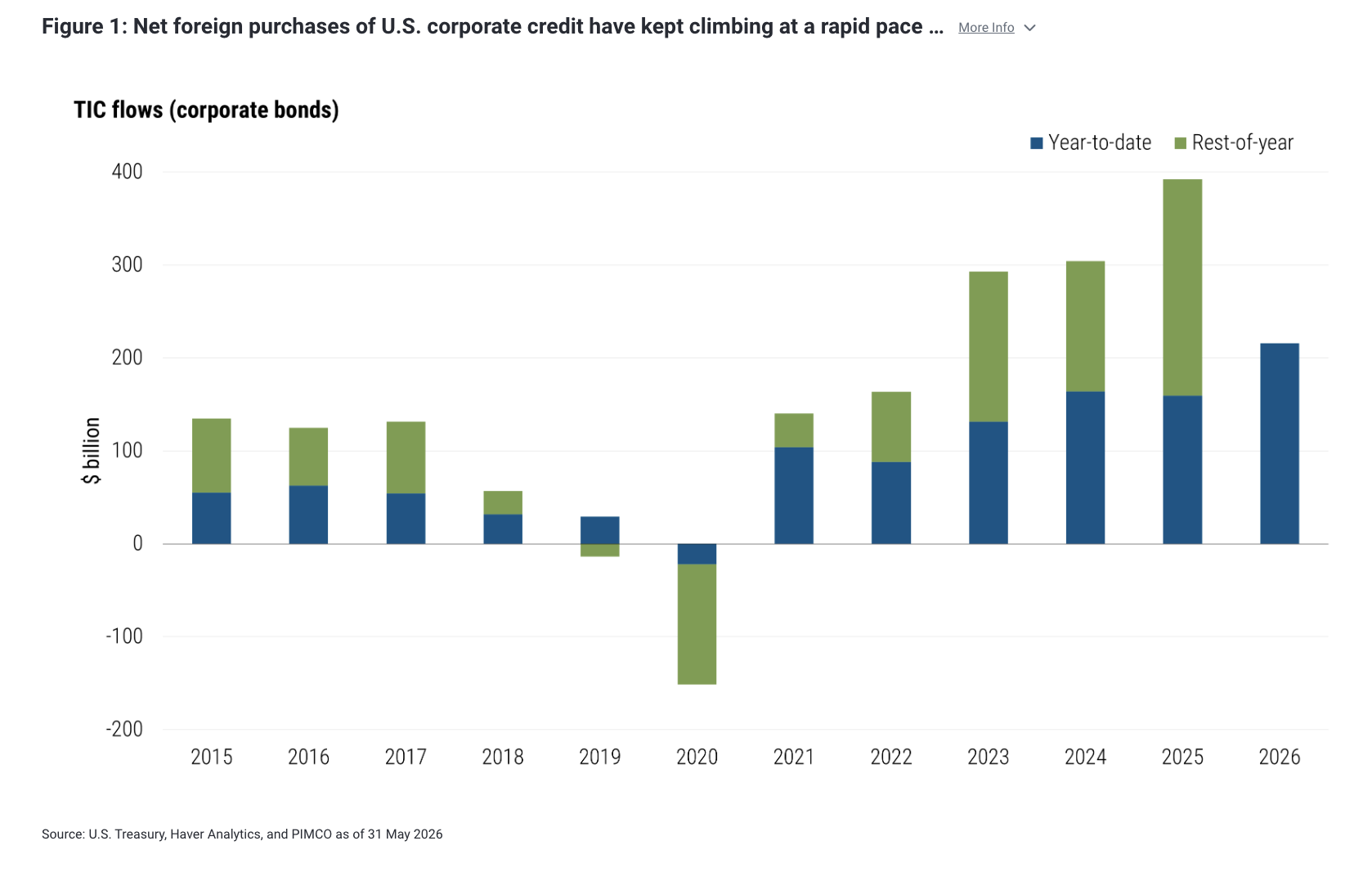
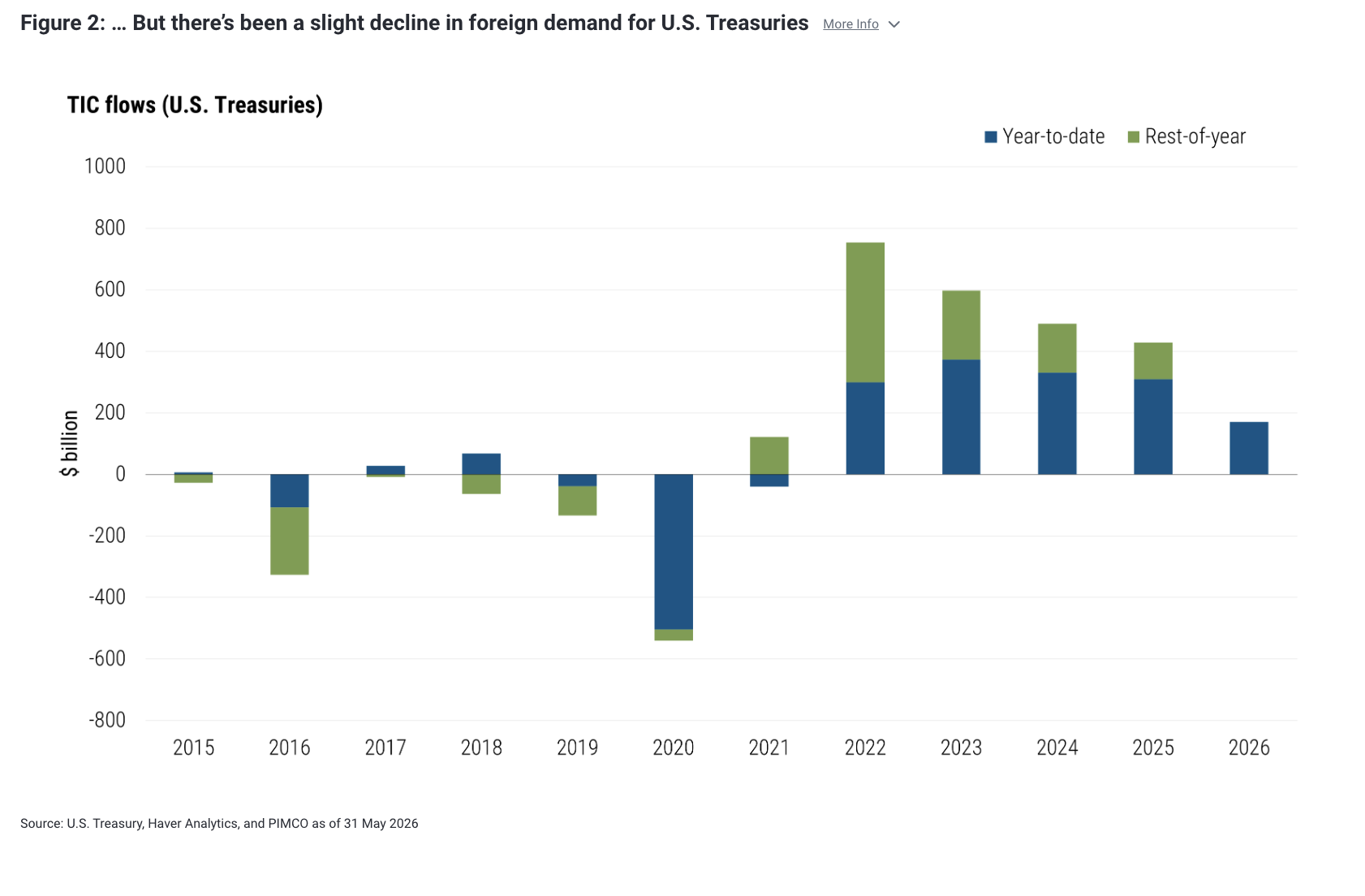
U.S. credit is seeing significant inflows, but it’s a more nuanced picture for Treasuries. Foreign net purchases of U.S. corporate bonds are on track to set a record this year. For U.S. Treasuries, foreign net purchases, while positive, are at a post-2021 low.
-
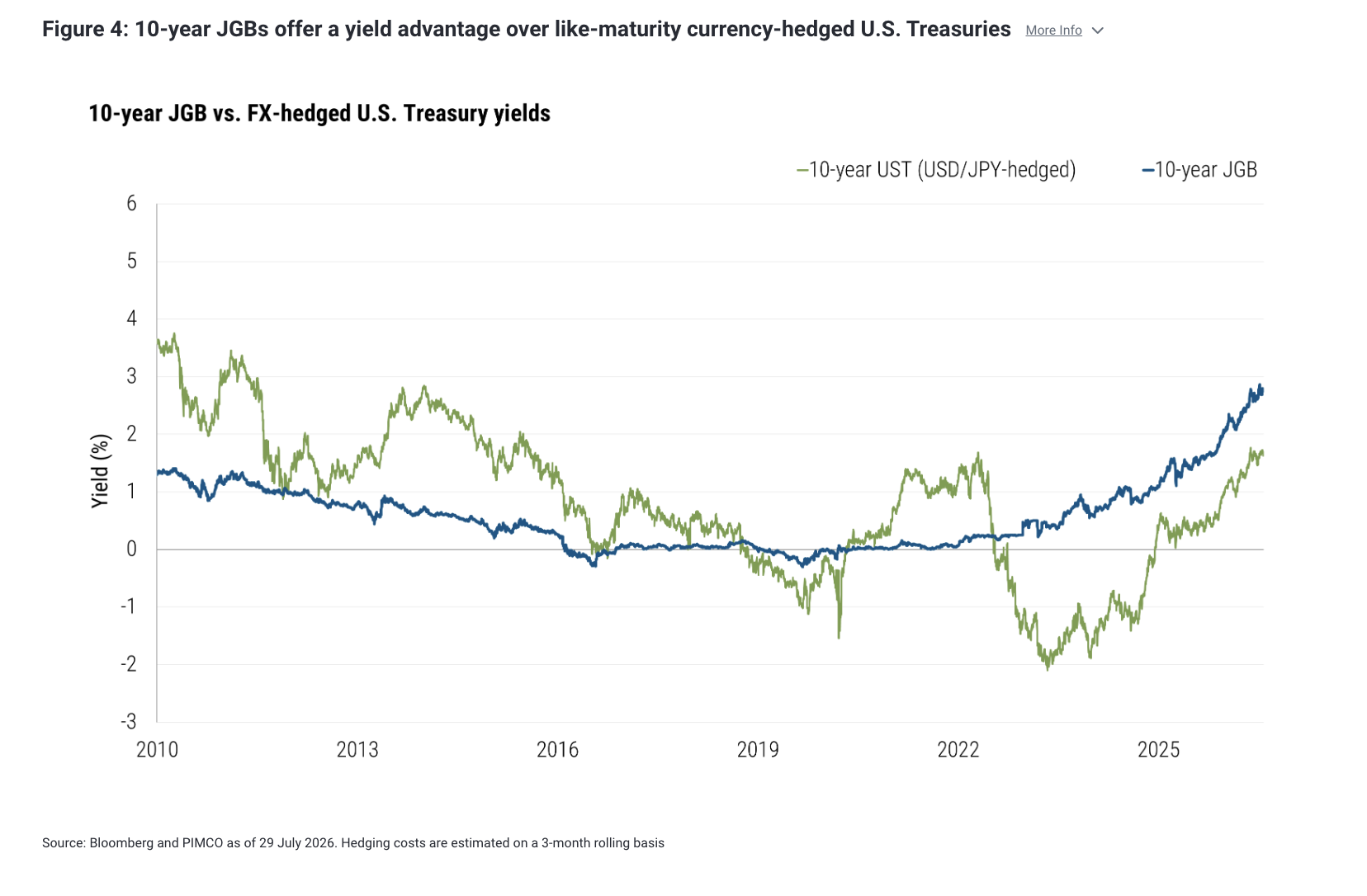
Relative value underpins shifting trends for investors in Japan. With 10-year Japanese government bond (JGB) yields comparing favorably with U.S. Treasury yields on a currency-hedged basis, Japanese investors have become net sellers of long-term U.S. debt.
-
U.S. assets still offer a potential hedge when risk sentiment softens. Relatively attractive Treasury yields versus other G-10 markets, combined with supportive U.S. dollar trends, suggest that many investors continue to view U.S. assets as a hedge against global risks.
More than a year after “Liberation Day” in April 2025 stoked concerns of a broad-based “Sell America” trade, we’re still not seeing much evidence of it.
In U.S. corporate credit, foreign investors continue to show a strong appetite. As of the end of May, cumulative net foreign purchases of U.S. corporate bonds reached $216 billion, according to U.S. Treasury International Capital (TIC) cross-border portfolio financial flows (see Figure 1). That is 32% higher than what’s been recorded through May in any year since the global financial crisis, and it puts 2026 inflows on track to exceed the already strong annual totals recorded in each of the past three years. Whatever concerns foreign investors may have about U.S. fiscal policy, politics, or the dollar, they have not translated into a retreat from U.S. corporate credit. If anything, foreign demand for the asset class has strengthened.
On the sovereign side, the picture is more nuanced. Figure 2 shows that net foreign purchases of U.S. Treasuries are at a post-2021 low, although they remain positive year-to-date.
See more: America Is Undergoing a Massive Debt-for-Equity Swap
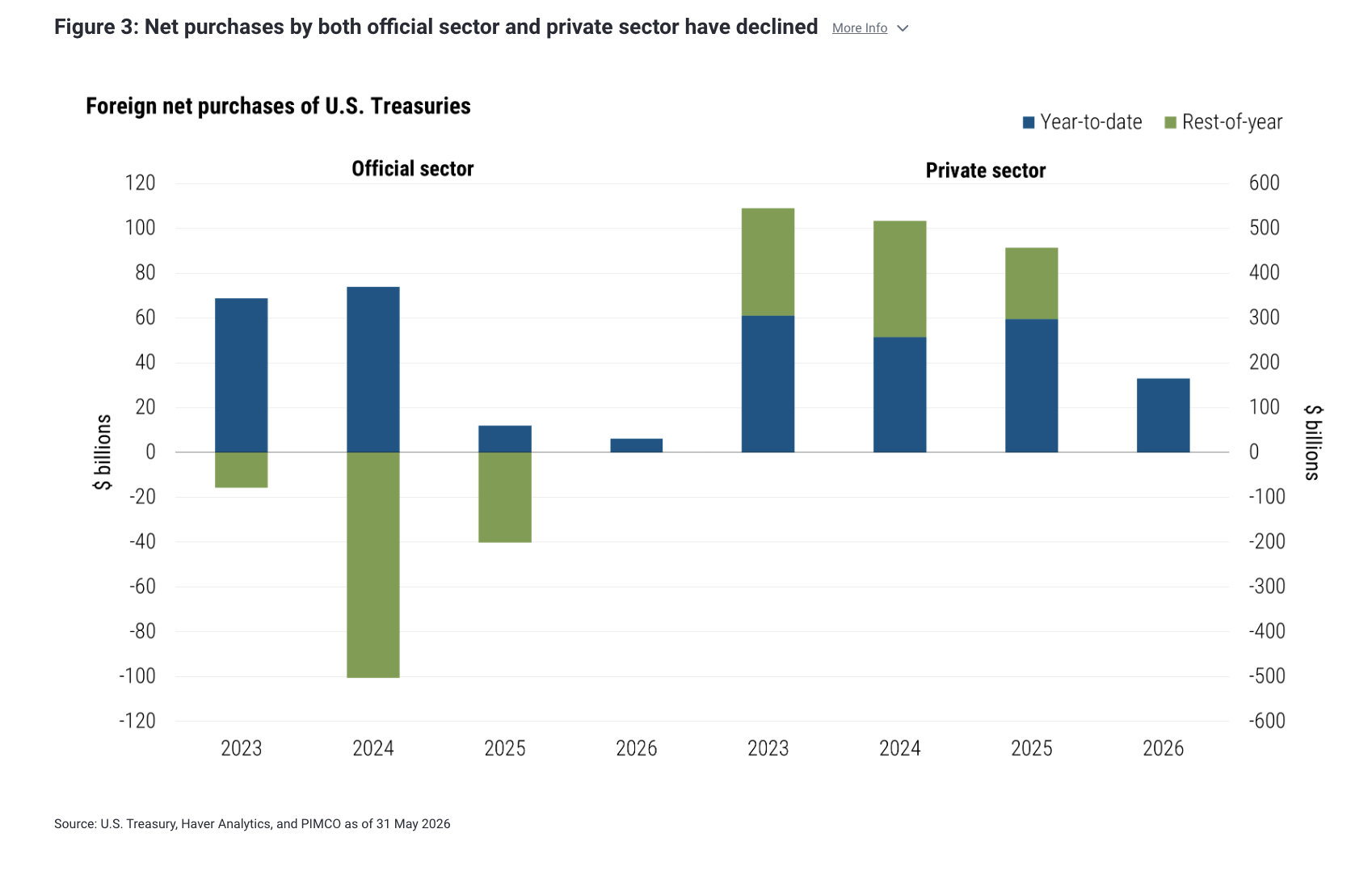
We note that the recent decline in net Treasury purchases reflects a notable drop in the official sector, which generally includes central banks, reserve managers, and sovereign wealth funds. Year-to-date through May, cumulative net purchases from the official sector totaled just $6 billion, compared with $165 billion from the foreign private sector (see Figure 3), though both sectors are on a downtrend. It’s not obvious what is driving the pullback, but the likeliest explanation is that higher sovereign yields in other jurisdictions can now compete more effectively for domestic flows.
Investors in Japan are increasingly turning toward JGBs
The best evidence of investors shifting away from U.S. Treasuries toward other competitive sovereign yields (for which we have data) is likely in Japan. Ten-year Japanese government bonds (JGBs) have reached yields not seen in decades, and those yields have been consistently competitive versus those of U.S. Treasuries after incorporating hedging costs (see Figure 4).
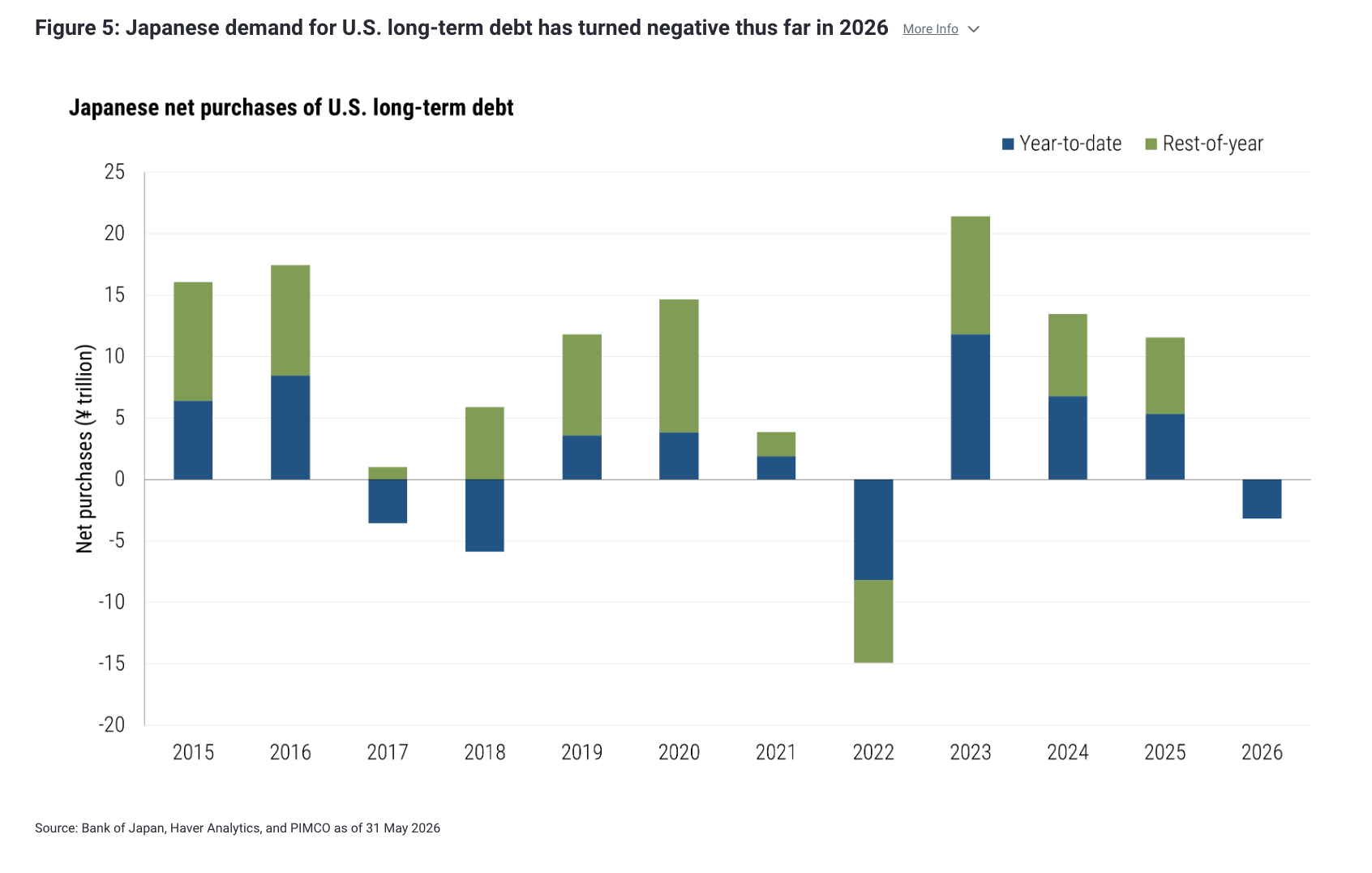
Using data from the Bank of Japan (BOJ), Figure 5 shows that Japanese investors have been net sellers of long-term U.S. debt year-to-date (through May). The BOJ doesn’t provide the breakdown between corporate and sovereign net purchases, but juxtaposed with the U.S. TIC data, it stands to reason that much of the net selling has been on the sovereign side.
U.S. assets generally remain attractive in uncertain times
Despite the trend in Japan, foreign investors in general have displayed steady demand for U.S. assets. Another sign is the absence of major correlated sell-offs: So far in 2026, only around 2% of trading days and rolling five-day periods saw 10-year U.S. Treasuries, U.S. investment grade corporate bond spreads (represented by the Bloomberg US Corporate Total Return Index), and the U.S. dollar all sell off in tandem. If there were a true loss of confidence in U.S. exceptionalism, we would expect such sell-offs to be much more frequent.
We’ll note that back in April 2025 – in the days immediately after the Liberation Day announcements – U.S. Treasuries, credit spreads, and the dollar briefly moved in the wrong direction together. But since then, the traditional cross-asset relationships have largely reasserted themselves, suggesting that the post-Liberation Day stress was more of a temporary dislocation than a durable regime shift.
Just as important, the dollar and U.S. Treasuries have continued to behave like hedges in periods of broader market unrest (driven by geopolitics or other conditions). When risk assets come under pressure, Treasury yields have generally fallen, or the dollar has tended to find support.
Of course, in absolute terms, Treasuries may not always offer a hedge as intended, such as when a market shock results in inflation uncertainty. That said, in these states of the world, Treasuries have still tended to outperform the rest of the G-10 sovereign complex on a relative basis.
Moreover, even in periods when long-end Treasury yields rose and investment grade spreads widened together, such as during the onset of the Iran conflict in March, the U.S. dollar has generally strengthened. This indicates that investors still wanted to own U.S. assets amid broader global tension and uncertainty.
Overall, while the demand for U.S. assets in aggregate may be lower this year relative to the past, it’s far from being low in absolute terms.
These trends underscore the importance of analysis: fundamentals, trends, relative value, and more. While our analysis shows that U.S. assets have remained in demand globally, it also supports a global approach to bond markets, where we see attractive yields in many regions. Diversification across global fixed income may bolster portfolios as growth, inflation, and policy trends continue to diverge. (Learn more in this recent video with Andrew Balls, PIMCO’s CIO Global Fixed Income.)
Michael Puempel and Gabriel Cazaubieilh contributed to this report.
For more from Lotfi Karoui on evolving credit market dynamics, listen to the Accrued Interest podcast on Apple and Spotify.
Disclosures
Past performance is not a guarantee or a reliable indicator of future results.
All Investments contain risk and may lose value. Investing in the bond market is subject to risks, including market, interest rate, issuer, credit, inflation risk, and liquidity risk. The value of most bonds and bond strategies are impacted by changes in interest rates. Bonds and bond strategies with longer durations tend to be more sensitive and volatile than those with shorter durations; bond prices generally fall as interest rates rise, and low interest rate environments increase this risk. Reductions in bond counterparty capacity may contribute to decreased market liquidity and increased price volatility. Bond investments may be worth more or less than the original cost when redeemed. Certain U.S. government securities are backed by the full faith of the government. Obligations of U.S. government agencies and authorities are supported by varying degrees but are generally not backed by the full faith of the U.S. government. Portfolios that invest in such securities are not guaranteed and will fluctuate in value. Investing in foreign-denominated and/or -domiciled securities may involve heightened risk due to currency fluctuations, and economic and political risks, which may be enhanced in emerging markets. Currency rates may fluctuate significantly over short periods of time and may reduce the returns of a portfolio.
Statements concerning financial market trends or portfolio strategies are based on current market conditions, which will fluctuate. There is no guarantee that these investment strategies will work under all market conditions or are appropriate for all investors and each investor should evaluate their ability to invest for the long term, especially during periods of downturn in the market. Outlook and strategies are subject to change without notice.
PIMCO as a general matter provides services to qualified institutions, financial intermediaries and institutional investors. Individual investors should contact their own financial professional to determine the most appropriate investment options for their financial situation. This material contains the opinions of the manager and such opinions are subject to change without notice. This material has been distributed for informational purposes only and should not be considered as investment advice or a recommendation of any particular security, strategy or investment product. Information contained herein has been obtained from sources believed to be reliable, but not guaranteed. No part of this material may be reproduced in any form, or referred to in any other publication, without express written permission. PIMCO is a trademark of Allianz Asset Management of America LLC in the United States and throughout the world.
CMR2026-0730-5801425
A message from Advisor Perspectives and VettaFi: Discover something new! Click here to register for our upcoming webcasts.
© PIMCO
Read more commentaries by PIMCO