AI Bear Case: What Skeptics Get Right And Wrong
Membership required
Membership is now required to use this feature. To learn more:
View Membership Benefits
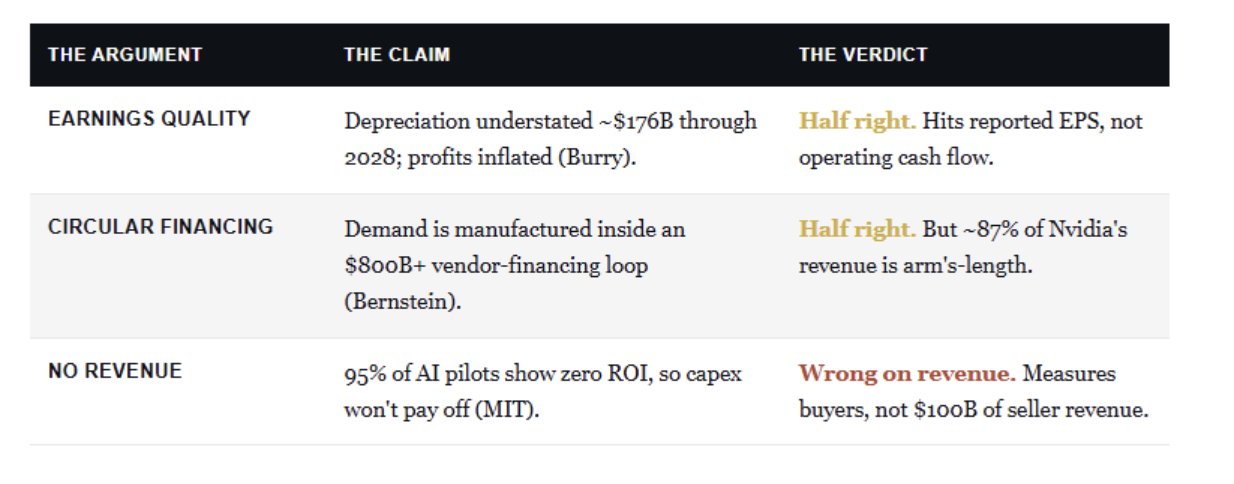
The AI “bear case” isn’t one argument; it’s three. Burry on earnings. Bernstein on circular financing. MIT on revenue. Two are half right. One falls apart on the data.
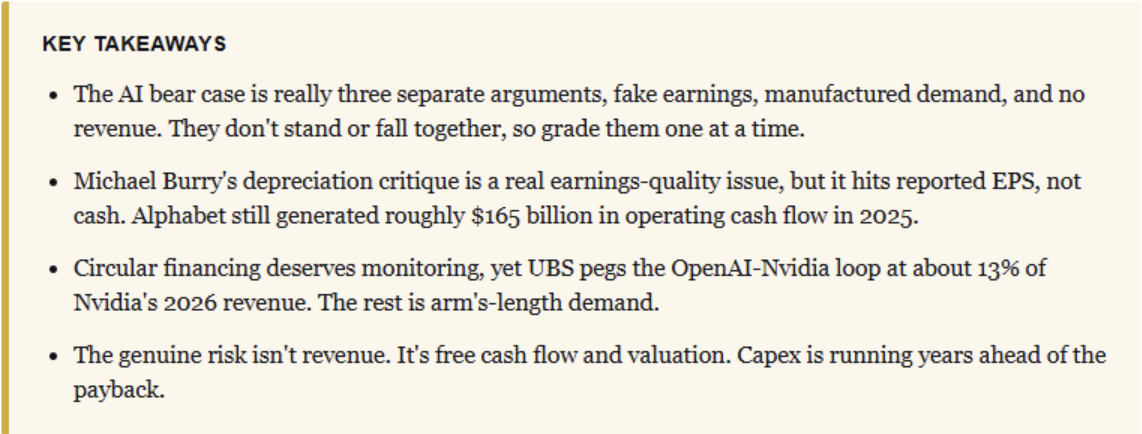
Michael Burry broke a two-year silence on November 11 to accuse the world’s largest technology companies of cooking their books, calling it one of the more common frauds of the modern era. That got attention, and it should. When the man who shorted the housing bubble says AI earnings are fake, you listen. But the AI bear case that has hardened over the past six months isn’t one argument. It’s three. And when you pull them apart, two hold up as real risks, and one falls apart on contact with the data.
Three Arguments, Not One
Here’s the problem with the way the AI bear case is usually discussed. The skeptics blur three separate claims into a single mood.
- The earnings are fake.
- The demand is manufactured.
- The spending will never earn a return.
Each one points to something real, but each one also gets stretched beyond what the evidence supports. Most notably, that often occurs in the same breath.
I’ve spent the better part of a year on this question. Last summer, I argued that the deficit narrative would find its cure in AI infrastructure. Then, last month, I stress-tested that thesis against Goldman’s research and conceded where my original multiplier math was too generous. So I’m not defending a permabull position here. I’m doing what my clients would want me to do: steelman the bear, then check the receipts. Let’s take the three in the order the skeptics usually make them.
See more: A Tale of Two Bubbles Defining a Third
The AI Bear Case On Earnings
Let’s start with Burry, because he is the sharpest. To wit:
“Understating depreciation by extending useful life of assets artificially boosts earnings.”
His math runs like this. The hyperscalers depreciate Nvidia hardware over five or six years, when the real economic life of a chip on a three-year cycle is closer to two or three. Stretch the schedule, undercount the annual expense, and the reported profit looks better than the economics justify. He pegs the gap at roughly $176 billion of understated depreciation across the industry from 2026 through 2028. By the same math, Oracle overstated near 27% and Meta near 21% by 2028.
Is he wrong? Not on the accounting. Useful-life assumptions are a genuine lever, and a two- to three-year chip cycle on a six-year schedule is a fair thing to question. If you own these names on reported earnings alone, take the point seriously.
Here’s where the argument gets stretched. Depreciation is a non-cash charge. Yes, it moves reported EPS, but it does not touch a single dollar of operating cash flow. Alphabet still generated roughly $165 billion in operating cash flow in 2025, and that number doesn’t care how the accountants schedule a server. The problem Burry describes, even if you grant every figure, is an earnings-quality and valuation issue. The bears conflate “earnings are overstated” with “the business isn’t working,” and only the first claim survives the filings.
Circular Financing And Manufactured Demand
The second argument is the circular one. Nvidia invests in OpenAI. OpenAI buys cloud from Oracle. Oracle buys chips from Nvidia. Bernstein’s Stacy Rasgon said the setup would “clearly fuel ‘circular’ concerns,” and the comparison to dot-com vendor financing, Nortel and Lucent lending customers the cash to buy their own gear, writes itself. Analysts have tagged north of $800 billion in these arrangements.
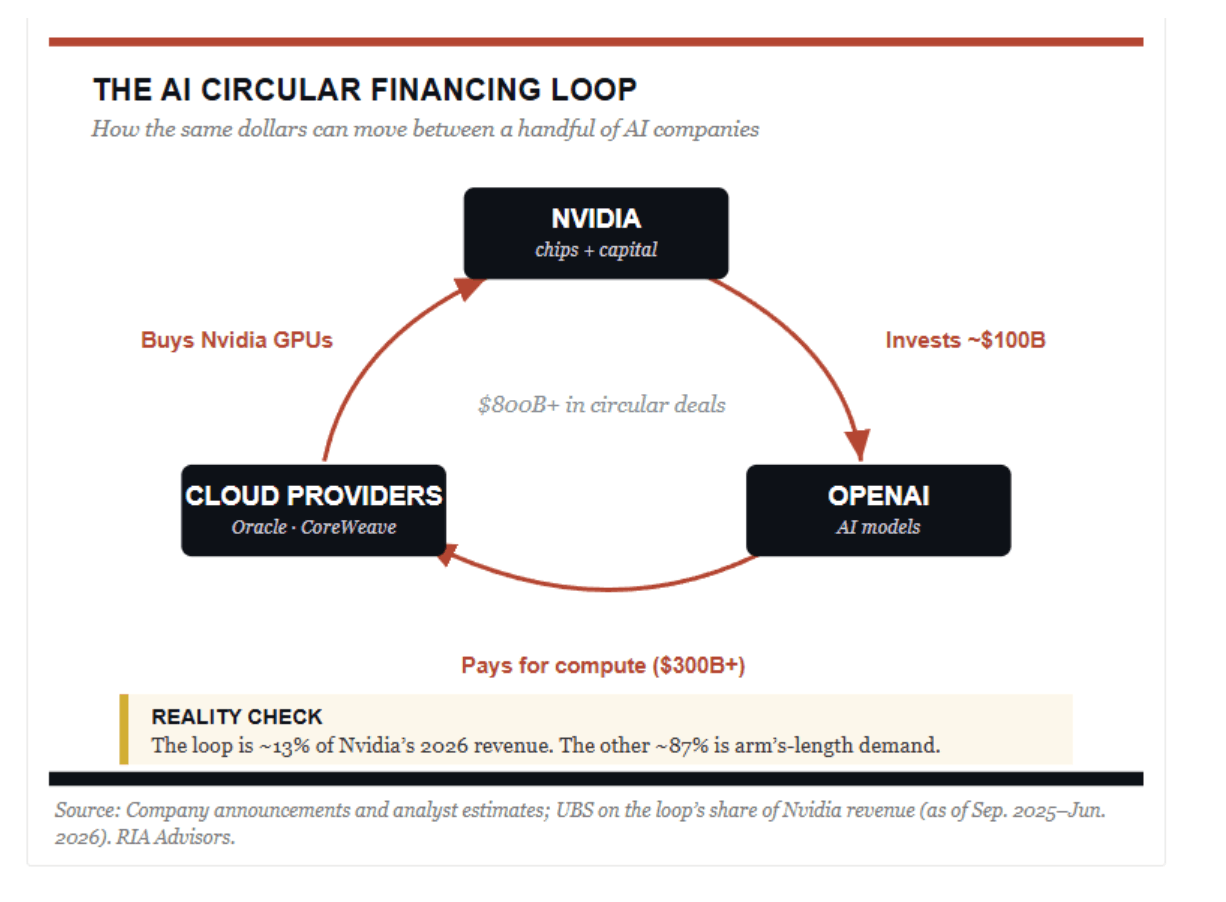
The concern is legitimate for those specific deals. The mistake is treating the loop as the whole story. UBS put the OpenAI-Nvidia arrangement at up to 13% of Nvidia’s projected 2026 revenue. The other 87% comes from customers buying at arm’s length. Most hyperscaler AI revenue comes from enterprises and consumers paying real money for cloud and software, not from the same dollars chasing themselves around a circle of five companies.
Does the circular piece deserve watching? Absolutely. OpenAI is reportedly on track to lose around $14 billion this year, and vendor-warrant deals like AMD’s are exactly the kind of engineering that looks clever right up until demand slips. But “some of the financing is circular” is a caution flag. It is not, by itself, a bubble thesis.
The AI Bear Case On Revenue
Now, the one that collapses. The headline version comes from the MIT “GenAI Divide” study: 95% of enterprise AI pilots showed no measurable profit impact despite billions spent. The bears read that as proof that the capex will never earn a return. Capex without revenue. The dot-com story all over again.
Two problems. First, read what MIT actually found. The failures were organizational, not technological. Companies were building tools in-house instead of buying them, and aiming them at marketing instead of the back office. In the same survey, roughly 90% of workers reported using personal AI tools at work, against only 40% of firms with official subscriptions.
Here is the most crucial point. The revenue is showing up. It just isn’t always running through the corporate AI budget.
Second, and this is the part that the “no revenue” crowd skips, the study measures the buyer’s return, not the seller’s revenue. Morningstar estimates that in 2025, the U.S. AI sector produced around $100 billion in services revenue. That is enough to cover the cost of running the models. The question was never whether the revenue is REAL. It’s whether that revenue eventually covers model training and research, not just the cost of inference. That’s a live question. “Nobody is paying for this” is not.
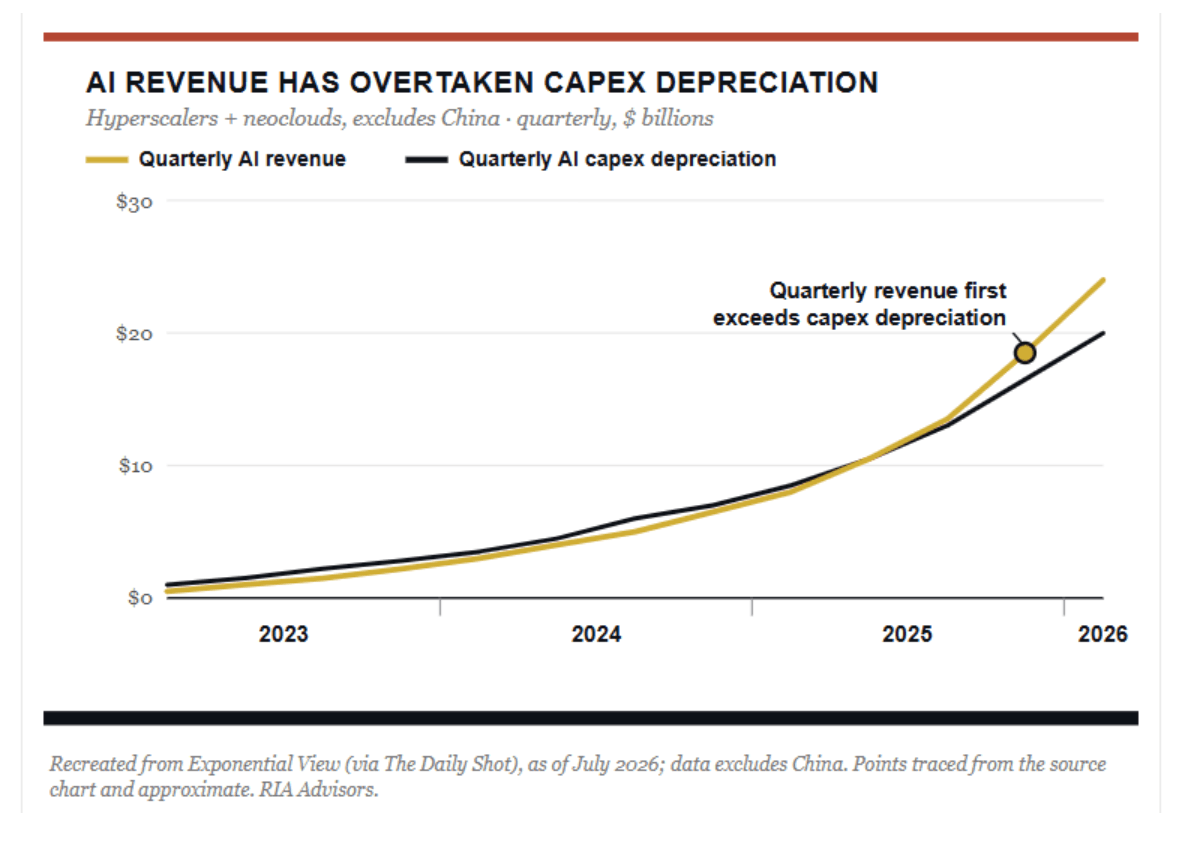
So, let’s recap where we are. Two of the three bear arguments are real risks about price and financing. The third, that the spending will never earn revenue, is the one that falls apart on the data.
Where The Bears Are Right
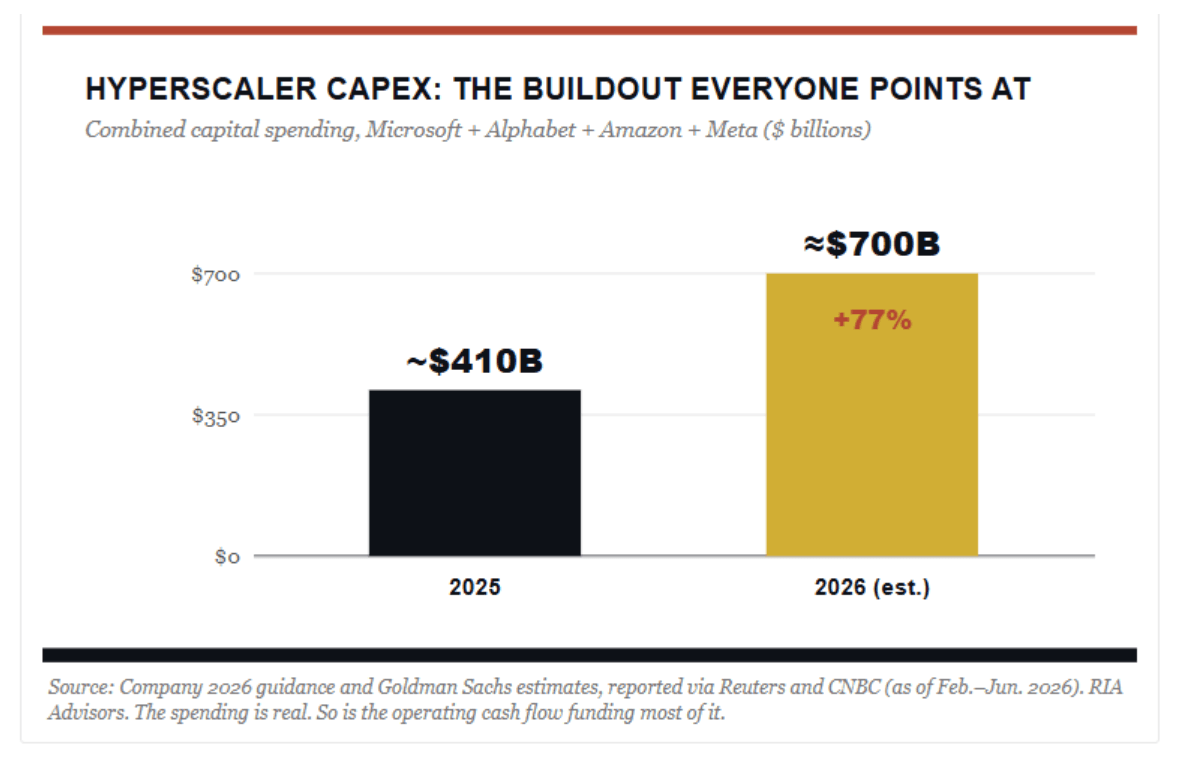
I like the AI trade. Mostly. What keeps nagging me isn’t the revenue. It’s the free cash flow. The four hyperscalers spent about $410 billion on capex in 2025, and 2026 guidance points to something near $700 billion. That’s real money leaving the building. Pivotal Research projects Alphabet’s free cash flow drops almost 90% this year, to roughly $8 billion from $73 billion. Amazon’s could turn negative.
But falling free cash flow isn’t automatically the red flag it looks like, and here’s where I part ways with the harder bears. There’s a difference between a company bleeding cash to prop up a dying model and one spending record sums to build the next one. Alphabet, Amazon, and Microsoft aren’t buying back stock at these levels. They’re plowing the cash back into the business.
The assumption buried inside the bear case, that the spending never earns a return and free cash flow never recovers, is itself a bet against three of the best capital allocators of the past twenty years. Amazon spent a decade being told AWS was a distraction. Microsoft was written off before Azure. “This time is different” is a dangerous phrase in both directions. The honest caveat is that the real difference this round isn’t the companies, it’s the asset: a GPU on a two-to-three-year cycle has to pay off fast, in a way those decade-long infrastructure bets never had to.
So the honest version of the AI bear case isn’t “the earnings are fake” or “no one is paying.” It’s this: spending is running years ahead of payback, and every hyperscaler is building as if the return has already been proven. It isn’t yet. What is crucial is that you can be right about the fundamentals and still pay far too much for them. Cisco had real revenue in 2000. It still fell 80% and took the better part of two decades to reclaim that high.
What The AI Bear Case Means For Investors
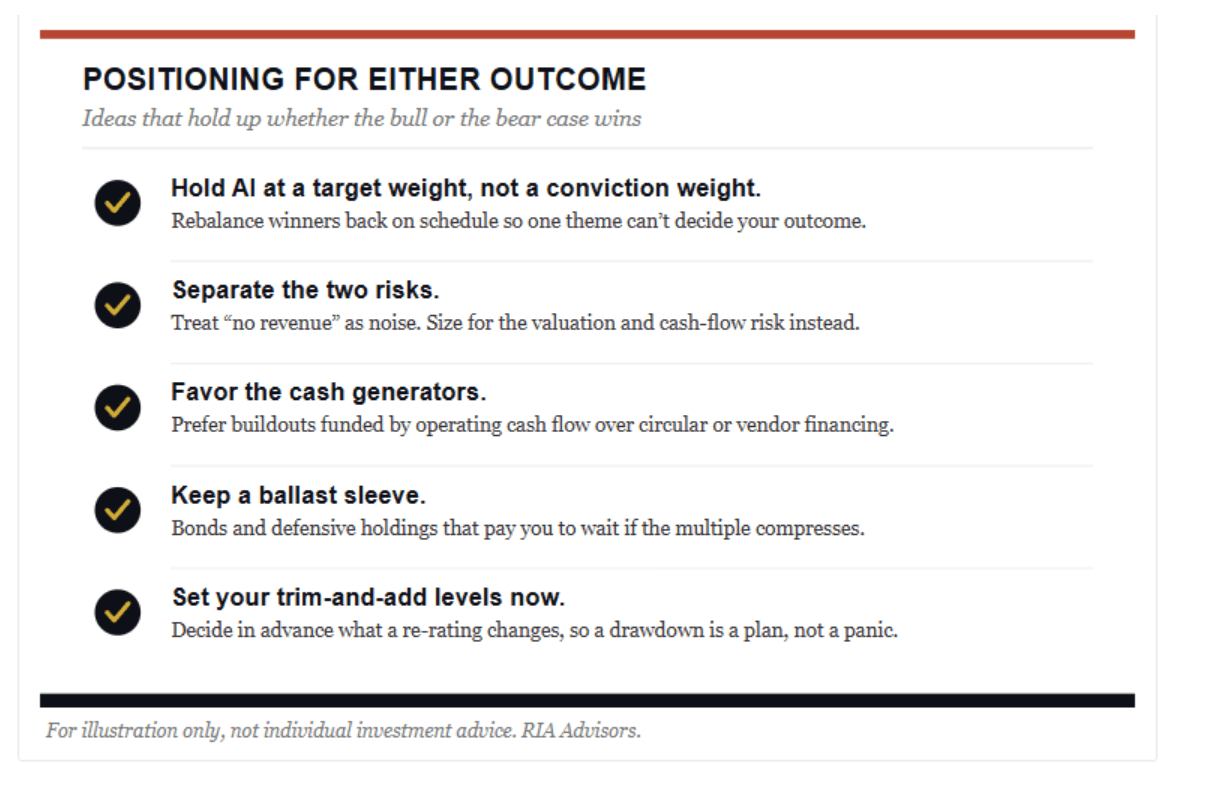
Separate the two risks, because they call for different responses. The revenue risk, the MIT “no ROI” story, is largely noise for a diversified investor. The valuation-and-cash-flow risk is the one to manage. Owning the AI buildout at a sensible weight is fine. Owning it as though every dollar of promised capex converts cleanly into profit is not.
That’s how we’ve positioned it. We hold AI exposure across both the Equity Aggressive Growth and Equity Conservative Growth models, but we’ve kept it trimmed to a target weight rather than letting the winners run to a concentration that would sting if the multiple compresses. When the group re-rates, and at some point it will, the gap between a 4% position and a 9% position is the gap between a drawdown you manage and one that manages you.
The bottom line is this. The AI bear case is worth taking seriously on price and financing. It is not worth taking seriously on demand. Anyone selling you the whole package as a single story, bull or bear, is selling you a mood, not an analysis.
The revenue is real. The cash flow is the thing to watch. Price accordingly.
Sources
- Michael Burry on hyperscaler depreciation and overstated earnings. CNBC, November 11, 2025. https://www.cnbc.com/2025/11/11/big-short-investor-michael-burry-accuses-ai-hyperscalers-of-artificially-boosting-earnings.html
- Stacy Rasgon (Bernstein) on circular financing concerns; Nvidia-OpenAI deal. Bloomberg via Business Standard, September 24, 2025. https://www.business-standard.com/companies/news/nvidia-openai-deal-sparks-concerns-over-circular-financing-in-ai-boom-125092401589_1.html
- UBS Chief Investment Office on AI vendor-financing scale (OpenAI-Nvidia ~13% of projected 2026 revenue). UBS Global, 2025. https://www.ubs.com/global/en/wealthmanagement/insights/chief-investment-office/house-view/daily/2025/latest-10102025.html
- “The GenAI Divide: State of AI in Business 2025,” MIT (Project NANDA). Reported August 2025. https://www.legal.io/articles/5719519/MIT-Report-Finds-95-of-AI-Pilots-Fail-to-Deliver-ROI-Exposing-GenAI-Divide
- Preston Caldwell, “5 Myths About AI’s Economic Impact, and What the Data Actually Shows.” Morningstar, July 8, 2026. https://www.morningstar.com/economy/5-myths-about-ais-economic-impact-what-data-actually-shows
- Hyperscaler 2025 capex (~$410B) and 2026 guidance (~$700B); free-cash-flow compression (Pivotal Research, Mizuho). CNBC, February 6, 2026. https://www.cnbc.com/2026/02/06/google-microsoft-meta-amazon-ai-cash.html
- Lance Roberts, “AI Capex Risk Cuts Both Ways In The American Economy.” RIA Advisors, July 10, 2026. https://realinvestmentadvice.com/resources/blog/ai-capex-risk-cuts-both-ways-in-the-american-economy/
Lance Roberts is a Chief Portfolio Strategist/Economist for RIA Advisors. He is also the host of “The Lance Roberts Podcast” and Chief Editor of the “Real Investment Advice” website and author of “Real Investment Daily” blog and “Real Investment Report“. Follow Lance on Facebook, Twitter, Linked-In and YouTube Customer Relationship Summary (Form CRS)
Join RIA Advisors and elevate your career within a deeply experienced team focused on innovation. Our collaborative environment is built on a foundation of advanced technology and effective investment models, designed to enhance your ability to serve clients and grow your practice. Benefit from a supportive culture that encourages professional development and fosters a forward-thinking approach. By joining our team, you’ll be part of a group dedicated to excellence and continuous improvement, empowering you to focus on building meaningful client relationships and pursuing your business ambitions. Discover the advantages of working with our accomplished advisory team by starting your conversation today.
A message from Advisor Perspectives and VettaFi: Discover something new! Click here to register for our upcoming webcasts.
Membership required
Membership is now required to use this feature. To learn more:
View Membership BenefitsSponsored Content
Upcoming Virtual Events View All











