It’s true enough that history rhymes, even if it doesn’t necessarily repeat. But that creates danger when we pick up resonances from the wrong episode of history, particularly in the fraught task of identifying and avoiding speculative bubbles.
Artificial intelligence stocks are enduring massive turbulence in recent weeks because investors suddenly fear that they’ve been listening to rhymes with the wrong bubble. Naturally, until now the great dot-com bubble of 1999 that burst in 2000 has preoccupied attention. The similarities are obvious; there was a new technology that nobody quite knew how to exploit, and share prices went to the moon as investors piled in. That’s changing. Vitaliy Katsenelson, chief executive officer of Investment Management Associates, says:
I wrote in the past that the AI rollout feels a lot like déjà vu of the 1999 telecom bubble. Today it is also starting to feel like the 1999 bubble is being supersized into something closer to what led to the 2008 financial crisis.
This is not a good change. Comparisons with 1999 provided some perverse reassurance. Burst stock market bubbles are in many ways a price of technological innovation as investors balk at trying to price new inventions years into the future. They didn’t stop canals, railroads, cars, or the internet from remaking the economy, and a stock market selloff needn’t stop the growth of AI.
Further, in stock market terms, AI is not as inflated as the dot-coms. Share prices are rising only because the earnings of chipmakers and others that profit from the growth in AI have already gone to the moon. If those profits can be sustained, their stocks don’t look particularly expensive. Shares in Microsoft Corp. and Apple Inc., both around during the 1999 bubble, are much cheaper now than they were then.
On the eve of the millennium, companies were going public without ever having made a profit, or in some cases earning any revenue. Even then, valuations were obviously absurd. This time, with Nvidia Corp. and the other big AI groups making money hand over fist, really is different.
Credit Bubbles
Now, investors are beginning to hear the rhyme with a different bubble — the 2008 collapse of a massive edifice of mortgage-backed credit that caused the Global Financial Crisis and the Great Recession. That was driven by companies borrowing and bankers lending far too much, using over-valued fixed assets as collateral. For houses then, read data centers now. If there doesn’t turn out to be demand for their services once built, then creditors could face the same problem as the financiers of homes whose owners couldn’t pay the mortgage.
This historical event generates alarm because credit bubbles can inflict far greater damage. When they end, equity manias merely rob people of wealth that only ever existed on paper. The recession that followed the 2000 crash was one of the mildest in memory, and the burst bubble didn’t stop the internet from transforming society (and eventually making a lot of people a lot of money).
Credit crashes lead to losses, forced sales and bankruptcies. As Katsenelson puts it, the fall in house prices isn’t what crashed the economy two decades ago but “the collapse of housing-linked financial instruments that infected the banking and financial system.” It would be hyperbole to claim that data centers could inflict a full-blown repeat of 2008. But that incident does provide the template for the risks we should monitor. Now that investors are looking, the parallels are evident.
CDS and the Market Radar
Can the “hyperscalers” — the huge internet platform groups led by Alphabet Inc., Amazon.com Inc., Meta Platforms Inc. and Microsoft that are building the data centers and other infrastructure that AI will need — continue to finance their debts? The crucial financial indicators to watch are credit default swaps. Another echo from the GFC, these instruments allow investors to insure against the risks that a borrower defaults. Their price will rise as investors get more worried about companies’ ability to pay their debts.
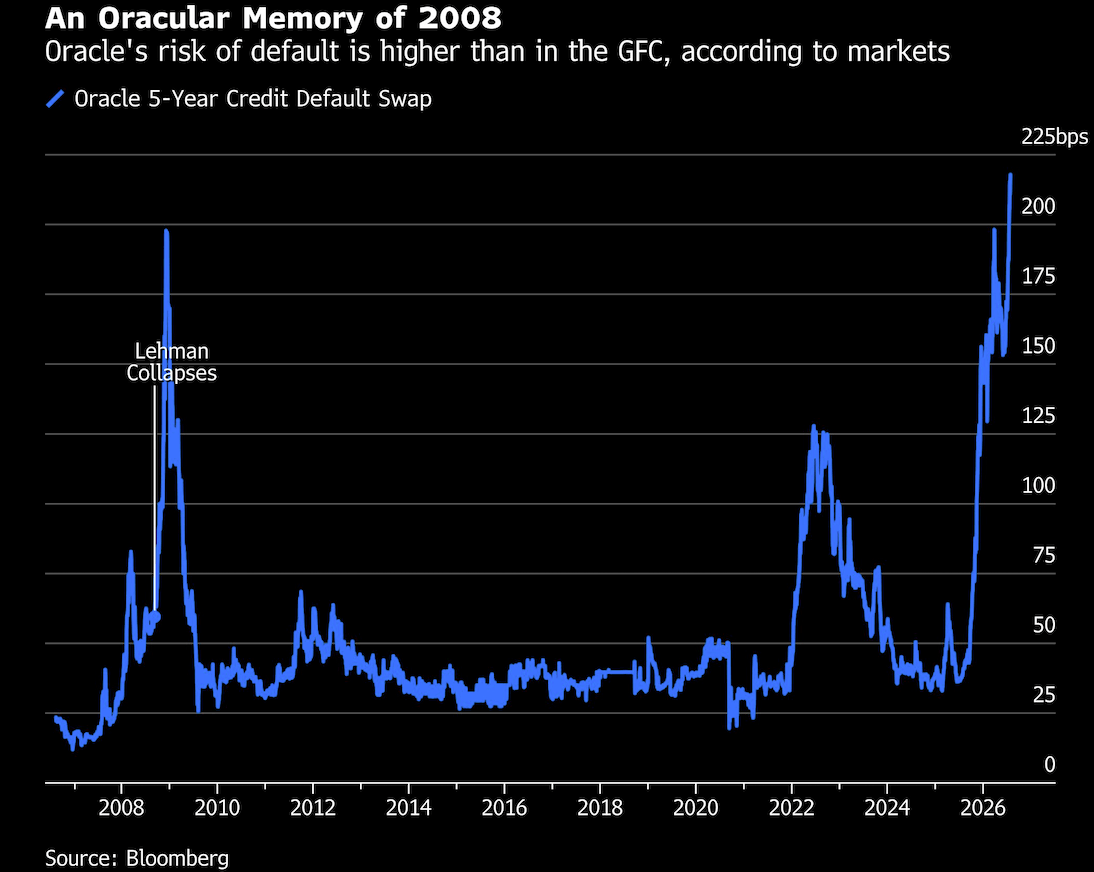
This has concrete effects on the ability to borrow. As default risk rises, so lenders will demand higher interest rates before advancing more money. In 2008, this led to a vicious cycle and cut companies off from funding. Anyone burned by that experience would be alarmed by the current price of Oracle Corp.’s default swaps. The company is spending heavily to establish itself as an AI hyperscaler — and this has made it more expensive to insure against default than it ever was during the crisis 18 years ago:

Jitesh Kumar, credit strategist at Societe Generale SA, calculates that the implicit default risk for Oracle now exceeds 16%. This is an outlier and significantly inflates the average for hyperscalers. But there’s reason for concern about the overall direction. Five years ago, he says, the average hyperscaler was two-thirds less likely to default than the average investment-grade company. These firms have never historically defaulted, and used to be light on capital. Now, their default risk is about 80% higher than the average.
As the industry is still taking shape, several competitors have a chance to establish leadership. That makes them reluctant to cut back on spending, even in the face of growing skepticism about credit and sudden reversals in their share price. “Simply put, current AI scalers believe that the dangers of falling behind are far greater than overinvestment and lower long-term returns,” says Viktor Shvets of Macquarie. “This is as good a recipe for a bubble as any.”
The new parallel with 2008 also shows up in a belated concern with free cash flows. It has crept up on many investors because of another misplaced echo from history. A decade ago, markets were excited about the FANGs (Facebook, Amazon, Netflix Inc., and Google), a group of companies that had established dominance over particular corners of the internet that they could turn into profits with virtually no need for extra capital. Information technology has always been “capital-light,” leaning on human and intellectual strengths rather than big fixed assets. The FANGs brought this to a peak.
As noted by Rob Almeida, chief investment strategist at MFS, every time someone opens a new account with Netflix, that money generates a 100% margin. There’s barely any cost to a capital-light business like a video streamer in adding new customers. That equals immense operating leverage. The same is not true of the companies generally known as the Magnificent Seven who are building out AI — even though several were previously in the FANGs. “There’s no leverage, and every query generates costs,” Almeida said. “It requires electricity and memory and computing capacity. It’s the opposite of FANGs in that regard.”
As this kind of thinking has taken hold, so psychology has shifted. Steve Sosnick of Interactive Brokers observes:
For some time, roughly coinciding with the rise of the “Magnificent Seven,” or “Mag 7,” all spending was good spending. The Wayne Gretzky quote, “You miss 100% of the shots you don’t take,” defined the mentality. Over time, the thinking changed somewhat. The cost of each shot at a fixed net in a hockey game, especially by one of the all-time greats, is essentially nil. The cost of taking shots at the ever-moving target of AI dominance is quite expensive.
This is nothing like the dot-com era, when companies would be punished for reducing their losses or curbing spending because it meant that they were investing less for their future. Thanks to such logic, Amazon was able to keep investors waiting until 2003, six years after it went public, before turning its first profit.
Cash Is King, Again
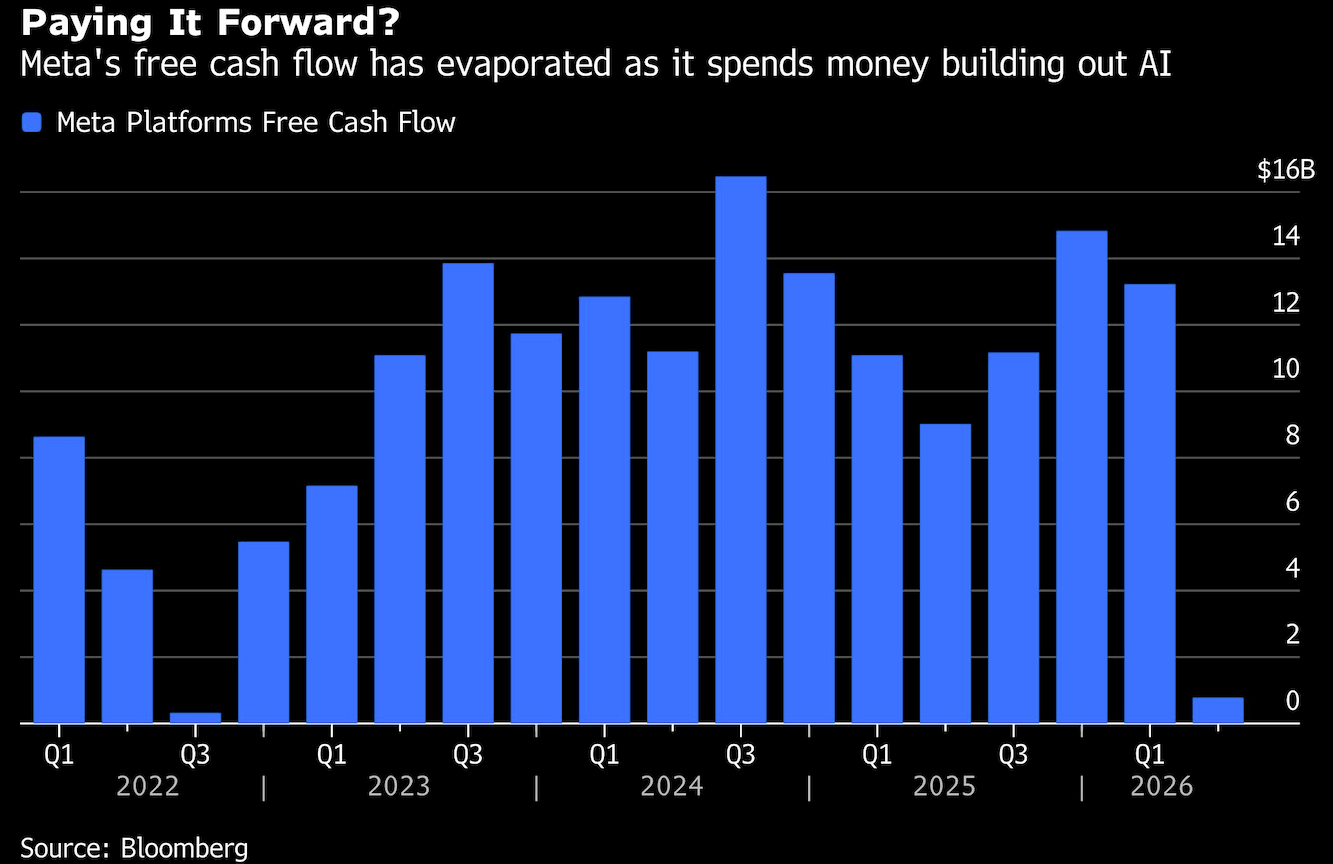
Cost-consciousness has prompted investors to pay renewed attention to cash flows, which they now treat as arguably even more important than profits. Alphabet published great second-quarter results, far ahead of expectations, but investors were preoccupied by the way it burned through $6 billion of cash and by plans to further step up capital expenditures. The stock took a hammering — very much behavior from 2008 rather than 1999. A similar fate befell Meta after it announced that free cash flows had dropped 90% in the quarter, as money that might previously have been available to share with investors was ploughed into data centers and chips:
With cash cushions running out, it’s no wonder that hyperscalers are now expected to borrow more than $200 billion this year, up from $125 billion last year — or that investors are expressing their anxiety by selling stocks. Until now, in another uncomfortable parallel with ’08, they have been able to borrow very cheaply, in large part because the Federal Reserve intervened to keep rates low for a decade after the GFC and again after the pandemic. That has changed. David Roberts of Nedgroup says:
What do all the hyperscalers have in common? They piled on cheap debt in the QE/post GFC period to swallow up rivals, to seek organic expansion. That debt was too cheap, so they got away with it. Now, as we revert to the “old normal,” companies need to pay up for debt. That means the “wing and a prayer” balance sheet expansion is much more dangerous and needs revenue generation to keep bond markets happy.
The technology is still taking shape. So far, AI revenues have been spectacular, and that keeps credit investors at bay. But it needs to continue. And indeed, it’s healthy that the spending splurge is being governed not by equity investors who find reassurance in the parallels with 1999, but by credit investors looking through the prism of 2008.
A message from Advisor Perspectives and VettaFi: Discover something new! Click here to register for our upcoming webcasts.
Bloomberg News provided this article. For more articles like this please visit
bloomberg.com.
Read more articles by John Authers