U.S. Treasury bonds are not likely to repeat their spectacular performance as income-producing risk reducers in portfolios of the past four decades. While bonds still have an important role to play in some settings (e.g., liability hedging for retirement plans), we believe investors should look at alternatives for diversification, including inflation-protected securities, gold, defensive currencies and stocks and option protection.
The transition toward a more sustainable energy system presents potential opportunities for investors. We explore what those opportunities are, and identify potential watchpoints.
We believe now is as good a time as any to do a portfolio assessment. Here’s why investors and their advisors shouldn’t lose sight of how diversification and taxes affect portfolio returns.
Despite stellar equity returns over the last decade, the funded status for many defined-benefit plan sponsors has either stagnated or fallen. Here's why.
We believe paying taxes is a scenario where kicking the can down the road can actually be a good thing for taxable investors. Here’s why.
It's a new cycle for the economy, but some asset classes look decidedly late cycle in terms of valuation. What might this mean for markets through the remainder of the year?
Imagine if you could show your clients the impact of taxes between funds and categories. Now you can. Here’s an exclusive first look at our Tax Impact Comparison Tool.
Your social network may be an untapped and robust source for uncovering prospects. While you may be suffering from COVID-19 fatigue, we believe prospecting and having introductory conversations about the services you provide could be one of the best uses of your time.
It’s open season on capital gains. Four ways advisors can help clients navigate potential unpleasant taxable distributions.
With the COVID-19 crisis far from over, we expect increased policy stability in the U.S. next year, no matter who wins in November.
Five companies now comprise 26% of the market capitalization of the S&P 500® Index, making for the most concentrated U.S. equity market in the last 40 years. What are the potential dangers of this for investors?
With multiple future scenarios as to how climate change may play out, there are also multiple potential consequences in store for investments. This post takes a detailed look at climate-change risk management.
The U.S. stock market seems to be looking through this economic catastrophe. For the five months and one week since the start of the recession—March through August 7, 2020—the U.S. stock market, as measured by the S&P 500, has returned +14.3%.
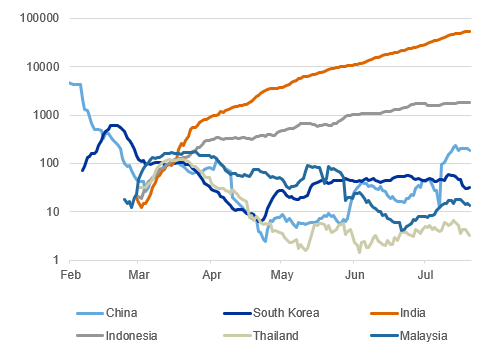
Emerging markets are confronting a slew of short-term challenges caused by the coronavirus pandemic. Is there hope for a turnaround on the horizon?
We believe that the Norwegian krone and the New Zealand dollar stand to benefit from how their governments have handled the coronavirus, whereas the appeal of the U.S. dollar may wane due to high infection rates.
We explore the increased use of engagement terminology by fixed income market practitioners as a part of their ESG integration efforts.
Ultimately, we believe that investors who are unaware of ESG and do not integrate ESG into their investment processes may be exposing themselves to additional, unnecessary and possibly unrewarded risks.
With less than four months to go until Americans cast their votes for president, we’ve fielded an increase in questions from clients as to whether the U.S. presidential election poses a risk to markets and the economy. The short answer is yes.
Imagine telling clients you’re their guru, guide and gladiator. Learn a simple framework to help articulate your distinctive value.
This is the second in a series of posts focusing on the formula of advisor value. In this post, we tackle the behavioral mistakes that investors typically make. Addressing the investment behavior of your clients may be the greatest value you provide.
The case for considering tactical and long-term allocations to small cap stocks.
Markets have rallied on hopes for an economic recovery as coronavirus-imposed lockdowns are eased across the globe. The rebound has been helped by oversold investor sentiment, but with sentiment back to neutral, so too is our strategists’ market outlook.
Can you reignite the growth of your business in the the second half of 2020? We think so. Here’s why we believe the next six months may hold a once-in-a-lifetime opportunity.
In this latest survey, 68 leading bond and currency managers considered valuations, expectations and outlooks for the coming months.
Having trouble helping your clients appreciate a balanced portfolio? These charts may help.
Our secrets for hosting a great virtual meeting.
Three factors that may explain today’s disconnect between Wall Street and Main Street.
This post is part of a series delving into the growth-versus-value debate. Here we explore three considerations when evaluating growth-versus-value positioning.
We're excited about the opportunities we see in value investing going forward. Here's why.
I’m trying to think of a year when rebalancing has been more important. None come to mind.
Potential for a large payoff on value strategies may exist soon, if history is any guide.
Capital markets are in disarray in reaction to the coronavirus crisis and the necessity of pausing the global economy. The CBOE Volatility Index (the VIX) rose to over 80 in March and thankfully has settled down to a level of about 35, which is still over twice its trailing five-year average of about 15.
Key watchpoints for China as it emerges from the COVID-19 crisis.
Drawing on lessons learned from the credit crisis of 2007, here's how we're transitioning fixed income assets amid the coronavirus pandemic.
I hope this message finds you and those close to you in good health as we all navigate the fallout that happens when a health crisis spills over and triggers an economic crisis.
I started in the business in a mutual fund call center right out of college in 1999 (DVD players were all the rage, Y2K panic was a thing and “Who Wants to be a Millionaire” was on). At that point, average annual returns were high for the S&P 500 and most mutual funds—until the bubble burst.
Russell Investments has long held that it is possible to create investment value while incorporating values into the decision-making. In this blog post, we continue on that theme and highlight a small collection of securities that demonstrate doing well while doing good.
See how the coronavirus pandemic is impacting manager viewpoints across key geographic and equity regions.
Client language is different from advisor language. If you want clients to understand you—and more importantly, you want to understand them—consider adopting these tips.
Two months into one of the most disruptive crises of our lifetimes, we have all become accustomed to words and phrases such as unprecedented, severe, social distancing, etc. Although these words are perhaps less jarring than they were prior to the onset of the coronavirus outbreak, they truly do capture the impact of this health crisis on the economy, now and in the years to come.
The health of our planet depends on responsible investing. On Earth Day and every day, it has our full support.
What is the value of a financial advisor in 2020? We believe financial advisors have never been more valuable than they are right now. This annual Value of an Advisor study quantifies that dedication and the resulting benefit.
News is an interesting concept, in that information really only counts as news if it’s unexpected. On the flip side, information isn’t news if it is expected. April, however, is showing that even when the expectation is for bad news, the cumulative effect of so much negativity can still weigh on markets heavily. In other words, just expecting bad economic data does not necessarily make the market invulnerable to mountains of it.
While ESG was initially a hot topic for equity investors, fixed income market investors are quickly catching up. In this blog, we aim to share some key ESG integration trends we see among the fixed income market participants.
With a very healthy dose of humility, let’s take a look at what a reopening of the global economy may look like.
When it comes to ESG, not all issues matter equally across industries. We believe our newly updated ESG scoring methodology best captures the issues that are truly material to companies.
Global equity index futures are trading up about 4% this morning. The coronavirus data over the weekend was less bad. The growth rate in new confirmed cases over the last 24 hours globally was the lowest since March 17—a welcome sign that containment measures are gaining some traction in slowing the spread of the disease.
Just about every facet of life has changed due to the coronavirus pandemic. For many, this has involved adapting to working from home. We share our best practices and tips to help you maintain your productivity—and your sanity.
As the world continues to grapple with the coronavirus, some areas of the market are showing signs of incremental improvement.
Hope is not stupid. My colleague, Paul Eitelman, did a nice job yesterday preparing our clients for the likely horrible news that will most likely greet us for the month of April each and every morning. Today, I would like to take a moment to talk about reasons for hope.