Key takeaways:
- September rate hike odds increase ahead of the Federal Open Market Committee meeting
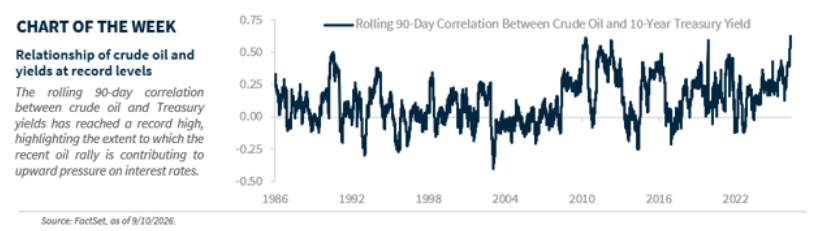
- Rising oil prices are pushing global sovereign yields higher
- Six consecutive months of rising Treasury yields is rare
As policymakers adapt to new leadership, navigate a challenging geopolitical backdrop and contend with meaningful internal debate over the path of interest rates, the stakes remain high. Below, we discuss what to expect from next week’s Federal Reserve (Fed) meeting and provide perspective on the recent rise of Treasury yields to multi-year highs.
See more: US Core CPI Tops Forecasts, Bolstering Case for Rate Hike
September odds tilt in favor of a hike
Following Chair Warsh's hawkish Jackson Hole remarks and Governor Waller's renewed focus on inflation, this week's Consumer Price Index (CPI) and Producer Price Index (PPI) reports were viewed as key inputs into next week's Fed decision.
With core inflation data running a little hotter than expected, the views of the Fed's more hawkish members are likely unchanged, particularly as elevated oil prices, renewed tariff tensions and rising electricity demand tied to the AI buildout may keep inflation sticky in the months ahead. For policymakers still on the fence, however, the firmer monthly core reading likely tips the balance toward a hike next week, with the market now pricing in approximately 90% odds of a rate hike. As Fed officials prepare updated economic forecasts and a revised dot plot, the broader backdrop remains favorable.
Growth remains solid, the labor market continues to demonstrate resilience and inflation is gradually moving in the right direction, even if it remains above the Fed's target. As a result, we expect only modest revisions to the Fed's economic projections, though any changes to the expected path of interest rates (i.e., dot plot) will draw attention. While the economy shows little evidence of overheating and many recent inflation pressures have originated from areas less sensitive to monetary policy, the rationale for a rate increase has strengthened.
We now expect the Fed to raise rates next week. Importantly, we view this as a mid-cycle adjustment rather than the beginning of a prolonged tightening cycle. Such a move could help reassure bond markets by underscoring the Fed's commitment to price stability, while having only a limited impact on economic activity given the economy's reduced sensitivity to higher rates and the strength of corporate earnings.
Oil rally pushes global bond yields higher
Escalating military action in the Middle East has pushed West Texas Intermediate (WTI) crude oil above $100 per barrel, up more than 15% month to date and to its highest level since mid-May. While the conflict has been unfolding for more than six months, recent developments have marked a significant escalation.
CENTCOM confirmed the destruction of five Iranian oil tankers after attacks on US vessels, while Yemen's Houthis have struck Saudi energy sites. Meanwhile, the US has ramped up economic sanctions in an effort to pressure Iran into reopening the Strait of Hormuz. With neither side showing signs of backing down, investors are increasingly concerned that disruptions could spread beyond the Persian Gulf and into the Red Sea, further curtailing oil exports from the region. Those fears have driven oil prices sharply higher and reignited volatility in the bond market, a risk we highlighted several weeks ago.
With oil back in triple-digit territory, the 10-year Treasury yield is approaching 5% as investors reassess both inflation risks and the path of Fed policy. The key question now is whether this is another temporary oil spike or the beginning of a more prolonged period of elevated energy prices. Our view remains that the latest surge will prove temporary, as we have seen multiple times throughout this conflict. While we have raised our year-end WTI target to $75 per barrel to reflect ongoing shipping disruptions and tight inventories, we ultimately expect a diplomatic off-ramp to the conflict. As a resolution comes into view, shipping activity should gradually normalize, allowing oil prices to retreat, inflation pressures to moderate and bond yields to move lower.
After six consecutive months of rising yields, the sell-off is getting stretched
The 10-year Treasury yield has marched steadily higher since the onset of the US-Iran conflict. After bottoming at a nearly a two-year low of 3.94% in late February, the 10-year yield climbed to nearly 5%, its highest level since October 2023. Rising yields often accompany higher oil prices, but six consecutive monthly increases are rare. Since 1970, there have been only five other instances in which the 10-year Treasury yield rose for six straight months or longer, and only two of those streaks extended to a seventh month. If the 10-year Treasury closes September near current levels, the sell-off will reach seven consecutive months. Yet with investor sentiment already deeply bearish on bonds and speculative short positions in 10-year Treasuries near record highs, the move appears increasingly overextended. That suggests yields may be closer to a peak than the start of a new, sustained leg higher. Notably, our analysis shows that following periods of six or more consecutive monthly increases, the 10-year Treasury yield declined by an average of 35 basis points over the subsequent three months and was approximately 40 basis points lower, on average, 12 months later.
All expressions of opinion reflect the judgment of the author(s) and the Investment Strategy Committee and are subject to change. This information should not be construed as a recommendation. The foregoing content is subject to change at any time without notice. Content provided herein is for informational purposes only. There is no guarantee that these statements, opinions or forecasts provided herein will prove to be correct. Past performance is not a guarantee of future results. Indices and peer groups are not available for direct investment. Any investor who attempts to mimic the performance of an index or peer group would incur fees and expenses that would reduce returns. No investment strategy can guarantee success.
Economic and market conditions are subject to change. Investing involves risks including the possible loss of capital.
The information has been obtained from sources considered to be reliable, but we do not guarantee that the foregoing material is accurate or complete. Diversification and asset allocation do not ensure a profit or protect against a loss.
The S&P 500 Total Return Index: The index is widely regarded as the best single gauge of large-cap U.S. equities. There is over USD 7.8 trillion benchmarked to the index, with index assets comprising approximately USD 2.2 trillion of this total. The index includes 500 leading companies and captures approximately 80% coverage of available market capitalization.
Sector investments are companies focused on a specific economic sector and are presented here for illustrative purposes only. Sectors, including technology, are subject to varying levels of competition, economic sensitivity, and political and regulatory risks. Investing in any individual sector involves limited diversification.
A message from Advisor Perspectives and VettaFi: Discover something new! Click here to register for our upcoming webcasts.
Links are being provided for information purposes only. Raymond James is not affiliated with and does not endorse, authorize or sponsor any of the listed websites or their respective sponsors. Raymond James is not responsible for the content of any website or the collection or use of information regarding any website's users and/or members.
Raymond James & Associates, Inc., member New York Stock Exchange / SIPC, and Raymond James Financial Services, Inc., member FINRA / SIPC, are subsidiaries of Raymond James Financial, Inc.
Raymond James® and Raymond James Financial® and power of personal® are registered trademarks of Raymond James Financial, Inc.
© Raymond James
More Tax Planning Topics >